

- Contributed by
- David-G
- People in story:
- Mr. R. H. Bennett, The Rt. Hon. Mr. Herbert Morrison, and the "Cavalcade of Stars".
- Location of story:
- Tottenham, Hornsey, Highgate.
- Background to story:
- Civilian Force
- Article ID:
- A3604646
- Contributed on:
- 01 February 2005
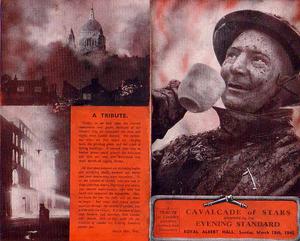
The outside of the Programme of "Cavalcade of Stars" presented by the Evening Standard, at The Royal Albert Hall, Sunday March 18th 1945
It took a while, but gradually Messengers were being acknowledged and provided for. The Fire Service Department ran a National Camp in Westmorland during the last weeks of July and the first week of August. Including fares and food the cost was only £1 a week! Yes, but remember many of those lads would be earning as little as 15/- a week! The Hornsey Open Air Swimming Pool offered reduced rates for Messengers in uniform. Names were being solicited for any willing to take part in an Area Boxing Tournament.
At O’Gorman’s Wharf, Barking on 19th November 1944 a vast array of Messengers from all over the Area gathered to compete with one another for trophies. ‘Abbey’ of ‘B’ Division won the Pump competition, and our lads of ‘Priory’ won the Squad Drill.
So the year moved on with Messengers having an ever increasing part to play as the V1 and V2’s landed indiscriminately across our area. Any time an explosion was heard and a lad was available, in no time at all, it was a quick change into uniform, on the bike, and reporting for duty. Again thanks filtered through from above for the good work done by the Messengers.
All too soon it was Christmas, and a few days after on the 30th December we were celebrating our Second Anniversary. Looking back over the year we were grateful for all that we had achieved in many areas and more white lanyards were being worn as evidence of tests passed. We were told an important personage had said that “Tally Ho” was by far the best Messenger Magazine he had seen. And he sees them from all over the Country!
We were saddened at this time to learn that our much-loved leader and exemplar Mr. Bennett would be saying farewell and setting out for Persia to join the Anglo Iranian Oil Company. We all realised that the progress of the war meant that in the coming year of 1945, it was likely that each of us would be moving on to other spheres of activity. The Messenger Service had more than adequately lived up to the expectations of its founders, and the promise of service and satisfaction held out to those young men was fulfilled.
News began to filter through of a Standing Down Parade, of concerts and the equipment that needed to be handed in. In the beginning it looked alright, but then the situation began to change.
In spite of the encouragement of some in the higher echelons many Messengers felt they had had a raw deal. I quote again from ‘Tally Ho’ “We wish to place on record a very strong protest at the raw deal accorded to the Messengers of 36 B. Division in connection with the Part Time Stand Down Parade and concert. After the boys had shown how keen they were about the parade, by their very smart rehearsal, some forty of them had to be told that they would not after all, be able to attend the concert at the Royal Albert Hall. We feel that this decision was made to cover up somebody’s error of organisation and we deeply deplore the attitude of “It doesn’t matter, they’re only Messenger Boys”.
Some lads were able to attend the parade which began with a speech by The Rt. Hon. Mr. Herbert Morrison, who constantly referred to the Men and Women of the Fire Service but did not think to mention the Messengers until someone prompted his memory in his closing sentence. At this the Messengers who had been waiting patiently, gave a very hearty cheer, which made a number of people smile.
The parade over, lads started a new game known as “Hunt the Ticket”. This consisted of finding an Officer and saying very nicely “Please Sir have you a spare ticket?” Fortunately all the lads from B. Division who attended the parade were allowed into the Royal Albert Hall and had a wonderful time.
The Programme was entitled “CAVALCADE of STARS” presented by the EVENING STANDARD.
Music was made by:-
Charles Shadwell and his full concert orchestra, the Central Band of London fire Forces, Massed bands of the Grenadier Guards, the Coldstream Guards, and the Irish Guards, The Drums and Pipers of the Scots Guards, and the United States of America Army Band.
Artistes included Daria Luna, Issy Bonn, Vera Lynn, Dorothy Pouishnoff, Leslie Strange, George Robey. A tribute written by J., B, Priestley was Spoken by Ralph Richardson. Then there was Petual Clark, Elsie and Doris Waters, Robb Wilton, Edna Squire-Brown, Nellie Wallace, Eddie Ready and Joy, Cyril Fletcher and the Cairoli Brothers.
The Programme was Compèred by Phyllis Calvert and Gerry Wilmot.
A TRIBUTE.
by
The Evening Standard and Citizens of London
Printed on the back page of
The Royal Albert Hall Programme
“Cavalcade of Stars.”
18th March 1945
To-day, as we look upon the charred
monuments and gaunt skeletons of our
Historic city we remember the days and
nights when London burned. We remem-
ber when we first heard the clanging
bells, the grinding glass, and the crash of
falling buildings. It seemed then that no
human power could quench the holocaust
and that our vast and well-loved city
must perish in raging flames.
All that stood between our shrinking bodies
and terrifying death, between our homes
and sure destruction, were yourselves. To
us, the citizens of London, who saw you in
those cheerless dawns, begrimed and weary,
you seemed super-human, men who had
faced and conquered the impossible. Now,
we know for you the bells will go down
no longer; but when the victory parade
marches through the streets of London, you
will be with the victors. It is because of you,
your heroism and devotion, that London
still stands, and to-day, with all the
Citizens of London the Evening Standard
salutes you.
March 18th 1945.
None of us had embarked upon this adventure for glory or praise, we had youth, energy and enthusiasm and wanted to do what we could to help in time of war. Locally we felt very encouraged and supported. Our immediate Officers knew how to get the best out of such large number of young men. There was always the drive to see that we were trained to a standard fit for service, and we willingly accepted the demand placed upon us. At the same time, as these pages try to show, the recreational side was not forgotten. The result? ‘Teenagers’ (a word unknown then!) accepting discipline and giving loyalty. I believe that because of that experience these young men grew into adulthood with values that have made them better citizens, who have continued life-long to serve their country well.
No one could wish for a National Emergency that could appeal to the youth of today to give of their energies for the benefit of others —but— there I’d better stop.
© Copyright of content contributed to this Archive rests with the author. Find out how you can use this.


 Recommended story
 Story with photo