

- Contributed by
- Tracey Middleton
- People in story:
- Arthur Robert Middleton
- Location of story:
- Camp Training, D-Day and Europe campaign
- Background to story:
- Army
- Article ID:
- A7932044
- Contributed on:
- 20 December 2005
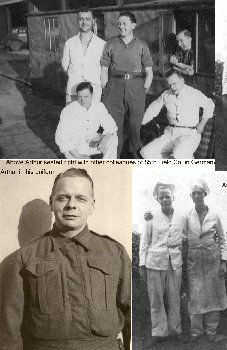
Arthur Middleton and Cooks of 85th Field Company in Germany 1945
I Tracey Middleton, have written this story of my Grandad during World War 2, I have put it together from his stories, and from research about him and his unit, from existing documents.
On 25th July 1940 Arthur Robert Middleton, attended a medical examination under the National Services (Armed Forces) Act of 1939 (compulsory conscription). At 32 years of age and 5ft 6 inches tall, with fair hair and blue eyes, Arthur was passed grade one fit for duty.
Arthur, born 18 December 1907, presently an insurance agent, was subsequently called up on 17th October 1940, and became Private Middleton in the Army. On that day the majority of men who later formed the 85th Company were absorbed into the 13th Training Battalion royal Engineers for their 4 months initial training in “B” Camp Barton Stacey, Hampshire.
After standard training, Arthur was remustered as a Pioneer 3rd class in the Engineers on 21st December 1940. 8th Feb 1941 The new unit of the 85th Chemical Warfare company, Royal Engineers was established at “A” camp, Barton Stacey, Hampshire and Arthur joined as Pioneer 2nd Class along with the other recently trained recruits.
From 8/2/41 — 26/5/44 the unit went through training in England and Scotland on special engineering tasks included - demolitions, Gas Projector and Rocket Firing, Watermanship, Mine Laying and Clearance Road construction and maintenance etc. On the 27th Feb 1943 the unit was converted to a field Company and thereafter additional training ensued in Beach Group Deployment, Combined Operations, Bailey Bridge and Pontoon Bridge construction, beach landing practises, beach exits construction and maintenance etc.
Sometime during the training, Arthur injured his back working with heavy equipment and spent a while in hospital. Possibly after which on 8/5/41 Arthur retrained as a cook at Winterbourne, and passed as Class 2 Cook. On 22/5/42 to cook first class (non tradesman) having spent 6 months in the units cookhouse. On 17/8/42 Arthur was tested and found to be Army catering core standard and was remustered as Army Catering Core cook 2nd class on 20/5/43, still part of the 85th Field Company.
On 28/2/44 at Boscombe, Hants, the unit was given a talk and inspection by the then Sir BL Montgomery and on 25/4/44 at Chandlesford, Hampshire, an inspection by the late King George 6th. On 27/5/44 the camp at Chandlesford, Hampshire was sealed and administration closed down. On 1-3/6/44 the Company embarked on L.S.I.’s, L.S.T.’s and L.C.I.’s at Southampton for “Operation Overlord” — “D” Day, the greatest amphibious landing in history.
It appears that the 85th Field Company was under the command of CRE Lieutenant Colonel F C Nottingham — 7th GHQ Troops Engineers, part of the 102nd Beach Sub Area all RE — HQ, and the 7th Beach group. They were the follow up troops to the 7th Canadian Brigade, and were placed under the command of 3rd Canadian Division, Lieutenant Colonel R. J. Cassidy RCG. The Canadians were to take Juno Beach from La Riviere in the West to St Aubin in the East.
Cyril Whitehouse another member of the 85th Field Company on the evening of the 5th June, played piano at an impromptu concert, along with an accordionist from the Winnipeg rifles. He documents this in some notes he donated to the Royal Engineers museum, along with the ‘D’ Day table plan which shows the names of the whole company, which landing craft they were on, and when/where they were due to land.
Arthur Middleton and the 85th Field Company of Royal Engineers embarked from Southampton on 1st, 2nd, and 3rd, of June 1944 in an LCI (Landing Craft Infantry), as part of assault force J. His Landing craft designation number was one of the following 3: 1121, 1131, 1138 (possibly most likely 1138 — due to land 135 minutes after ‘H’ Hour [7:45 a.m.] on ‘D’ Day).
The first Royal Engineers of the 85th landed at 08:10 on the Mike Green beach at Courseulles. According to one of Arthur’s rare stories about the Second World War, he disembarked “behind a large seargent” , and saw a Canadian “with an accordion strapped to his back lying dead motionless in the water, floating with the tide”. After some research this must have been on Mike Green sector of Juno beach at around 10 am of ‘D’ Day. According to another of Cyril Whitehouses notes, it appears that the accordionist was the same one he had been performing with the night before.
To get out of the sand dunes, the Canadians and 85th had to cross some marshland on the way to La Valette . The 85th consolidated the exit on the beach, by using fascines over an AVRE tank that had become disabled, later when enemy fire subsided, the Company entombed the AVRE in concrete. It was later recovered in 1976, refurbished, and placed in a nearby spot on the Graye-Sur-Mer beach in October 1977.
The company remained in the Graye/Courseulles area for a further 7 weeks dealing with mines, and other obstructions, and refurbishing bridges. The square in Graye was named after the corps — Place Des Royals Engineers, Place De Anglais.
The 85th moved about a lot in the coming months, it appears from their whereabouts list (also donated by Cyril to the Royal Engineers museum), that they followed close behind the army (possibly still the Canadians), up towards the Falaise pocket. Just prior to this the company spent a short time in the Bocage following up after scenes of fierce fighting (particularly for the tank units).
The company moved to the south of Rouen and assisted in the crossing of the Seine. From there the company moved to Belgium and Holland (north of the Battle of the Bulge), and on from 21st — 29th January 1945, Arthur was granted 9 days leave to the UK. On the 10th February Arthur became the Platoon Cook. Arthur made friends with a family in Lille — St Hubert, Belgium and stayed in touch with them after the war. In March 1945 they built a 320 Bailey Pontoon Bridge to assist with the Crossing of the Rhine at Xanten, Germany.
In March 1945, Germany they received a talk by General D. Eisenhower.
The Company were in Munster, Germany on V.E. day — May 8th 1945, moved on to Ebstorf near Luneburg, just below Hamburg, in Germany for four months. On 10th September they held a farewell party as on 12th September 1945 the Company was disbanded and its personnel posted to various formations.
Arthur appears to have ended up in the 619 Field Park Company and was reviewed by the military dispersal unit on 17th October 1945, five years to the day that he had originally joined up. Finally being demobbed on 16th January 1946. He lived happily in Birmingham with his wife, daughter Audrey, son John until he died of a stroke in 1981.
© Copyright of content contributed to this Archive rests with the author. Find out how you can use this.


 Recommended story
 Story with photo