

- Contributed by
- mon52don
- People in story:
- Staff Sergeant John William Wilson, later promoted to a Warrant Officer.
- Location of story:
- The Horror of Dunkirk
- Background to story:
- Army
- Article ID:
- A6054743
- Contributed on:
- 07 October 2005
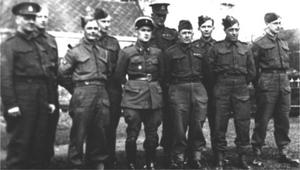
After arriving in France the men of the BEF made friends with the French Army. Dad is on the left of the picture.
My dad died on the 31st March 1979 at the age of 84 years. His wartime diaries included the First and Second World Wars and are included in a book called "Our Lives", a family history of the personal life of my husband and myself. Because the diaries are written in pencil it has been difficult to decipher many of the spellings. However, the following story relates to the Second World War and the words are his own.
On May the 6th 1940, I terminated my leave from France, leaving Middlesbrough at 08:00 (Monday) for Kings Cross, arriving 13:55. Took the underground to Victoria arriving at 14:40 and remained there until the boat train left at 22:30, arriving at Dover 00:40 the 7th May 1940, where I proceeded to the rest camp for the night. Left again the next morning at 09:00 walking to the boat, which was only ten minutes from the camp. The boat left Dover at 10:20 and arrived Boulogne 12:30. Weather was fine and the crossing smooth. After disembarking I entrained immediately for Liencourt where transport was waiting to take me back to my unit at Don, near Lille, arriving at 18:00.
Resumed duties on the 8th May. Following at the rear of the Brigade I left Don on the morning of the 17th May 1940, at 01:15. At Toumas Cuisery the Brigade was bombed and machine-gunned. We were most heartened to see the refugees leaving Belgium. The convoy pulled in at 22:30 in the vicinity of Renais Ogy. Reveille was at 02:00 next morning for another move, after recovering two vehicles that had been ditched. Left at 10:15 for Dott-Mes and stopped the night in a cinema arriving at 01:45.
The Brigade had to keep going and on the 19th May we prepared to move again at 12 noon for Annappes, sleeping in a wood that night under cover from German aircraft. Next morning, the 20th May, more air activity going on. At 16:45 we prepared to move from Annappes at 16:45 for Vimi village, arriving at 01:45 on the 21st May. The convoy was being machine-gunned en-route inflicting many casualties so we parked in a farm at Farbus.. Everything had been left by the occupants because of the evacuation. We fed the cows, pigs and chickens. Left Farbus on the 24th May at 22:00 for Waching because of the constant bombing by aircraft and shellfire — one cow killed, another seriously wounded. We had to shoot it. Arrived at 02:45 but moved off again for Dickebushe on the 25th May at crossroad Café Berge. Shelled continuously, we had to make a quick get away.
On the move again in convoy with aircraft flying overhead with congestion on the road — continuously on the move getting sleep when we can. Next we travelled through Poperinge.
During the night of the 28th May two shells landed quite near and we arrived at Corbiene at 16:00.
On Wednesday the 29th May the enemy was getting rather close so we moved again to Bray Dune en-route to Dunkirk on the Thursday the 30th May. There were scuttled vehicles and armoured carriers all along the road. On Friday the 31st May, we had to dig in for protection anywhere.
Arrived in Dunkirk on Saturday the 1st June and proceeded to the beach in cover of darkness, we were shelled with shrapnel falling along the way. When we arrived on the sands the Officer-in-Charge, Capt Jackson, told everybody that it was every man for himself, so we dispersed in bodies of two or three men and started to dig in on the sands until such time we were given the order to proceed to the boat. I dug myself in alongside a scuttled 8 cwt truck but before I was finished we were being shelled on the sands so I worked in intervals of shell bursts. I was so frightened that I at once settled ‘down in my hole’. A shell exploded 15 yards away. The explosion was most terrific but, luckily, none of us were hit. I called out the names of the men who were in the hole nearest to the explosion and was pleased when they only took it as a joke for escaping injury so near. Eventually the order came for everybody to collect the gear together, both army and personal. When this was done we led off in single file across the sand to the boat. What a relief to get off the beach, as I thought, there were thousands of men heading for the same boat. Passing over and around holes of different sizes in the sand made by shellfire, or men digging themselves in. What a march we had across the sand when we eventually arrived at the Mole.
We came in contact with French soldiers who were also going for a boat, any boat. It was a most terrible slow procession for the Germans kept up shelling us inflicting many casualties each time. I got halfway along the Mole, keeping all my section together, when the man in front began to turn back because they had been told that there were no more boats left. Everybody thought the most advisable thing to do was to get off the Mole as quickly as possible before dawn because the German aircraft would return and it would be suicide to remain on it. It was most desponding for everybody. I thought nobody (the General Staff) cared for us because we had been left on the beach. Anyway, we have to take the only chance left for us and that was to wade out to rowing boats, or any other craft that was there, or dig in on the sand again and survive the whole day until it came in dark again to await the arrival of more boats. I got all my men together and advised them to dig and dig, as far down as possible, and wait for lines of men to get away. My corporal and myself dug in under a scuttled motor truck. An officer of the R.A.S.C., Capt Bradley, attached to us; he joined in the digging and shared the hole with us. We were absolutely deadbeat for sleep, not having slept for five nights. We tried to sleep but the Germans came along with his aircraft again — 3, 6, 9, 12, 15, 18 of them. We thought it was all in for us when he started to dive bomb and machine-gun everybody. The bombs shook the very foundation of the beach and we all wondered when he would stop this murderous attack. We kept perfectly still hoping he would leave us alone.
When we got out of our holes, fires were burning feverishly all around us. I mentioned to the officer (Capt Bradley) that we had better see what arrangements could be made to get away from this hell, so he went to find B.H.Q. He was away some time during which we experienced another air attack. When he did find us again he was pleased we had all once again survived. He brought back another officer (Capt Leaman); we had lost him the previous night. He was pleased to see everybody intact. Both officers asked me if I would rather stay outside, dug in with the men, or go into a cellar in the town, which was still burning. I told the men to pack up and we moved into a cellar where we remained until 21:00 on the night of the 2nd June. I filled my water bottle with some brandy from a keg in the cellar. We left under ideal discipline arrangements for one final dash to the beach. On our way to the boat alongside the Mole, we passed quite a few of our unfortunate lads lying dead. Everything went off perfectly without a shell being fired by the enemy that night. A destroyer of the H Class eventually pulled alongside. With the assistance of two seamen I scrambled on board, first throwing my rifle onto the ship before I had to jump for it. Within a few minutes of my getting on board, together with as many wounded as possible, we pulled out and it was not long before we were steaming at full speed away from this blazing inferno of DUNKIRK.
We left the Mole at 21:50, on the 2nd of June when, within a few miles off the English coast, we encountered an enemy aircraft firing tracer bullets into the sea with the object, I expect, of hitting any ship that may be within range. It was, of course, dark at the time, and the forward gunner of the aircraft started firing. The gun on the ship immediately fired two rounds off in the direction of aeroplane from where the tracer bullets were seen. Having got over that little excitement we proceeded at a steady pace until we arrived in the port of Dover at 03:00 on Monday morning. Photographers from the newspapers and magazines met us. A photographer from “The Illustrated” magazine took my photograph as I stood on the dockside. I had returned with all my equipment intact, overcoat, water bottle, gas mask and rifle.
© Copyright of content contributed to this Archive rests with the author. Find out how you can use this.


 Recommended story
 Story with photo