

- Contributed by
- bernardelliott
- People in story:
- Bernard Elliott
- Location of story:
- Savernake forrest, normandy, brussels
- Background to story:
- Army
- Article ID:
- A7138541
- Contributed on:
- 20 November 2005
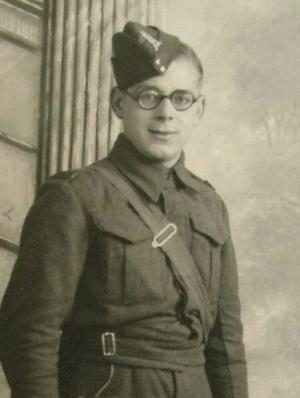
Bernard Elliott 1940 - 1946
Enlisted into the Royal Pioneer Corps June 20, 1940. After basic training, I was posted to Marlborough for a period of 2 years. I was to establish an ammunition dump to keep the ammunition out of sight of the German Reconnaissance. These spy planes always came at the same time, 5pm, 1 or 2 times per week. The ammo was transported off trains, back to Savernake forest. On arrival at the forest, the troupes had to firstly round up red deer by forming a circle and slowly mustering them into a coral. At times the deer were quite agile and jumped over the head of the troupes. Ammo storage included everything from the bullets of a 303 rifle to 12-inch shells used in cannons. Some of shells contained mustard gas. Some days the troupes were expected to work from 8am to 10pm and, at times, wore gas masks for practice in the event of a gas attack. January 1942 was my first leave back to Manchester, which had recently been bombed. My recollection is the bombed warehouses and the lists of the confirmed dead displayed on the church wall.
In 1942 I went to the orderly room to inquire about an alternative position. After a quick test in dictation, and with my quick draw, two finger typing skills, I was posted to Warminster as a clerk, at No. 8 Group HQ. Here I remained there for the duration of the war and received a nice raise in pay. As Clerk of HQ, I was responsible for typing amendments to the Army Council Instructions, such as pays and uniform changes. I was also responsible for notifying next of kin, demobilisation papers, daily company orders, typing out signals from the 1st Canadian Division, manning the phones and court marshals. One court marshal that I remember was of a Private who stabbed a Sergeant in the cheek with a fork.
In 1943 I was posted to Minehead, then in January 1944 to Southhampton until D Day. Here, we were taken to a camp known as the “Cage” and waited for 4 — 5 days before being sent to Normandy. To prevent escape, the US army patrolled this camp, as the UK army patrolled the US camp. Each person was issued with 400 francs of “Occupation Money” and then deployed to the American Liberty troupe ships, which then transported them to Normandy. 1 mile from the beach, with full kit, the troupes were required to disembark via the scrambling net onto the landing craft. It was only the CO whom managed to tangle his foot in the net, much to my amusement. The troupes landed on Gold Beach. On the beach the troupes left their kit bags and went in search of a suitable campsite, leaving me alone to look after the gear until they returned. As the evening came, I met a lieutenant who had been given the same orders.. As it seemed unlikely our troupes would return to us soon, we searched for somewhere to sleep for the night. We came upon a campsite and scrambled into the first empty tent. Waking the next morning we found ourselves in a British POW camp full of German prisoners. Much to our relief, we were ignored and watched the Germans being loaded into tank landing crafts, much like cattle, for their journey to England. Once back on the beach, I spoke to a Colonel, who arranged for my transport back to my troupe, the No. 8 Royal Pioneer Corps Group HQ. The corps continued to advance, following the movements of the infantry. There were, however, small pockets of resistance along the way.
At this time, my group was under the command of the 1st Division Canadian.
In Alamache, our 30-man troupe surrounded a farmhouse holding about 20 German soldiers. A German soldier who was otherwise unarmed hit me on the back, with a spade. In response, I rolled onto the ground and fired my Sten gun into the man. The result for me, 2 broken ribs. The German soldiers surrendered after a few hours as they ran out of ammunition. Overall there were few casualties and 1 ally shot dead. The Germans were transported to Alamache.
The next move was to Caen. There was little for the RPC to do here as it had been heavily bombed and the Germans had retreated. However, the troupe found the French people to be very unfriendly, rude and ignorant. RPC were definitely not welcome.
Onward the troupe moved to the Falaise Gap, again here all was quiet after a heavy tank battle. Passing through Dunkirk, I noted in the mess hall a mural painted on the wall. It showed many German soldiers looking at Britain with the inscription “We are coming”.
Belgium was very different for the troupe. The people were excited and happy to see the British army. They ran to the trucks and cheered while throwing bottles of wine up for the soldiers. During our stay, the Belgians couldn’t do enough for us. Each soldier was housed with a family and life was full of R & R. At this point I was offered a position of field commission, which I declined.
Through Holland, we met with no resistance. As the troupe entered the Ruhr we were stunned at the destruction of burnt out shells that once made this town, a result of the English Incentry bombs. The Germans were living in extremely poor conditions and were housed in the sewers. Across the Rhine and into Munster where the war was to end and the clean up begin. It was here that we came across Belsen concentration camp. The smell and desolation surrounding the camp was overwhelming. The CO rounded up all the officials and wealthy people of Belsen and set them to work caring for the sick and dying and burying the dead.
The troupe settled in Altone for occupation until September 1946. Although the stores were empty and the people went hungry, there was plenty of beer. After being given a 48-hour pass to travel to Brussels for some R & R, King Leopold opened one of his palaces for the use of the 21st Army group. This became known as the “21st Club”. I have fond memories of rows of tables, white linen and silver cutlery. All meals and drinks were free to the service men. Towards the end of 1945, No. 8 Group HQ was disbanded and I was posted to No. 1 Group HQ until discharge. The night before I left Germany, the Major 2/IC invited me into the officer’s mess for a celebration. Christmas in the army was just another day, but on Christmas day 1945, this infamous Major once again surprised his troupe and ordered two lieutenants to wake the lads up with a hot cup of tea.
I was discharged to England in September 1946. I was transported to Falkstone then caught a train to Newcastle. Here I handed over my arms and then boarded the train to Stayley Bridge. I was then issued with a complete new civilian outfit, 500 pounds in back pay and 500 pounds in discharge money. A rich man now, I went home and bought my first car, a Morris 8, for the pricely sum of 180 pounds.
My most memorial experience is of the people of Belgium and their welcome and warm reception. My best moment was my discharge and the sight of the rookies on their way to Germany for the occupation. My worst experience was walking into Belsen concentration camp and seeing the millions of refugees trying to find their way home.
Although discharged from the army, I continued to be a part of the army reserve until 30th June 1959.
CORPOAL BERNARD ELLIOTT
13038317
ROYAL PIONEER CORPES
1940 - 1946
Medals include the 1939/1945 Star, France and Germany Star, Defence Medal and 1939/1945 War Medal.
© Copyright of content contributed to this Archive rests with the author. Find out how you can use this.


 Recommended story
 Story with photo