

- Contributed by
- Hilda M Taylor
- People in story:
- Hilda M Taylor, Stanley L Taylor, Phyllis Parry, Marjorie Parry
- Location of story:
- Lancashire, Yorkshire, Portsmouth, Dundee
- Background to story:
- Royal Navy
- Article ID:
- A4423141
- Contributed on:
- 11 July 2005
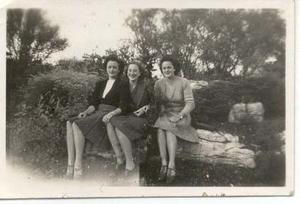
HMT with Phyl and Marj Parry
MY WAR, part 2
Yes, I became a Wren, was allocated my number (98009 - do we ever forget it?), and despatched to Blundellsands, near Liverpool, for yet more training. What had changed …? Rise at 6am, wash, tidy room, make bed, and go down the road to offices that I had to clean and polish until 8am. Return to quarters for breakfast, back to the offices I had just cleaned to do secretarial work throughout the day. Then an urgent draft to Portsmouth had to be filled and I was the one to go. Breakfast at 7 am and I was on my way to Liverpool to catch the already overcrowded 8am train to London. I stood all the way to London, still holding on to helmet and gas mask and wearing greatcoat, along with masses of soldiers, sailors, airmen and women’s forces crammed together like sardines in a tin. There was barely enough room to put my suitcase on the floor. No food or drink available either.
Arriving at London Kings Cross many hours later, an air raid was in progress when certain tube trains were stopped and I had a long walk to Waterloo station to join another long queue for my train to Portsmouth, finally arriving at my new depot — a commandeered school — at 10.30 pm, still not having had food or drink. When I asked for supper I was handed one sardine on hard, dry toast that had been in the oven since 6pm supper, together with a cup of cold cocoa.
I was ordered to join the rest of the “ship’s company” asleep on the basement floors. My ‘official’ bunk was on the 4th floor, but air raids meant we had to sleep on the basement corridor and bathroom floors. I climbed the stairs, claimed my mattress and trod carefully
along corridors avoiding sleeping bodies, to claim my patch on the bathroom floor. Mattresses had to be carried back to bunks every morning and the vacated sleeping area left clean and tidy, the procedure for very many more weeks to come. My ‘urgent’ draft had been taken and I would have to remain in ‘holding’ awaiting another draft so it was back to cleaning, scrubbing and polishing until then.
We had alternate days of doing these duties. One day we rose at 6am to clean and scrub, have breakfast at 8am, then continue the same duties until after lunch when the afternoons were free. Alternate days we rose at 7, breakfast at 8am and did light cleaning all day — ‘light’ meaning polishing door handles, washing and drying dishes by the hundreds etc. No detergents then meant hundreds of plates and cutlery floating around in warm greasy water, to be dried with the six or so tea-towels available which we would wring out as they got wet and continue trying to dry dishes. My first job on my first day was - once again - to clean lavatories, only this time they were worse. They were all outside in an old stone enclosure. For an officers’ dance one evening, three of us were given tins of polish and ordered to polish the floor to make it ‘slippery’; the next day three more wrens were detailed to scrub it all clean and non—slippery again
I wasn’t long in finding out that night-time fire-watching duties gained one freedom the next day so a friend and I volunteered for this most nights. This wasn’t so delightful as it might sound though, for during the night we had to scrub out floors of First Officer, Second Officer, Regulating Office and “Quarterdeck then every two hours thread our way along corridors of sleeping wrens to stoke boilers. During air raids, we would just dive under a table with our helmets on and wait until the bombing had ceased. The table wouldn’t have given much protection, but it made us feel safer. This at a time when the dreaded V1-bombs were being replaced by the V-2’s, pilotless planes that, when the engine stopped, would descend somewhere ….We knew not where ….. We just waited and hoped our names weren’t on it. All around was devastation, piles of rubble and shells of buildings, one such being Portsmouth Town Hall itself.
Though I complained about the length of time I was kept in holding depot, having arrived initially to take up an important draft, it was a long time before my assignment arrived and I was posted to HMS “Marshal Soult”, an old monitor in the dockyard used as the Depot Ship for the DD invasion fleet. There I was secretary to the Supply Officer (Stores) later to become Base Supply Officer.
We supplied Clothing, Naval and Victualling stores to invasion ships, my office being on the top deck; Pay Office was in the deck below. Victualling stores were housed in an attached vessel — the “HMS Lupin” and every day ships and small boats arrived for their supplies.
Occasionally, when Captain’s secretary wasn’t available, I was assigned to take notes at “Captain’s Court” when, personnel were being ‘tried’ for misdemeanours. On two occasions I was temporarily replaced by a male Writer, because of the nature of the offence — once when a sailor had gone AWOL (absent without leave) because he was responsible for his girlfriend becoming pregnant, and once because two sailors had been discovered in the same bunk. It wasn’t considered proper for a wren to hear such evidence!
I had an interesting, though perhaps a little sad, experience once when I had to attend, this time as witness, first at a prior Board of Enquiry then at a Courts Martial held on board HMS Victory, when our Chief Petty Officer (Stores) was tried and convicted of stealing. He had stolen various items from stores together with a quantity of clothing coupons. It was part of my job to receive and log out the clothing coupons, though he had denied having received them. Fortunately I was able to prove this by the records I kept, and eventually he was convicted and sentenced to loss of rank and to be dismissed the Service. “Sad”? Well, yes, I felt so, because I had always liked him and found him to be helpful and friendly. I still recall entering the Boardroom to see on the desk his sword pointing towards him, an indication he was to be pronounced guilty.
Although I worked on board ship, I was assigned to my new WRNS quarters at Strathearn Hotel situated on the promenade at Southsea, and where, once again, I found myself on the top floor. Every night (usually) when the sirens sounded we had to rise, cover ourselves with coat or dressing gown and proceed down the road to the ‘dug-outs’ -shelters underground equipped with 3-tier bunks. I was allotted a third tier bunk into which I had to climb the best way I could — no steps up to bunks as in today’s modern counterparts. If ‘all-clea’ sounded before midnight, we returned to our bunks (two-tier) at Strathearn, sometimes having to do this a few times if before midnight. After midnight we stayed in the shelters when, the following morning, the procession of pyjama clad wrens could be seen returning to quarters.
After I time I was moved from the main part of the hotel to the annexe where I shared a cabin with 5 other wrens, two being twins from Wales, and with whom I still remain friends. As with other wren establishments, it was ‘lights out’ at 10.30, with two late passes per week until 11pm, though this meant one had to creep quietly to bed then and undress in darkness. We were allowed one sleeping out pass per week, meaning that if we ‘saved’ one, we could be away for two nights at a weekend once per fortnight, thus allowing those nearer their homes to spend a weekend away. Not so for me, however, as it was too far to travel to Lancashire and back in the time allowed. Nor could I have afforded the train fare.
We were paid the handsome sum of £2.8 per fortnight, (24 shillings per week) which may seem a lot for those days, but, for wrens, any new items of uniform had to be purchased out of this as well. We had a free issue of initial uniform (greatcoat, gabardine raincoat, two suits, 3 shirts, collars and ties, 2 pairs of shoes). We had to purchase our own naval underclothes towards which we received a grant of £2.8 (48 shillings) but after that, replenishments of any clothing had to be purchased from Stores. Shoes at stores cost 13 shillings, so that left little pay when we might need new ones — just 11 shillings left for that week. Food often just wasn’t good, and a lot of our pay was spent at the eating-place down the road — one could hardly call it a restaurant — where we consumed our very greasy fish and chips costing 1/11 (one shilling and elevenpence). Occasionally if we had a little extra to spare we would go to a nice restaurant for similar fare, served more ‘genteelly’ but at a cost of 2/6 (two shillings and six pence)
For breakfast there was plenty of toast and margarine and our cooked breakfast was always a half slice of fried bread served with a different topping each morning - dried egg scrambled (always very wet and floating in water), piece of dried egg omelette (somewhat dry and rubbery in texture), piece of bacon or tinned tomatoes. On Sunday morning we were given a hard-boiled egg. Lunch times were dreadful. We had to have lunch at the mess hut alongside the ship. Three days per week we were served dried meat and dried potatoes. The meat looked like cooked dried minced meat, which was left steeping in galvanised buckets presumably to soften it, then it was boiled up. The dried potatoes, once reconstituted, were piled on plates just like, wet ‘soupy’ potatoes, totally unlike the dried potatoes we are offered today. Failure to eat any of this meant we had to starve until supper-time or eat some bread with the dripping which always seemed to be in plentiful supply. In the mess hut there was a large stove on which we would place a slice of bread until it ‘toasted’ then we could spread it with margarine — not the more palatable margarine, though, of the kind we can buy today. There was always plenty of this margarine. Butter, as with most foods, was strictly rationed and at first, usually at breakfast time, there was a tiny amount allocated to us on our plate. Later, though, we were given our standard allowance of 2 ounces per week — the civilian ration - to keep in a jar.
Wartime food rationing for everyone, civilians and forces, was very strict. Practically all commodities were rationed and those that weren’t were in very short supply. Tiny amounts of fat cut from the meat ration were rendered down to help eke out fat for use in baking, and I have known housewives who used liquid paraffin sometimes to bake a cake. Nothing was wasted. With only 1 egg per person per week, dried egg was used for baking and, indeed, for serving as scrambled or made into omelettes. Long queues would form at shops when word got round that there had been delivery of ‘luxury’ items such as bananas or oranges and mostly these were sold to people who had children. Many gardens were used for growing vegetables instead of flowers, and people without gardens (even some with gardens) rented ‘allotments’ for this purpose. Sweets and chocolate were rationed too - 4 ounces per person per week was the allowance.
Back in WRNS quarters suppers were variable in appeal, but mostly not very good and so it was a case of fill up at the chip shop or starve. About once per week we were served a meal of bacon, beans and chips - always well received and seldom were there ‘seconds’ then. Summertime food wasn’t too bad as it was often cold meat with salad, mostly edible if one avoided the odd caterpillar. I once found half a caterpillar on my plate and always wondered where the other half went….
Mornings were a bit of a scramble. I usually could ‘programme’ myself to waken first then wakened my companions. A scramble for the washbasin ensued, rush down to breakfast at around 7am, followed by another rush across the promenade gardens where transport (buses) awaited to convey us all to the dockyard.
Thus continued day after day, mostly with evenings free until ‘curfew’ at 10.30. Woe betide anyone who arrived back late, detention being punishment for such an offence. We didn’t volunteer for fire watching. There was a rota, but with so many wrens our turn was fairly infrequent. No boilers to stoke. We could make coffee in the ‘galley’ where, as soon as we turned on the lights, the cockroaches and beetles would scurry away to their hidey-holes. Not so the large rat that usually slept atop the central heating pipes near the ceiling. Nothing to eat other than the large, very dry ship’s biscuits left out for us. Mostly we left these to the cockroaches and any other livestock that were around.
I mentioned that on rising we had to wait our turn to use the washbasin in the bedroom — no such luxury as showers or baths every morning. There was one bathroom in the annexe to be shared by about 30 wrens, with sufficient hot water available for about 4 baths. The first one off the return transport would rush upstairs to turn on the bath tap, thus ensuring (unofficially) that that bath was hers, so the twins and I had a plan….. first upstairs turned on the taps, had a wash at the hand basin then a quick soak in the bath, leaving the water clean for the next to do the same. Three baths out of one. Sometimes though, someone beat us to it and there was only cold water. In such event like others, I would go into Southsea, first to the YWCA, then to the Salvation Army, ever hopeful that a hot bath would be available there, but more often than not I had been ‘beaten to it’ and returned to quarters to a quick cold bath - very, very cold in winter.
As part of Britain’s war effort economy, the recommended amount of water for baths was 5” — some civilians painted lines at this level along the insides of their baths to help make sure this level wasn’t exceeded — and it became such a habit that to this day, I mostly still only use about 5 inches of water. We had an issue of coupons with which to buy soap, but more often than not the shops would only sell us the kind of soapblock used as general purpose kitchen soap, and kept back the nicer toilet soaps for residents. We also received coupons with which to buy black stockings as most wrens preferred to wear ‘artificial silk’ ones rather than the standard issue thick lisle. Off duty wrens also
were allowed to wear civilian clothing, not easily obtainable, of course, as all clothing had to be purchased with a coupon allowance available only to civilians, but if we travelled further afield than Portsmouth, some shops would exchange our stockings coupons for, perhaps, a dress — quite illegal. Appropriate stockings then became a difficulty as our regulation black ones were unsuitable and so, when on leave, I would purchase a ‘colour remover’ in which to boil the black stockings so that I could re-dye them to a more ‘natural’ tone. If any had been darned the black in the darn didn’t change colour, so then I would have to unpick the darning and re-do in the correct shade. Mending, darning and ‘making-do’ played a large part in the lives of civilians or forces personnel and part of our naval issue was a “hussif” (housewife) containing needles, threads etc for mending purposes). Throughout the ages of course, sailors at sea would always have had to do their own repairs.
Our self-same washbasin was in regular use, too, for washing underclothes. We could send shirts etc to the laundry, but with an issue of only 3 items of each in the case of underclothes we couldn’t leave any at the laundry for a whole week. With only ordinary soap (no detergents then of course) we could never be rid of the scum caused by such hard water, something I had never experienced in the soft water of my home town, and the rinsed articles always emerged coated with scum, no matter how many times they were rinsed. Anyone who looked up at wrens’ quarters could see the ‘smalls’ strung across the open windows to dry.
© Copyright of content contributed to this Archive rests with the author. Find out how you can use this.


 Recommended story
 Story with photo