

- Contributed by
- pete probst
- People in story:
- REGINALD KENNETH PROBST
- Location of story:
- Bath
- Background to story:
- Civilian
- Article ID:
- A4011841
- Contributed on:
- 05 May 2005
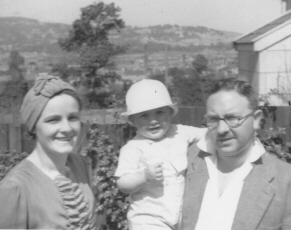
Bernard, Lillian and Kieth, Bath
After the funeral, dear old Mrs Matthews used to insist that I bring my clothes round to her for cleaning and socks for darning. The house was too big for her, so it was sold and she moved into a first floor flat in the house of a friend, Ken Davies, whom I had known from my days at G.E.C.. They had been lucky and found this terraced house in Coronation Road and moved from London. Flats had to be let quickly or the billeting office would be around to take the unoccupied rooms, so it was convenient to have Mrs Matthews. Sadly, she was not there for long. One evening Jack came to visit and she waved to him in the road from the upstairs window. Jack went upstairs to find her slumped in a chair. The district nurse had a bed-sit along the road and she was fetched. She checked the old lady, but she had died. The nurse immediately asked Ken if she could have the flat, and Ken promptly relet it before the body was cold.
At the office I had been working on the last parts of the design of Singapore Naval Base, but building work was coming to close and as we know the war was to take a turn for the worst in the Asian theartre. I was put on to the designs of the water supply system for the Naval Stores at Fishguard; more precisely the springs, collecting leats, dam and filter house; which was interesting work. The year was running into a very cold winter. I was posted to Cornwall assisting Charlie Phair, an Ulsterman, on a survey of the coast near Delabole. Culdrose was being improved to take the carrier borne planes for offloading and repairs when the carriers where in Devonport. For testing the planes they needed a bombing range in the Bristol Channel and an area near the village of Treligga with landing strip, control tower and Wrens quarters, with coastal range finders to check accuracy of the bombing. We got rooms at Court Farm, Treligga, owned by Mr Knight. It was a lovely place with rugged scenery and Mr and Mrs Knight could not have been kinder, especially considering we were going to take over a large part of the land that Court Farm worked. They also had a son, Harvey, and daughter, Cecille, and a ginger haired married daughter. I got on with the family very well during our stay. We first required workmen to carry out the odd surveying jobs, such as chainmen and staff holders and we found these from Delabole quarry, which had reduced production with the war. The men employed were part of a concert party led by a local singer known as the “Cornish Fisherman”. They had been on the radio and in our work team was the band leader, base, comedian and a singer who looked after the groups business. Charlie Phair was a strict Plymouth Brethren and would obey rules and regulations. The men were on Dockyard hours, so he insisted they arrive an hour before we set out, to ready, clean and check equipment. These jobs were soon done and often the team moved into Mrs Knight’s kitchen where she served hot cocoa and they regaled us with Cornish songs and jokes from their shows. The job took a few months starting in the bitterest cold of winter and finishing in early spring, but it was a pleasant time indeed. Mr Knight’s son-in-law had a car hire firm and would take his wife, Harvey, Cecille and myself to local church hall dances, occasionally Mrs Knight would come along, complete with hot water bottle for the journey home. I grew very fond of Cecille, perhaps I should have asked her to marry me, but I did not.
Later that year I went to Salisbury as I had a posting to the site office at Deer Hill where the construction of tunnels for storing Naval mines was being undertaken. It was during the summer and I found digs on Aarnem Water near Salisbury Cathedral. The work was in conjunction with a Royal Navy Armament Supply Depot and as some local residents and employees were on the depot sewage system, sewage works were required and it was my job to design. At the time we were still a class society in the drawing office of chief, senior and junior officers, as the number of professional architects were in and out of the offices it was wearing a bit thin. We had toilets for the Chiefs and the rest, but one junior officer from the north insisted on using the Chief’s toilet. One day Jimmy Rait the Chief had to wait for the junior to come out of the Chief’s toilet, “What’s this, promotion?” he said. “ No, Sir” the junior replied “just motion.” Jimmy didn’t bother much about toilets protocol after that!
Whilst in Salisbury I went out with a WREN, nicknamed “Tweeney”, a few times. We went to Old Sarum where the original site of ancient Salisbury is. The outline of the old walls of the cathedral is quite clear to be seen. It was demolished and rebuilt on the plain, some time in the 13-14th century. Its magnificent stone spire supported with timber and the reversed stone arches under the spire to transfer the load to the ground is a tremendous feat of engineering carried out by those early structural engineers and masons, an additional wonder to the beauty of the cathedral. I also took “Tweeney” to a concert in the cathedral, although she did not say, it was not really her interest. I soon finished the sewage works and returned to Bath.
As I came up to Ivy Grove, Lillian was looking out of the bedroom window, I called out to her, “I had a lovely time, met a smashing WREN.” She showed signs of concern, put her fingers to her lips. I then saw Maggie who had come down for a surprise visit. She had talked Lillian in to letting us sleep together. I began to think we ought to get married.
We spent a week together, having a fairly reasonable relationship and she returned to London with out anything definite planned. A few weeks later she wrote to me, mentioning that she had missed her period. This piece of information brought me round to “popping the question”, to which, she quickly wrote accepting. I told the family, who were not surprised, nor were they jubilant. She had already visited my mother and looking back I realise they must have recognised each other as fellow travellers. I was somewhat concerned that her father had sharp words with her and with her mother she was always having differences; even at the Lab she had strong discussions with her seniors. At that time I could not see why every one was getting at my girl. How could I have been so stupid? I gradually drifted into wedlock. The only decision I made was naming the day, being mindful of the Income Tax quarter day it had to be before 6 April, so 5 April 1941 it was. On the day Dick was my best man and before the event he took me for a few stiff whiskeys and tried to put me straight on a few of Maggie’s characteristics, but again I did not see what he was getting at. Maggie managed to get a position in the Admiralty as a junior electrical engineering assistant and came down to Bath. We found a flat, through a friend in the office, and we moved into “Oneglia”, Wells Way a few weeks before the wedding.
Of the wedding I remember very little and I cannot think of anything particular, except that it was held at St Andrew’s Church, Kingsbury. The church was in central London and had been dismantled stone by stone and moved out to replace a temporary building. The vicar who conducted the ceremony must have been gardening, or perhaps digging for the war effort, as his shoes were covered in mud. After the reception, about which my mother made a few caustic remarks, we returned to Bath. We were bereft of funds. The Civil Service paid annual salaries and each month one twelfth was handed out, rounded up or down to suit the Paymaster. Each quarter it was checked and in March paid to the correct annual amount. On this occasion the amount I received was equivalent to about a weeks pay. I was relieved a few weeks later to receive a cheque in back payment of one years married man’s allowance.
Bath was a lovely city to live in and the surrounding countryside was beautiful. We made some good friends from Maggie’s department, including Fay and JB Harris who became lifelong friends. We soon established a regular bridge evening with the Harris’ and other friends.
“Oneglia” was a pleasant home with good views over the hills just on the outskirts of Bath. The only problem was sharing the kitchen with our landlady. She did not like wasting things and being a widow one couldn’t blame her, every time we cooked she would be in with a little dish of something to do in the oven or on the gas. Most people would take this in good part, especially during the austere time of the war, but Maggie began to object and fell out with her so that they would not talk to each other. I looked around for other accommodation and found a house in Bath Easton, which had been let by an RAF Officer, whose wife moved in with relatives. We took the whole property which backed on to the River Avon in a nice area with easy access to the river bank and up the Limpley Stoke valley. A beautiful area indeed where the Kennet and Avon canal goes over the railway and the river.
Problems arose with the tenancy as the billeting people would want to take the vacant rooms, so I let the downstairs to Jimmy Hands in the office with his wife and baby. Mrs. Hands did not like the arrangement, but it suited Jimmy and I well. We had a spot of bother as Maggie found a cot in storage and given it to Jimmy and his wife for the baby. The original tenants who had sub-let it to us were quite a bit put out about us using the cot as baby had recently died. The next problem about the letting was when a young lady called on us and informed us that most of the furniture in the house was hers and she was arranging to take it down to the auction rooms and sell it. I felt that an explanation was due and asked her in.
She explained that the couple who let it to us had rented the house and had hardly any furniture whilst she had a fair amount. She was in the Hotel trade and both she and her husband worked in the same hotel, unfortunately he had died and left her in the house alone. She was then asked if she would like to take a ‘living in’ job and the young couple asked if they could borrow the furniture she had in the house. She had a form of agreement with them promising to pay her and then he was called up into the R.A.F. They did not tell her they were furnishing the house to let it to someone else - that happened to be me! I asked her if she would sell it to the young couple but she was adamant that they were the last people she would sell it to - “Well how about selling it to me?” She said she would think about it. The lady turned up a few days later and said that she had been going out with an American living in the Hotel. He had just told her that he had a chance to return to America on a ship leaving Bristol in a weeks time, had asked her to marry him and come back to America with him. Would I give her, and she named quite a low price, so much for the furniture. So I bought the house full of furniture. The day before she left she turned up in a Taxi with some suitcases full of blankets linen and trinkets saying that the quarters on board were a bit cramped and for £2 I could have this lot too. I gave her the two pounds. She tripped out to the Taxi, waved farewell, and I never heard of her or saw her again.
The situation became a little tricky after this, as the couple repossessed half of the house and rushed up some furniture from somewhere, we retreated into the first floor half and brought all our newly purchased furniture with us. We then received a Solicitors’ letter giving us notice; to this I replied by stating I would be moving out as soon as I could and meantime I would pay unfurnished rent on my half of the house. Maggie’s temper did not improve in what was an extremely tense period. As a precaution I consulted a Solicitor myself. The Solicitor did not think he could quote any previous case of such a nature, that is a furnished tenant buying the furnishings and becoming an unfurnished tenant. I wrote several letters and exchanged a few with the tenants downstairs, which gave us some time. It was during this period that we had the “Baedeaker” raids from the Luftwaffe and Bath had a very bad time during the Blitz. Holloway, near the Railway Station was badly smashed and the road was so filled with rubble that we were walking over the roofs of cars and many residential areas were destroyed. The Abbey and the Roman Baths and Pump Rooms were spared without damage, but the Assembly Rooms were destroyed and a gaping hole two or three houses wide was left in the Royal Crescent. This brought a slight relief and we started talks again through solicitors, fortunately it did not last long. Fortunately, a member of Maggie’s office was leaving on promotion to another station and was moving out of an unfurnished flat and we rushed round to the Estate Agents with him and took over the tenancy. Luck was with us, we fixed up a removal and the next door neighbour tipped us off that our landlady was going away for a few days and when she came back, we had gone. I left the accumulated rent for her, and never saw the couple again.
I went down to the Solicitor’s office to settle up with him and whilst in the waiting room, I noticed an R.A.F. symbol on the wall. I went into his office and asked him if one of his partners was representing the Plaintiff in my case. He went out of the office and came back. He told me his partner was and they did not realise it, but that he thought neither he or his partner were biased. Generously he offered that if I would pay for the typists time, he would be satisfied and make no other charge for his services.
We were now in a place of our own but I was finding it expedient to agree to go out on jobs that kept me away from home; but I still had to listen to continual complaints from Maggie, that men from the office were playing her up and being difficult. The main trouble she was having was from her immediate senior, his name was Chambers and he seemed to be going on about her work and efficiency. It so happened that I knew her Chief and one day I phoned him up. I told him that I was worried that Chambers and Maggie were not hitting it off very well and what could be done. Old Dick Whiteman replied “I really don’t know”. If she does not leave poor Chambers alone he will have a nervous breakdown” - It suddenly hit me, it was not all these people getting at my girl - it was her! A short time later when we got at cross purposes and I thought she might do a bit more about the house she said “If you think you have married me to get a cheap housekeeper, you have got another think coming” and I had, too. But hope springs eternal - and I soldiered on.
And so we settled into 8, Park Street. It was Mr. Pickwick in Pickwick Papers that complained about the steepness of Park Street Bath and I add mine. It is behind the Royal Crescent being one of the streets running out of the top side of St. James’s Square. The top of Park Street ended at the rear wall of a Chapel which became famous after the raid on Bath because of the marvellous painting by Piper, I think, of “The ruined Chapel” which was used in calendars, postcards and brought sympathy from all quarters; the fact that it was being used as a furniture depository at the time was left unmentioned.
© Copyright of content contributed to this Archive rests with the author. Find out how you can use this.






 Recommended story
 Story with photo