

- Contributed by
- Brian Brooks
- People in story:
- Brooks family and neighbours
- Location of story:
- East Acton, West London
- Background to story:
- Civilian
- Article ID:
- A7066136
- Contributed on:
- 18 November 2005
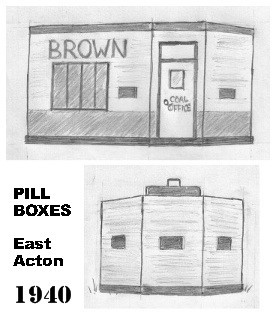
Top: Brunel Road ‘Coal Office’ Pill Box. Not a convincing fake, even to child of 5. ‘Window’ and ‘Door’ frames were wood strips, other details - including ‘door handle’ - were painted on. Right: The Fairway/Old Oak Common Lane ‘Police Telephone Box’ Pill Box
My Brooks family lived at 18 The Green, East Acton: Mum (36), Beryl (10) Brian (me, 5) and new baby sister Jasmine. Dad was Corporal Harry Brooks, on Searchlights.
June 1940. Grown-ups were very worried about invasion and bombing after Dunkirk. Lots of sandbags were everywhere, protecting buildings and shelters. Sandbags could be bought from the Council, and Mr. Stephens (our neighbour, no. 19) luckily got some, but filled them with earth as sand was hard to get now.
The railings round The Green and Acton Park, in fact all railings and many gates, were removed for scrap metal. I thought it would be easy to play on The Green now, but a chestnut paling and wire fence replaced the railings. (There would be no playing on The Green for 6 years!)
Anything metal was wanted and I saw old lawnmowers, bedsprings, rusty buckets and old paint tins piled up on an old smoky collecting lorry.
A large public Air Raid Shelter covered by earth was built on The Green, close to The Fairway. It had a corrugated iron roof over the entrance steps. For walking across the muddy ground a cinder path was put down from the road to the public shelter. Mum thought this was a good idea, so instead of putting the fire ashes in the dustbin it was my job to sprinkle them in front of our shelter to make a path. It didn’t really work.
The rest of The Green was turned into allotments to ‘Dig For Victory’. Ships bringing food to Britain were being sunk by Jerry submarines so everyone was supposed to grow as much as possible. Even Mrs Hatswell (No. 16) had her lovely front lawn turned over to growing vegetables. Mum was occasionally given a surplus cabbage or some carrots, which always tasted extra nice.
As the threat of bombing increased, strange white paint signs appeared on the pavement outside some houses. Using one whole pavement slab, these were a box outline with a large letter in the middle: ‘P’ meant (Stirrup) Pump and ‘L’ meant Ladder. Mr. Stephens and Mr. Middleton (no. 17) both had a large ‘P’ with a small ‘L’ marked outside their gates, this meant that they had a stirrup pump and a ladder available for fire-fighting and rescue work, which were not locked away.
A stirrup pump was like a large bicycle pump with a rubber pipe. You put one end of the pump into a bucket of water, with one foot standing on a metal frame to keep it in place (the stirrup). Then you pushed the pump handle up and down which squirted water up the pipe which you, or someone else, aimed at the fire. They were really invented for gardeners to spray plants - I suppose it was better than nothing.
Several houses round The Green had ‘P’ or ‘L’ signs painted outside, so, not wanting to be left out, I chalked a ‘B’ for Bucket by our gate.
The grown-ups seemed to be holding their breath, waiting for the Jerries next move. Beryl was evacuated with the school again, but we didn’t go this time. To save time Mum put blankets and cushions in the Anderson shelter so it would be all ready for us when we had a raid, but they just got damp, smelled very bad, and had to be washed again. Nothing could be kept in our shelter.
PILL BOXES
Strange small buildings started to appear. ‘Jimmy’ (school friend) told me about one at the end of Brunel Road, by the railway bridge over Old Oak Common Lane, where the siren was. Jimmy was always full of stories but after school we ran down and there it was, a new small building against the railway embankment at the entrance to the small industrial estate which ran behind the houses on Long Drive.
It was like a box with the front corners cut off. It had a name, ‘Brown’, and a picture of a ‘window’ painted on the front wall. A ‘door’ was painted on the right corner which was marked ‘Coal Office’. There was a small oblong opening on one side.
‘Jimmy’ said that his Dad had been on watching duty on a factory roof and had seen five German parachutists land and hide in the ‘house’. I thought about this and said “Why don’t our soldiers go in and get them?” “They’re not allowed to,” he said, nodding with the emphasis of someone with inside information. ‘Jimmy’ seemed to live in a world more like the stories in ‘Hotspur’ or ‘Wizard’ comics!
More of these little houses appeared. One, on the corner of The Fairway and Old Oak Common Lane, was six sided and was called a ‘pill box’, as it was like the shape of pill boxes used in the olden days. This one had an imitation roof of a blue telephone ‘police box’ on top, to fool Jerry soldiers that it was just blast protection round a ‘phone box.
There was one on the corner of Brassie Avenue and another in front of the shops. They were all called ‘pill boxes’ in the end although many were different shapes. Most were disguised as something ordinary, like newspaper or ice-cream kiosks.
We saw many others at Shepherds bush, Hammersmith and Ealing. They were mainly built at crossroads, by bridges, by factories and near railway signal boxes. Aunty Glad, who worked in a factory, said that many factories had built their own ‘pill boxes’ for defence against Nazi paratroopers. If the Jerries invaded us they would not find it easy.
Later I would go inside The Fairway ‘pill box’. It was brick built with a thin covering of concrete. The entrance had a curved wall just inside to stop hand-grenades from being thrown straight in. The oblong openings had hinged wooden shelves underneath to take the front legs of a Bren gun, a light machine gun.
These ‘pill boxes’ became great playgrounds for kids playing ‘soldiers’ during the day, for grown-up games at night and as emergency lavatories at any time. ‘Pill Boxes’ always smelled bad and had a resident festering dead cat.
Postscript: Although they were hastily built many ‘pill boxes’, such as the one beside the railway line at ‘Wormwood Scrubs’, one at the entrance to a factory on Gunnersbury Avenue, another on the Great West Road, and also beside the District line at Acton Town, survived for almost sixty years.
Revised extracts from ‘A Sheltered Childhood ~ Wartime Family Memories of an East Acton Child’
© Copyright of content contributed to this Archive rests with the author. Find out how you can use this.


 Recommended story
 Story with photo