

- Contributed by
- RachelLyon
- People in story:
- William (Billy) Lyon
- Location of story:
- Normandy, France
- Background to story:
- Army
- Article ID:
- A7167233
- Contributed on:
- 21 November 2005
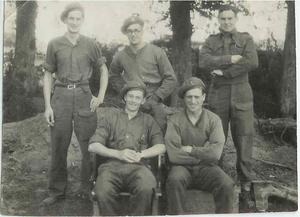
Normandy July 5th 1944 Billy Lyon (Front row, left hand side)
Billy had swapped his bren gun on the landing craft for a comrades sten gun, he thought he’d be better off with that, he sprinted up the beach flat out to make the safety of the sand dunes. They were waved forward by a camouflaged commando with a rifle aimed at a tree as they got up to advance he fired and a German sniper fell out of the tree. The first German he saw close up was a giant a really big man and Billy hoped they weren’t all that size, fortunately this one was dead with a large hole in his head.
They lived rough on the battlefields of Normandy for many weeks. During the battle for Caen Billy and his mate Fred Polly from London were pinned down all one night in fox holes in a corn field by German mortar fire. They stayed on and survived even after the enemy set fire to the corn. Billy was in the Royal Artillery and part of a special radar unit with the job of being in position ahead of the guns, but behind the infantry assault troops, to get a fix on enemy positions and send that information to direct the fire of their own guns.
They drove the Germans out of France, Belgium and Holland and arrived on the banks of the Rhine. The battle of the Rhine crossing saw Billy in position behind the advancing Argyll and Sutherland Highlanders he could hear the screams of death and mortal fear as the highlanders went in with fixed bayonets. They slept and lived in German houses many of which were stripped and wrecked by tired hungry soldiers grabbing what they wanted and sleeping booted and in battle dress. Sometimes the German families were still there, in fear of the invaders and giving up their valuable possessions,food, drink, anything to please and pacify the invader. We started getting interesting parcels from Germany.
Billy was in Hamburg when the war ended, in late 1945 he came home and was soon back to work in Pilkingtons Glass factory were he was a carpenter joiner, but it took him years to readjust and settle down to normal family life and by then their were four kids I’d been joined by two brothers and a sister between 1939 and 1946.
© Copyright of content contributed to this Archive rests with the author. Find out how you can use this.


 Recommended story
 Story with photo