

- Contributed by
- Roy Gibbins
- People in story:
- Signaller Thomas Edward Perkins 12297
- Location of story:
- Dunkirk
- Background to story:
- Army
- Article ID:
- A7061230
- Contributed on:
- 17 November 2005
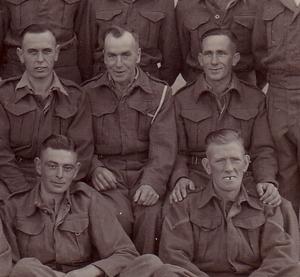
Thomas Edward Perkins seated bottom row, extreme left.
My uncle Tom was in the Royal Artillery with the BEF. During the Dunkirk evacuation they were with the Caledonian Regiment near Ypres. They couldn't understand why they were going forward when the French and the Begians were going back. They were taken at a town near Ypres and spent four years in a POW camp in Poland. The Poles in the camp were not allowed to speak Polish because the Germans couldn't understand and were paranoid that they were plotting - so all Poles had to speak German.
During the Russian advance in 1944 they were evacuated back to Germany. He was interned in Stalag XXB. They couldn't understand why they were being taken by the Germans, some of whom were undoubtedly war criminals. They decided they were being kept as hostages so that the 'war criminals' could negotiate their way out of prosecution. The forced march back to Germany took 4 months in atrociuos conditions with hardly any food. Eventually they started encountering air attacks from the allies. This told them that the 'front' wasn't far away because the fighters did not operate that far in front of the infantry. The fighters attacked anything that moved on the roads. If the attack was in a shallow dive they had time to stand in groups waving and shouting. The fighters would then usually pull out of the attack and give a wag of wings in a victory roll. If the fighters attack was in a steep dive there was no time to warn them and it was a case of diving into the nearest hole for cover. They eventually ended up in Hanover. There the Germans kept them locked up in cattle trains in a station alongside ammunition trains. The consequences of a bomber raid on the station was obvious but although the 'pathfinders' dropped flares over large areas of Hanover in front of the bomber attacks, none were dropped on the station. Eventually the allied artillery shelling came near and they knew the infantry was not far away. They managed to break away from the Germans who were no longer interested in them. My uncle ended up running approximately 10 miles towards the artillery fire and towards the allies. As they got near they all lay down in fields to wait for the infantry to find them. They knew that if they ran towards the infantry they might be mistaken for Germans and shot.
When they were captured they were marched through Germany into Poland. During the march he lived on beetroot most of the time. In the camp they were asked what their occupation had been. He was a miner but didn't want to go down the mines so he said he worked on the railway. The miners were taken to the pit head each day by the Germans and left to go down the mine with the Polish miners. Working on the railway he spent his time laying and repairing tracks under constant German supervision. He saw numbers of cattle trucks packed with human beings, seeing fingers sticking out of the slats in the wooden trucks. In Poland they could only be going to one place - the concentration camps. They received Red Cross parcels containing amongst other things soap and chocolate. The chocolate they would give to the young German children in small pieces. They hoped in this way to demoralise the parents, who could see that the prisoners had chocolate but they had none to give their own children. The soap was specially valuable, as a bribe for the German guards. They would do almost anything for soap and if the Germans got stroppy, the prisoners would threaten to withdraw the soap bribe. This brought the Germans back into line. The prisoners also had soap issued to them. This was of a particular colour (possibly green) and the pieces were stamped for identification. But for some reason the Germans would not accept this soap as a bribe. Years after the war, in a book on the Nurembourg War trials, he found out where the soap was made and what it was made from. It was made in the concentration camps from the bodies of the inmates and the guards wouldn't touch it because they knew its source. My aunt gave him a small cross to carry with him when he went off in 1939. He sewed it into his uniform to stop the Germans from pinching it and kept it during his days as a prisoner of war. After the war, when he got back he showed her that he still had the cross. Then it disappeared and when asked she said she had put it away safe. At Easter 1987, she died and when my uncle was going through her things he found the cross in the back of her purse. She had carried it with her for 40 years without him knowing. My uncle was awarded the British Empire Medal in 1971 for his outstanding work in the equipment branch of the Royal Artillery in Larkhill, Wiltshire. My uncle died in 1987.
© Copyright of content contributed to this Archive rests with the author. Find out how you can use this.


 Recommended story
 Story with photo