

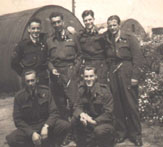
Air Gunner Tony Winser (kneeling, left) with his crew.
- Contributed by
- Clare Hardy
- People in story:
- Anthony Douglas Winser
- Location of story:
- Lincoln and North Europe
- Background to story:
- Royal Air Force
- Article ID:
- A4365830
- Contributed on:
- 05 July 2005
(continued from part 1)
“So how long would you be in the air?” I asked.
“I suppose the longest one was about eight hours something by the time I’d taken off and came back.” replied Tony. “But the times are all in there actually,” he added, indicating his log book. “But then of course, you see, we’d have to go back to the section to put all our flying kit on. We’d have our Air Crew meal before we had briefing. That was bacon, eggs, that’s all we had. That was a special for us Air Crew boys, because you didn’t get a lot of bacon and eggs. Then we’d have briefing, and then when the briefing was done, we’d go back to the section and put all our flying kit on, electrical suit, electrical gloves and flying boots and that. You used to have flying boots with straps around the ankles, and you used to pull them tight because of bailing out and everything - they would blow off, so you had to have these special straps on the flying boots. Then the crew bus would come along, pick you all up, take you round to the dispersal and you’d all stand outside the aircraft, just waiting for a red signal from the control. We got in the aircraft and they’d come along and they’d start the aircraft with a special thing they’d got. They’d have to put a pipe in and start the engines up. And many’s the time when it was a target I wasn’t very happy about I thought, ‘Oh God, don’t let one of them engines start up tonight - I don’t feel very much like going.’ But of course they’d all start up, and then you’d just taxi out, take off, circle round, and then get in position in the direction of Reading. And en route, it was probably still daylight, and you’d see all the others taking off from other airfields, they would all join with us. Well, it was a thousand bombers, it’s a lot of planes in the air at the same time. And it was all timed right to the split second. Perhaps the first wave in would be at 18,000 feet - so many aircraft do that, and then so many aircraft do 20,000 and some do 22,000 - it goes up to about 24,000 feet. And then the thing is, you’d let all the bombs go together, once you were running on your target. The bomb aimer says ‘Left, left, right, right, steady,’ to the pilot. He was giving all the instructions, you see. And in practically all of them, certainly in Le Havre, we had to try a thousand pound ‘Cookie’ bomb, which is right in the middle. It’s just like a big tank - a huge tank. There weren’t any fins on it. It used to just go down like a beer barrel and no matter how it hit the ground, it would blow up. You’d also have (it would depend how they were loaded up) so many incendiaries with it, or perhaps so many five hundred pounders or thousand pounders. And they all went together. And if somebody in the wave was not running on time over the target, you’d look up, and you could see stuff coming down. Cor! I looked up many a time to see these bloomin’ cookies, just missed us! But you see PFF, that’s the Path Finding Force, light all the target up - and when you’re briefed, you’re briefed to either bomb the centre of the red T.I.s, which is ‘Target Indicators’ on the ground, or the yellow, or the green, the blue, whatever, and you’ve got to do it at exactly that time, and then there’s a Master Bomber above you - he’s searching around all the time, and quite a way up above you, and he’s giving instructions as well, to you to say, ‘Now look, the wind has changed, don’t bomb to the middle of the red T.I.s that you were briefed upon, bomb to the left.’ So it was quite a job!”
“Did your missions all go according to plan,” I asked. “Or did you have any incidents?”
Tony chuckled. “Well, we ditched in the North Sea on the first night trip I went on. But on the way back, when you’re having your briefing, you were always briefed to look out for distressed aircraft in the North Sea, and if you spot them, you’re supposed to circle round them in the dinghy, and flap your wings, to let them know that they’ve seen you and have reported your position. So we knew we’d been spotted, but you’ve got to get out the aircraft very quickly. Once that hits the sea, and then it goes up, and then it hits again, the second time it hits, you’ve really got to get out quick. You’re all trained for ditching stations. Of course, the dinghy inflates inside the aircraft and breaks through the panel and is attached to the aircraft while it’s still there, and you all have to get out fairly quickly. And I think that was about - middle of January time. And it took us about eight hours before we got picked up. So that was goodbye to that aircraft, because that went down soon after we got into the dinghy. It didn’t stay afloat for long.”
“That wasn’t the only one, though”. Tony continued, getting into his stride. “What it was you see, when you joined the Squadron, your pilot has to go with another experienced crew on a bombing mission so he can get used to what’s going to be over the target and he’s in control. So they call that a ‘Spare Dickie’. Well, when he goes on the Spare Dickie that night, the rest of the crew are off - you can’t go without a pilot. So we’re sitting in the Sergeants’ Mess one lunchtime, - the briefing was about half past two or something like that - we were sitting in the Sergeants’ Mess, and we decided we were going to down to Lincoln because Les was going on a Spare Dickie, and we were going to have a night out down in Lincoln, round the pubs and all the rest of it. And then the tannoy went, and it said, ‘Sergeant Winser, report to Gunners’ section immediately.’ So I said, ‘I shall have to go’. So I got on my bike and biked off to Gunners’ section. And the Gunnery Officer said, ‘Oh, hello Sergeant Winser. I’m afraid you’re on ops tonight.’ I said, ‘I can’t be on ops - I’ve got no pilot.’ And he said, ‘Well, you’ve got to go with another crew.’ I said, ‘Oh dear, I don’t fancy that. I’ve been training with my pilot all this time.’ He said, ‘Well, you’ve got no option. You’ve got to go, because Flying Officer Campbell says the Rear Gunner, has gone LMF’ which means his nerve had completely gone. ‘And there’s got to be a hundred per cent take-off from us as well as everybody else. So you’ve got to go.’ I said, ‘I don’t fancy that.’ But anyway, I had to go. As I said, I knew the chaps, but I’d never flown with them. Because when you’re training, you get to know what you’re doing in the air. Anyway, that was Frankfurt. Everything was all right until we got over the target. And the flak was coming up, the searchlights were up, but there were no fighters that night. But what happened was, I heard them say ‘Bombs gone.’ And I thought ‘That’s good,’ because once the bombs go your aircraft lifts up a bit you see, because of the weight, and then you put your nose down and get out of the target area as quick as you can. And I looked out of the side of the turret and I said, ‘My goodness, I can see some smoke!’ So I said to Flying Officer Campbell, “Skipper, there’s some smoke coming up on the starboard side.’ And the Flight Engineer says, ‘Oh yes, we’ve got an engine alight.’ So the pilot feathers that engine - stops it - and there’s an extinguisher inside the engine that puts it out. Well, that’s fine, because that stopped. Then I looked the other side, and I could see some more smoke coming that side. And I said, ‘Well I’m sorry skipper. There’s some more coming the other side now.’ So that’s two engines that had gone and of course we’d only got two engines left, and our actual height that we were briefed on was 18,000, and I felt myself going back, and I said, ‘What’s happening?’ And we had gone into a dive. We couldn’t pull it up. And I was just laying there on my back in the turret, and we were going down, and I thought ‘This is it, I’ve had it now.’ And the Navigator, the Flight Engineer and the Pilot, between them, managed to pull the joystick so that we actually came out of the dive at 2000 feet - nearly there - nearly at the bottom - and of course we had to come back with two engines. We had to crash land at Woodbury which was a crash drome in Suffolk. And we had to crash land there because the skipper didn’t think we were going to get enough height or something to get back to base. He was losing quite gradually I think, and so of course I thought then, when we were diverted and crashed there, the rest of my crew would think I’d gone! I’d had it! And I was worried because my Mum and Dad didn’t know that I was flying, and I said to my skipper, ‘Well, we shall have to get in touch with base pretty quick so that they don’t report me missing, because my Mother and Father don’t know anything about this.’ And he said, ‘Don’t worry, we’ll get into the control tower and we’ll report it.’ So they did. And we had to go back the next day in a Dakota. I had to take all my guns out of the turret. You had to take all your guns everywhere, if the aircraft crashes or anything, you have to take it all back with you. You mustn’t leave it.”
“ So your Mum and Dad knew you were in the RAF, but they didn’t know you were flying?” I asked.
“Well if Mum had known, it would have killed her, what with losing Trevor.” Tony continued.
“So when did they find out” I asked.
“It was when I got home on leave after my tour,” Tony explained. “Dad was late getting home, and I was home, so I hid all my RAF jacket up and everything out of the way, and I hid under the table. It used to be a big round table. And of course Dad came in and had his meal, sat down, put his feet under the table. And then all of a sudden I got hold of his trousers and started pulling - ‘What’s that under there? Is there a cat under there?’ - And then of course I got out, and he was so pleased to see me. So anyhow, Mum went off to bed, and Dad’s sat there in the armchair and I said ‘Oh I think I’ll come up Mum. I’m a bit tired tonight, I think I’ll have an early night.’ So I followed her up and kissed her goodnight by the stairs. And I always like to have some water when I go to bed so I came downstairs and went out in the kitchen, Dad was there, he says: ‘What did you come down for?’ I said, ‘Water, I get a bit dry.’ So when I came back through, he said to me, ‘Have you finished your ops yet?’ I looked at him - I said, ‘How did you know about that, Dad?’ He said ‘I’ve known for just a little while - not long - that you’re on ops. Never mind who told me, I know that you’ve been flying on ops.’ I said, ‘Well, I’m pleased to tell you Dad that I have finished.’ He said, ‘Thank goodness for that. Better tell your mother about that in the morning.’ So I said ‘Well, I shall see about that.’ So anyhow, I was a bit late getting up, and I went downstairs. Dad was in his armchair, smoking his pipe. Mum said, ‘You’d better have your breakfast. Have a cup of tea first.’ And she was going round the living room, just dusting with her duster, you see, and she got round behind me as she was dusting, and she said, ‘Well, I don’t know, Tony,’ she says, ‘You never, ever tell us what you were doing.’ She said, ‘What on earth are you doing?’ I said, ‘Oh, just the usual, Mum, just the usual.’ So Dad said, ‘Well, now’s the chance to tell your mother.’ So I said, ‘No!’ She said, ‘What have you got to tell me?’ I can see her still with her old duster in her hand! ‘What have you got to tell me, Tony?’ I said, ‘Oh, Dad’ll tell you. I’m not going to tell you.’ So he said, ‘Well, I’ll tell you. He’s completed a tour of ops, and bombed Germany thirty-odd times.’ And she looked at me, she went white as a ghost. She said, ‘Is that true?’ I said, ‘Well yes’. ‘Oh my God!’ She said, ‘However did you do it? However did you keep that away from me like that.’ I said, ‘Well, it was for your own good, Mum.’ I said, ‘You lost Trevor, and I wanted to get my own back for losing him, and it was the only way I could get him back.’ And she said, ‘Oh God, thank goodness you’re all right.’ And I thought, ‘Well, I would never say to you, but after my six months’ rest period, I’ve got to do another tour!’ But as luck would have it, the war finished, you see. So I didn’t have to go. And Mum... she was so... she went and told everybody! And they said, ‘We know all about that, Mrs Winser. We know all about what Tony’s been doing!’ So I used to go up the Royal Oak, and I used to have drinks with people. And they used to say ‘Go on, have a drink, because we’ve got to celebrate, you know!’ Practically everybody knew! But I don’t know who told Dad. I’ve no idea from that day to this who told him, but somebody spilled it out to Dad. And he was so pleased, poor old Dad. He had a bit of a job getting around, because he had this asthma, and he said, ‘Well, I’ll tell you what. I know Mum won’t come, but I’m going to take you up to the Royal Oak, and we’re all going to have a celebration drink up there. Get all your friends - all your mates!’ There was loads of us there, and Dad was so proud in the pub. He said, ‘This is Tony, my son, who has done so well. He kept it all such a secret.’ It was really quite a nice evening, you know.”
I asked, “Do you think you were lucky to have got away with 31 ops over Germany?”
“Well, the Rear Gunner is the most dangerous position in the aircraft,” Tony answered. “And I’ve come back off ops with the Rear Gunner being hosepiped out of the turret. As soon as you get back from an op, the crew bus is there to take you back to remove all your flying kit, and your first job is to go to the interrogation room. And once you walk in there, there’s a big black board, and you had to put the pilot’s name up there, and my pilot’s name was Les Titmuss. So they used to call us ‘Tit’s Boys’! So we’d always sign in as Tit’s Boys. And then you’d go to certain tables. You’d have plenty of fags on the table. Loads of fags you used to get. Pile your pockets with them! Coffee, biscuits, and that. And then you’d go to this table, just the crew, and they’d interrogate you on this trip, and all that. They’d want to know if you’d seen any aircraft shot down, if you’d seen any in distress, or in the North Sea, or anything like that. And so that’s how it was with us.”...
(Please read part 3 for the continuation of this story)
© Copyright of content contributed to this Archive rests with the author. Find out how you can use this.



 Recommended story
 Story with photo