

- Contributed by
- Brian Brooks
- People in story:
- Harry Brooks, 'Doll', Brian and Jasmine Brooks
- Location of story:
- East Acton, West London; 'Q' Site; Abergele, North Wales
- Background to story:
- Civilian
- Article ID:
- A7440329
- Contributed on:
- 01 December 2005
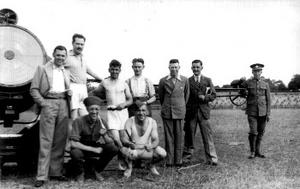
Army Camp Open Day 1938. Harry Brooks in physical training kit (squatting centre) and searchlight team. Note the uniform (on right) is still First World War pattern with ‘puttees’, canvas bindings from boots to knees. The searchlight is also First World War vintage.
SKY CROSS 1940. Each evening at dusk I was taken to our front door by Mum to see the searchlights switched on and tested. We lived at 18 The Green, East Acton. Dad was Harry Brooks, 36, (still a corporal then) with the Royal Artillery on Searchlights, Home Defence Force: a shoulder patch of a red square with black ‘Bow and Arrow’ design.
Dad’s searchlight battery was in a park to the south of us (unfortunately name unknown). All searchlights were tested at dusk and he had an arrangement with another searchlight to the west. These two lights would be switched on and form a cross in the sky, a signal to both families. It was nice to see our special signal and know that Dad was out protecting us.
They would hold the searchlight cross steady for a minute or so, and then test the lights by sweeping backwards and forwards a few times. Then they were turned off to wait for air-raids. Testing the searchlights at dusk made a nice flickering light show behind the roofs as there were a lot of them.
BLOODY LIGHT. Dad’s Searchlight crew had been made very welcome when they had first moved into the park, the nearby residents often sent sandwiches, cakes and sometimes some beer. Then the bombing started and everything changed, they were booed, fists were shaken and women wouldn’t fill their kettles. “It’s because of you and that bloody light that we’re being bombed!” shouted one woman.
LIGHT RELIEF. Later, having been made up to sergeant, Dad was transferred to a ‘Q’ Site. “Q’ stood for ‘Question Mark’ or something secret (these were later codenamed ‘SF’ or ‘Starfish’ sites). This ‘Q’ site was in farmland a few miles from a big town or factory area (he couldn’t tell me where, it was Top Secret, of course).
It was a decoy site to fool Jerry bombers. They had oil tanks and rows of pipes in a big grid and loads of burnable stuff in huge open containers. Searchlights and AA guns ‘defended’ the area.
When a Jerry raid started on the town or factories it was done by special experienced crews, then the rest of the raiders just bombed the fires. That was when Dad’s ‘Q’ site was set burning, with the searchlights and guns defending it like the real thing. The ‘fires’ would start up, and then spread and tanks of oil catch light. Water in tanks dumped into burning oil made great ‘explosions’ he said.
Dad said that it worked best when the fires at the real target could be put out quickly so that they were replaced by the decoy fires. He said that even when that couldn’t be done up to half the bombs of a raid could fall on the fake target. It sounded very dangerous to me, like shouting: “Here I am Jerry, please bomb me!” He said that some aerodromes had ‘Q’ sites with fake aeroplanes and buildings and lights that Jerry sometimes bombed and shot up.
One day he saw one of our ‘plane’s circling around looking lost, so they used the searchlight on the ‘plane to get the pilot’s attention, and then pointed towards the nearest aerodrome. Later they got a letter of thanks from the aerodrome’s Station Commander, which cheered them up as there wasn’t much thanks working on searchlights.
LIGHT CONES. Dad told me that when a searchlight found a Jerry bomber, two other searchlights would also turn to him, so that the Jerry was on a ‘cone’ of lights. As the Jerry flew on he was ‘passed along’ to the next searchlights, always ‘coned’ with three lights for as long as possible. This was to give the AA guns and fighters a good target.
Dad also said that the searchlights in use when the war started were small and underpowered. As new larger ones arrived they were teamed with old ones, one new with two old. The powerful light would pick out the bomber and the other two would follow its beam to create the ‘cone’.
Later in the war Dad was stationed at Abergele, on the North coast of Wales. Not only were they defending Wales but also guarding the approach to Liverpool Harbour, part of the Battle of The Atlantic. Most of the supplies, and later troops, from America came into Liverpool.
Once when we were evacuated in Llanelli, South Wales, Mum, baby Jasmine and me went up to Abergele to visit him. We stayed overnight at a boarding house. It was bitterly cold there, and so windy it was hard to walk along. Dad said they were stationed in a very bleak, open area and always cold.
I remember being in a very cold bedroom in a bed with a very cold satin eiderdown, and my parents, talking quietly at the foot of the bed.
Postscript: The work of the Searchlight Batteries seems to have been an unglamorous and now largely forgotten part of Home Defence and the Blitz. I suppose pointing a big torch at the enemy isn’t the stuff of heroic drama. At least the guns teamed with them got to fight back, with some success.
Yet the enduring iconography of the war with graphic artists and designers is still the simple one of searchlights against a night sky — as with the Imperial War Museum logo and BBC Peoples War site. And that’s a good and fitting memorial for Harry Brooks and his comrades of Home Defence.
Revised extracts from ‘A Sheltered Childhood ~ Wartime Family Memories of an East Acton Child’
© Copyright of content contributed to this Archive rests with the author. Find out how you can use this.


 Recommended story
 Story with photo