

- Contributed by
- Raymond E Aldous
- People in story:
- Cyril Arthur Aldous
- Location of story:
- France
- Background to story:
- Army
- Article ID:
- A4444229
- Contributed on:
- 13 July 2005
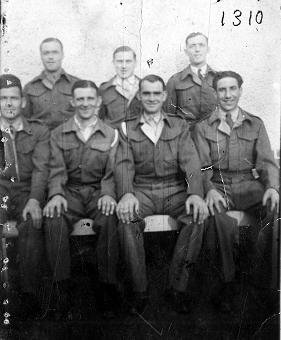
Pte C A Aldous 2nd Battalion Royal Norfolks Seated Far Right
At the outbreak of the Second World War, my farther (Cyril Arthur Aldous) was serving with the 2nd Battalion Royal Norfolk’s. He was stationed at Aldershot, and as part of the British Expeditionary Force, left for France aboard the vessels Royal Daffodil and Royal Sovereign, arriving at Cherbourg on the 21st September 1939. Then began a period known as the “phoney war” for the 2nd Battalion and my farther. This ment patrolling, digging trenches, and laying barbed wire and more hard training. He never got to see the enemy during those harsh autumn and winter months, and January 1940 saw temperatures drop to minus 22 degrees below zero. The French climate did its very worst for the Battalion, my farther going about his duties in thick snow and ice, rat infested billets, and water logged trenches, Battalion morale was tested to the limit. March 1940 the Battalion spent its time camped around Orchies but on April 9th the Germans invaded Denmark and Norway and the 2nd Battalion was put on full alert. May 15th saw heavy dive bombing attacks on the Battalions positions. May the 21st and 22nd the Germans attacked in over whelming numbers but the 2nd Battalion stood firm and drove them back. The fighting was heavy; twice more the Germans came at them but the Battalion although out numbered managed to hold the line. Some men found that they were split from their company’s and were fighting on their own, my farther being one them. Men were being captured or killed as they retreated still trying to stop the German advance. The Dutch and Belgian Armies had completely collapsed and the French overran at the Maginot line, retreating from the advancing German armoured divisions. But the position of the 2nd Battalion and the whole of the British Expeditionary Force was hopeless. In the west Boulogne had fallen and the enemy were on the outskirts of Calais. My farther remembers retreating back as far as the village called Le Paradis 2nd Battalion HQ. He and a squad of men were guarding the road to Arras just south of the village. On the 27th May 1940 one of the worst episodes in history of the Royal Norfolk Regiment took place. About 90 officers and men many wounded and battle fatigued surrendered to the N0,4 Company 1st Battalion 2nd SS “Totenkopf” at Le Paradis. They were marched down the road and into a field; they were marched beside a barn wall where two German machine guns opened fire massacring the men. Two privates survived, Albert Pooley and Bill O`Callaghan, both badly wounded they crawled from under a heap of dead bodies. They were found and tended by a French farmer and his wife but were recaptured by the Germans and sent to hospital. On returning to England they told the story of the massacre and finally brought the SS officer responsible “Fritz Knochlein” to a war crimes trial, he was found guilty and hanged in 1949. My farther and the men he was with were being driven by the Germans back towards Arras, and it was some where around there that he was wounded, captured and taken prisoner in June 1940. He spent the remainder of the war as a P.O.W and when he returned home it was then that he found out about the massacre at Le Paradis and of the Dunkirk evacuation for which the 2nd Battalion was a part of the force providing the rear guard. Although he never new privates Pooley or O`Callaghan very well he new of them and he always told me how lucky he was to have been given the job of guarding the road just two miles from the field at Le Paradis. In England after the evacuation from Dunkirk the 2nd Battalion Royal Norfolk’s numbered just five officers and 134 men; they landed in Cherbourg France with over a thousand.
THE END
© Copyright of content contributed to this Archive rests with the author. Find out how you can use this.


 Recommended story
 Story with photo