

- Contributed by
- ritsonvaljos
- People in story:
- Jean-Pierre Nogaret, Firmin Nogaret, Justine Nogaret
- Location of story:
- Badaroux, Mende, France
- Background to story:
- Civilian
- Article ID:
- A3621629
- Contributed on:
- 04 February 2005
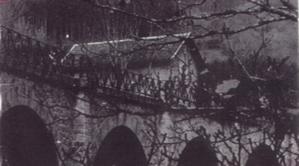
The little house beside the railway viaduct. In this house the Nogaret family who lived here used to listen to BBC News broadcasts. (Photo: J.P. Nogaret)
Introduction
This account is a brief explanation of life in Badaroux at the outbreak of World War Two and the day the German soldiers arrived in town. Mostly, it draws upon the spoken and written testimony of Jean-Pierre Nogaret given to me for a university project. I have translated some of this testimony into English, which has been used for this article. It has been submitted so that others may also know a little about events in this part of France during the war.
Jean-Pierre agreed the research could be released for sharing with others and I hope that others may be able to profit from this shared memory. I would like to thank Jean-Pierre for his kindness for sharing his memories. There is a written account in French by Jean-Pierre about his life during the wartime years. It has been translated into English by another researcher. It is entitled ‘Memoirs of a ‘Refractaire’ but has not been widely distributed.
Between the signing of the Franco-German Armistice of June 1940 until the Allied invasion of North Africa in November 1942, Lozère was in the ‘Unoccupied Zone’ ruled from Vichy. From November 1942 until August 1944 this Vichy Zone was also occupied by German troops. These events had a bearing on what happened even in small towns and villages in southern France.
Before the war
Jean-Pierre was born in April 1923, as he explains:
“I was born at Badaroux in the Lozère department, a small village that is situated 35 kilometres from Marvejols, to the east. I have three sisters. We were four children, of which three were sisters, two older than me, and one younger than me.”
Firmin Nogaret the father of the family was a railway worker. After having been mobilised in 1914, he had been sent to the Balkans seeing action in Albania and Yugoslavia, receiving a decoration from the King of Yugoslavia. After the Great War, Firmin returned to Badaroux, where he lived with his wife Justine and their children in a little house, not far from the railway tracks.
According to Jean-Pierre:
“My father was an employee on the Railways, and we used to live at Badaroux, alongside the railway tracks. The newly-built little house which you see there in the photo, that little house has since been demolished. But I was born in that little house, which was one kilometre from the village.
To begin with, I was a pupil at the village school, then at the Secondary School in Mende and finally I attended the Teacher Training College in Mende during the War. I had hobbies the same as all children of that time, especially a little bit of sport, and in particular some football. I also had a bike. But I am not a musician.”
Life in France before the Second World War was tolerable, a relatively comfortable life — ordinary — but relatively comfortable. Really, it was comfortable. We used to live well before the War.”
The importance of BBC radio
Before World War Two, there was not the same use of technology as would become the norm in later years. The Nogaret family had no fridge, freezer, television or telephone. However, like many other families they did buy a radio set / wireless before the war.
During the war, and particularly after the Armistice of 1940, the family used to listen to the BBC radio transmissions, both in French and English. In particular they wanted to hear the news from unoccupied London and the BBC was an important source of information even in the small French village of Badaroux.
According to Jean-Pierre:
“My father and my mother bought a radio set at the beginning of the War. We used to listen every day — in the morning and especially in the evening — to the BBC from London.”
Listening to the BBC was against the dictates from Vichy. So families listening in were doing so clandestinely. These families could have been arrested had they been discovered.
The Germans arrive
Between 8 and 11 November 1942, the Allies landed in Morocco and Algeria that were then part of French North Africa. On 11 November the Germans invade the French unoccupied zone in the South of France. The German soldiers who arrived in southern France requisitioned certain key buildings for their own use and expelled the existing occupants.
In a scene reminiscent of the Louis Malle film ‘Au revoir, les enfants’ the Germans arrived at Mende College to expel the staff and students. Jean-Pierre was studying at the College the day the Germans arrived. Until that day, the Germans had not been seen in that part of France.
According to Jean-Pierre:
“We had never seen them, the Germans. They came into the South of France when the Americans and the English landed in North Africa. They arrived in Mende. It was a Thursday morning. At that time, French classes had holidays on Thursdays. It wasn’t on a Wednesday like now, but it was on Thursday. And the Thursday, we used to work in class, to be sure, but there hadn’t been lessons. And it was a Thursday morning, at the beginning of November.”
The German officer in charge just gave the order they had only hours to evacuate. Once the Germans had moved in, anything was also taken over. Jean-Pierre and his fellow students did manage to rescue the coal that was used to heat the college. Fuel was critical for heating buildings so nothing could afford to be lost.
Conclusion
Not long afterwards, Jean-Pierre went into hiding to avoid being sent to Germany under a Compulsory Work Order, known in French as STO. Although not a member of the maquis (French Resistance) Jean-Pierre became a ‘Refractaire’. He had to live under a false identity. With assistance from others and some good luck he managed to survive until the Allies liberated southern France in late August 1944.
© Copyright of content contributed to this Archive rests with the author. Find out how you can use this.




 Recommended story
 Story with photo