

- Contributed by
- Audrey Lewis - WW2 Site Helper
- People in story:
- Barbara-von Thadden and family.
- Location of story:
- Pomerania, formerly Prussia, now Poland.
- Background to story:
- Civilian
- Article ID:
- A8683527
- Contributed on:
- 20 January 2006
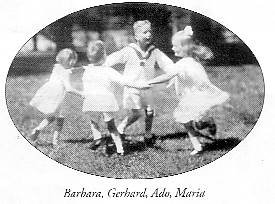
Barbara, Gerhard, Ado, Maria
Continued from part eight -
“A day or two later my mother was taken to our relatives in Trieglaff, where she stayed for a few days.”
“I stayed on in Vahnerow but I walked the 2km across the meadows to Zimmerhausen as often as I could get away unseen, to bring the things I had rescued for my mother. We heard that there were safe trains to the west. The Germans were to be taken to a collecting point, and from there they would be taken to the British Zone in Germany. It might be a week or two before we could be on a safe train. I was to join them on the day before the departure.”
“Because I had saved more things than we could possibly carry between us, we decided that I should drastically reduce our belongings and perhaps sell some things so that we would have some zlotys. I went to Greifenberg to ‘sell’ her coat, we felt sure that it would be taken from us on a ‘safe’ journey and she would not wear it openly. It was very big and heavy as well. Sadly, I got pathetically few zlotys for it, but I was able to buy a few provisions for the journey. Ado had told us that the old German money was still valid in the west, but we had none. Leni came and gave us 1000 —RM of her money — ‘just to help a little once we got to Gottingen’ she said. Her unselfish help knew no end!”
“I still had too many things in my room in Buth’s house and still more were hidden in the garden house and lay buried in the sand in the shed. These treasures were rather more valuable and they had not yet been discovered. We discussed it with my mother who readily agreed to my plan. Once it was really dark, I would spend several evenings in the following week to visit all our families to give them some mementoes from us. Meissen plates, some silver spoons or knives, or some towels or bedding or linen, and I wrote a card for each of them, thanking them on behalf of my mother and our family for their loyalty and affection. If they felt that they could not keep the things then they could sell or exchange them for something else in the town. Life was getting more and more difficult and the winter was bitterly cold in January 1946. To talk to the families on my evening visits that were suffering so much hunger, illness and deprivations of all sorts was very hard for me. My mother had imagined that our staying in Vahnerow with all the suffering it meant would be the saving of all of us. Now I realised that we had achieved nothing at all. The future for all our people in the village was much bleaker than for us, because we had relatives in the west, but they had nobody there at all.”
“When my mother told me to come I said goodbye to Buth and his wife and Hannchen. They had been so kind and helpful to me and it had been brave of them to shelter me for four weeks. I shouldered my last bundle and walked across the wintery meadows to Zimmerhausen again. I looked back to the village. I felt nothing at all. It was no longer our home, it was so changed that it no longer seemed to mean anything at all to me. I never wanted to see it again. I did not cry. After all the bad months my heart was cold and empty.”
“I moved into Brigitte’s room and shared my mother’s bed, but the safe train which we had been promised and which was to leave in a day or two did not materialise for two more long months. Brigette and I worked in the gardens. Our household had one enamel bowl, which was used for everything. We washed ourselves in it, we washed our clothes in it, it served as a mixing bowl for the rather wonderful piroggen my mother had learnt to make in Greifenberg in the lieutenants house and we heated water in it on the little wood-burning stove. We cooked on that stove as well, Brigette had some pans. Our toilet was a bucket outside the room in the attic, this we had to carry down as well. Every day we hoped to hear that we were going to leave.”
“Mother persuaded Brigitte to leave with us telling her that her husband, when he came back, would be able to find her.”
“Tante Liesi, Rudolf and an elderly aunt left Trieglaff in January. Renate and Ilse von Senfft had gone, but Tante Oda von der Marwitz was going to come with us. Leni wanted to stay. She was still performing all the duties of a parson, a nurse, a doctor and an undertaker and she did not intend to leave until she was no longer needed. She was the last of the Thadden family to leave the villages which had been ours for hundreds of years.”
“Ado visited us once or twice. He was still restricted in what he could o, but he managed to get a permit to come and see us. He was earning some zlotys, cigarettes and food by playing the piano in somewhere like a pub in the evenings. He was a very good jazz player and he found other things to do to keep himself occupied. He hoped to get away soon, but he could see no chance to come with us, because he was not allowed to leave Naugard.”
“At last we got word about a safe train and we could leave, only three of us. We went quietly, before the village woke up. We climbed onto a horse drawn wagon and set off into the early dawn. We went past the destroyed castle of the Bismack’s in Plathe. In the unkempt messy park I could see pieces of broken furniture and sodden, torn bedding lying about the grass. How beautiful the park had been when we were walking around in it the afternoons when Grafin Bismarck had invited us children to tea. Those annual visits in the summer had been highlights for us. She had a room full of shelves with fascinating silkworms and she showed us the mulberry trees, which supplied the food for the mysterious creatures in their boxes. The lawns went down to the riverbank of the Rega. The castle was not very old but I remember it having some very fine rooms, and there was a butler and of course we were on our best behaviour.”
“On this morning in March 1946 we joined several groups of people sitting on their belongings outside the station in Plathe. Gradually more people arrived, each group accompanied by armed Polish soldiers. Tante Oda joined us with her bundle. After a long time we were taken to the train and counted into cattle trucks, 40 people to each wagon. ‘That’s how they took the Jews to the camps’ whispered my mother to me. She had seen one of those trains at a station in Berlin. It took three days to travel the 80km to Stettin! We were never allowed to get outside. There was nothing to eat or drink but what we had brought with us. With armed soldiers we were hurried out of the train at last and we walked a long way from the place where the train had stopped to a big, fenced off building in the outskirts of Stettin. There we were scrutinised at the gate and asked about the things we had in our bundles or sacks. We were lucky, nothing was taken from us and we did not have to open our bundles. That was a relief, because into the big old sack, which we carried between us, we had stuffed my mother’s silk eiderdown. We were then led into the building which had been a Savings Bank but which was now completely empty. In a corner of a big room we settled down and waited. We stayed there for a week. UNRRA had supplied dried soup for us which was boiled in large pots in the yard and we queued to get a watery bowl full. There was nothing else all week.”
“The younger ones among us were called to work every morning and we had to march to the river where we had to remove the large concrete remains of a blown-up bridge. This was terribly hard work because we only had our hands to shove and heave the chunks along and up the steep bank. The Poles delighted in shouting abuse at us. Brigitte and I stayed together while my mother and Tante Oda sat on our bundles and on the eiderdown sack to guard them from intruders who often wandered into the rooms. I remember the hunger, and I vividly remember one evening when I sat talking to Tante Oda. She described in great detail how to arrange a dinner party and what one ought to offer, from entrees and soup to fish and meat, which vegetables required which sauce and what dessert should follow which dish. She explained how important it was to combine the right colours and textures with the right flavours, and she created for me a wonderful phantom dinner. For a short time we forgot our dreary condition and our empty stomachs.”
“At long last we were taken to the station and put into cattle trucks and the train took us to Rendsburg in Schleswig-Holstein. This journey took ‘only’ two days. The refugee camp consisted of large, low barracks. Families were given a little privacy by curtains made of grey army blankets, which hung from the rafters. We were received with great kindness and sympathy, the buildings were warm and we were given good food. We were allowed one free telephone call and we were able to speak to Mona and Atti. We hoped to leave the camp very soon. As soon as we registered my mother tried to get an interview with the English officer who was in charge of the camp. But although we stayed in the camp for several days and although there was some initial interest in this English lady, she was never called. She felt that the world should be told that we had been expelled and that we had not left voluntarily, no matter what papers we had been forced to sign.”
“We were given travel documents once we assured the authorities that we knew where we could go. There was a train with seats, which first took us to Hamburg, where we arrived towards evening. We parted from Brigette who wanted to go to Nienburg to join her family. I was sad to see her go. In spite of our cramped life in her room and the long frustrating waiting time, we had become close friends and had enjoyed each other’s company. I do not know what we would have done if we had not been able to stay with Brigitte.”
“My mother and I found nowhere to stay in Hamburg. It was getting dark and cold by the time we found an even darker, dank, cold air raid bunker, which was turned into accommodation for people like us. The city looked awful, it had been so badly destroyed in countless air raids. My mother coughed all the time; the bunker was an appalling place. In the morning there was a crowded train, which took us as far as Bremen. As there was some time we called on some friends of my mother’s. Although surprised and probably taken aback by our appearance, they were very sweet and concerned about us. They shared their lunch with us and we were able to wash. We heard that our brother Gerhard was dead. We were shown a letter that said that he had been murdered by unknown men on October 2nd, last year, more than five months ago. Why Gerhard? ‘Why not me?’ He was the best of all of us, kind and gentle, intelligent and understanding and compassionate, who was loved by everybody. Every time there was some light shining in from the outside, I could see my mother’s distraught face and her tears streaming down.”
“It was late in the evening when we reached Goettingen. We walked slowly up to the Herzberger Landstrasse, through the town, which was so familiar to me from my schooldays, it was miraculously quite undamaged. There was no one around, it was still the time of curfews and that was the reason why the family could not come to meet us at the station. Our luggage seemed to get very heavy. When we finally arrived, everybody was there to greet us — Maria, Mona, Atti and Eta. We all cried as we hugged each other. Now Eta had to feed two more mouths and accommodate two more people in the house now bursting at the seams with seventeen relatives and friends. Uncle Percy was still away, he was held as a witness at the trials in Nuremberg. The boys were there, Jost had come home after he had been a PoW with the Russians.”
“In the train from Bremen my mother had said to me that it had been the thought of wanting to see Gerhard again that had made her determined to stay alive when she had been in that terrible cellar in Trieglaff, with her teeth broken and her body bruised.”
“My mother told me never to talk to the sisters or to anybody else about our experiences under the Russians and Poles because nobody would understand what we had gone through if they had not been there themselves. When my sister arrived without me, they thought that my mother had ‘kept me’ in Vahnerow.”
“I stayed because I knew I had to stay, and that was that. Never before or after had I been so close to my mother. She told me about herself, about her life with our father and about her childhood in Hanover, stories which I did not know. My mother had been quite amazing in her courage and strength. Because of her protection (and Ilse’s saving me in the garden house) I was never raped. In fact I know that I was the only female in Vahnerow who escaped that fate.”
“I am glad my father did not have to see the end of our life in Vahnerow. He did not live to see what Hitler’s rise to power would mean to Germany and to us. I do not think that any of us could have foreseen such an end, the collapse of everything that generations of our family had valued. What was left? Materially hardly anything at all. In human terms our losses could not be measured. Elizabeth was dead. Gerhard was dead. Brigitte’s husband died in a Polish camp. Her eldest brother was killed in Russia, her father never came back. Reinold came back from the camp near Murmansk with an unbroken spirit, but his health never recovered and he suffered from cancer-related problems of the throat until he died. Three of his five sons were killed on the eastern front. Two of Anza’s three sons, both in the navy, were lost at sea. My mother’s indomitable spirit never came back in full. Maria was the only one of us siblings who was able to finish her studies with a Ph.D in history of art in Bonn. Mona, Atti and I had to get what training was available, without money everything was very difficult. Life after the war became very different for all of us who were refugees, or who were expelled people like my mother and I. The fact that there were 10 million or us who had to leave their homes and come to the west must have made it all a bit easier, because we felt that we were not isolated cases. We all had to make a new start. We were able to set off to new beginnings.”
Conclusion in part ten
© Copyright of content contributed to this Archive rests with the author. Find out how you can use this.


 Recommended story
 Story with photo