

- Contributed by
- happyHARRY_H
- People in story:
- DAVID JOHN HOSKIN , RUTH HOSKIN
- Location of story:
- DAVIDSTOW CORNWALL
- Background to story:
- Civilian
- Article ID:
- A4929825
- Contributed on:
- 10 August 2005
Where is this German POW today?
North Cornwall
In 1941, Davidstow, now famous for cheese, had a population of some 400 scattered over an area of ten square miles. It was considered an ideal spot to receive evacuees. I, then aged 6, lived in a three bed roomed cottage with my parents and a lodger. We were allocated three official London evacuees, a mother with her two daughters aged 8 and 12. Shortly afterwards due to my grandparents temporarily not being able to cope with all their allocated evacuees we were joined by an infirm couple in their eighties. All these people had ration books. There was a heavy air raid on Plymouth and ten of our relatives turned up on our door step some having been bombed out, including a very young baby. These people did not have ration books. After three days three were found a bedroom in a nearby house but still ate with us. Finding food for everyone became a serious problem although we kept our own hens and could get some milk from nearby farms and smallholdings.
During this period I walked about one and a quarter miles to school attended by some thirty five local children which suddenly jumped to ninety three following the arrival of evacuees. The local children brought Cornish pasties and the evacuees in the main brought sandwiches.
My father died suddenly on 6 January 1942. He had been badly wounded in the First World War. We still had three evacuees and a lodger in the house. It was decided that my mother’s parents should come to live with us. My grandfather who had reached age 60 would let his farm.
Radar had not been developed at this stage and apparently it was impossible to have fog on Davidstow Moor, nine hundred feet above sea level, and at sea level where there was an existing aerodrome some thirty miles away at St. Mawgan. Hence work started to build runways. Following my father’s death my mother, Ruth, was entitled to a state pension of ten shillings a week with a further five shillings for me. She got a job at a quarry checking the number of lorry loads of stone taken for the construction of the runways. In the meanwhile my grandfather took steps to let the farm. He was approached by Claude Sellick the head of the construction firm that was building the aerodrome. Although I think it was extremely unlikely that he would be called up for military service at his age, he wanted to make doubly sure by becoming a farmer, a reserved occupation. Consequently he employed my grandfather as his farm manager on the farm he was renting from my grandfather. As time progressed more of the lorry drivers and other construction workers were called up for military service and my mother found herself taking on some of their jobs including driving a road roller.
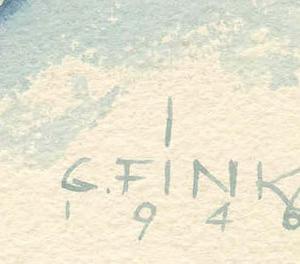
When the aerodrome was completed the contractor ‘farmer’ asked my mother to help her father on the farm, which was specializing in pigs. The ‘War Ag. Committee’ decided that one field needed draining and this was suitable work for Prisoners of War. My mother was given the responsibility of organizing them. As far as I remember there were two teams of Italian prisoners and later one team of Germans arrived just as the war was ending in 1945. One of these German prisoners did a watercolour of me (see picture). He signed it “G FINK” and dated it one year later (1946) presumably so no one would guess that it was painted when he was a POW.
In the meanwhile the RAF had arrived including a girl of 19, Sybil Mullins, who knew some friends of ours from Wells. She used to come to our house together some other RAF men and women. She worked on the maintenance of the airplanes. She was killed when she was in a plane that crashed locally. We were aware of some six planes that crashed nearby during the operation of the airfield.
We could see the RAF sickbay from our bedroom window and at least one observation post. One day my great aunt, who was staying with us, focused her opera glasses on this post only to see that she was being observed by them in her nightdress.
© Copyright of content contributed to this Archive rests with the author. Find out how you can use this.


 Recommended story
 Story with photo