

- Contributed by
- familyshortt
- People in story:
- Philip Pengilley
- Location of story:
- Henley-on-Thames, Oxfordshire
- Background to story:
- Civilian
- Article ID:
- A6385520
- Contributed on:
- 25 October 2005
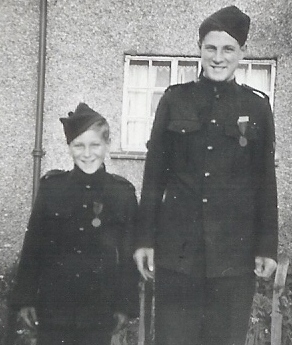
Philip Pengilley, aged 10.
This photograph shows me, Philip Pengilley, aged 10 and my elder brother Roy, taken in 1939. The uniform is of Henley-on-Thames Trinity Hall Lads Brigade which was given out for monthly church parades and the annual camps which were mostly taken at Beachy Head, Eastbourne.
If memory serves me right, this last camp before the outbreak of war, was also taken at Beachy Head, though it may have been at Felpham, near Bognor Regis. A band always led the various parades and consisted of drum and fife with buglers and bagpipers. The ‘gongs’ worn were for progress in music, in both cases here, for the flute. Jack Banbury was bandmaster, assisted by Charlie Bund. Charlie Piper was in charge overall with ‘Ginger’ Talbot second in command.
I was told war had been declared on my way home from singing in our church choir by an older boy, at least 13-years-old, and told to hurry home. Things began to happen with the building of shelters in some roads (in the centre of Station Road for instance) and in the National School’s gardens, the issuing of gas masks and the arrival from London, (shouted ell-oh-en-dee-oh-en) loud and clear, of the first group of young evacuees.
Our schooling was put out of kilter with Henley Grammar and North Henley High sharing the same building until they moved up to Park Place. Education itself suffered problems with teachers entering the Forces and a general lack of replacements, - quite often a senior prefect sat in for a missing tutor. With the sounding of sirens we had to troop into shelters which had been built on the girls playground, no mixed playgrounds in those days, though thinking back the the school building with its many corridors and stairways was a stronger refuge than the shelters eve would have been.
A searchlight battery with sound location equipment was set up at Bolney, near Shiplake and the ‘Border Boys’ were encamped at our own Trinity Hall in Harpesden Road. Ration books were issued and then nothing happened for a while.
The air war began to get under way with the bombing of London and living, as we did near the War Memorial Hospital, at night the sky over White Hill direction (at Park Place, where some of the evacuees were billeted) was lit from the many fires. During the day barrage balloons could be seen in the sky in the same direction.
Later at night it was a common thing to lie in bed and listen to the sound of German bombers with their unsynchronised engines wending their way north to bomb the Midland areas. Henley had about three bombs in this time which fell at Gillott’s Corner, doing little damage.
The tempo of the war quickened when the Americans began to arrive, troops being billeted in hutted encampments in the grounds of Phyllis Court, Shorlands Meadow, Dry Leas, Henley Town Football Club and other spots.
While we were at school one day a Wellington, flying low, hit trees close by, crashing into Abrahams Meadow, killing it’s crew. Photo Reconnaissance aircraft were also flying very low up and down the Thames Valley, quite often being below tree-top height.
With the daytime/night-time bombing of Germany commencing it was a common sight to see badly damaged American aircraft making hard work of getting back to their bases during the day and one in particular flew round and round Henley before crashing into the backwater at Wargrave. My mother was in tears about this as my brother Roy, by now after pilot training in Canada, was a Flight Lieutenant flying Lancasters over Germany and she must have thought this could happen to him too. In the evenings the skies seemed full of Lancaster and Halifax aircraft making their way out to Germany to continue this round-the clock activity.
Being a member of the Henley 447 Air Training Corps by now and having attended various aerodromes and camps, it used to make us ‘old sweats’ smile to see but not hear our American allies march in their soft shoes.
Henley had it’s one and only flying bomb (a doodlebug)about this time which landed in the Stoke Row area and also a V2 which made a nice hole at Upper Culham but the war was coming to an end when once again the sky was full of aircraft. Dakotas towing one glider, Stirlings and Halifaxes two, all on the move towards Arnheim and Nijmegen. The round-the-clock bombing of Germany continued.
So came VE Day and the various Victory parades and parties and my signing on under the Boys’ and Girls’ Registration Act for later National Service. On reflection, with the number of people who were killed during this Second World War, I can only think of one lad I knew personally and can put a name and face to about six others.
We must have been a rather war-like family. — My father and three of his brothers went through the 1914-18 war. My father was a Territorial with the Oxford and Buckinghamshire Light Infantry (the P.B.I.)taking part in trench warfare as did another brother in the same regiment. Another brother was in the ‘Queer Objects On Horses’ (the Queen’s Own Oxfordshire Hussars). The fourth brother transferred as a mechanic to the Royal Flying Corps. They all survived that war. My father carried on his activities during the second war, on fire-watching duties and teaching the Home Guard to shoot. He could still ‘hit a pin in a tree at 100 yards’.
My generation saw my brother flying Lancasters, brother-in-law flying as a navigator/observer in Liberators of Coastal Command and cousins in the air-force in the Far East. My sister-in-law was a plotter in the Womens Auxiliary Air Force. at Tangmere. I, too young for war service, went into the Air Force for National Service, becoming a Flight Mechanic (Airframes) on Spitfires for 541 Photographic Reconnaissance Unit Squadron at R.A.F.Benson., finishing up on the station snag gang, ensuring the planes’ airworthiness. My other brother-in-law of my age went into the forces in the Light Infantry, finishing up in the Far East. Also it seems to be following family traditions — my nephew, my brother’s son, flew as navigator in Vulcan bombers.
© Copyright of content contributed to this Archive rests with the author. Find out how you can use this.


 Recommended story
 Story with photo