

- Contributed by
- PeterThorn
- People in story:
- Douglas Thorn
- Location of story:
- France 1940, UK 1940-45,Germany 1945
- Background to story:
- Army
- Article ID:
- A7780719
- Contributed on:
- 14 December 2005
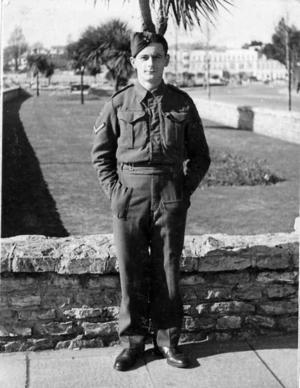
Lance Bombardier Thorn on his honeymoon in Torquay February 1944.
My father told me a few stories of his time in the army but regretfully I never learnt or asked specific details of where he was and what units he served with. More recently I have tried to add dates and places to the stories and put them into some sort historical context. I asked more questions of my mother, obtained his military records and by researching the period through literature and unit war diaries learnt a lot more about the post-Dunkirk activities of the British Army in France. Although not complete this is what I have on his military career and concentrate on the short period he was with the B.E.F. in May/June 1940.
He was conscripted on the 16 July 1939 and was in the first batch of 34,000 20-21 year old men called up to the Militia under the Military Training Act, April1939. After a period of training he was posted to 307 Battery 37th Searchlight Regiment Royal Artillery. With great help from Firepower, the Royal Artillery museum, I was able to consult the War Diary of the 307 Bty/37th S/L Regt for the period it was in France in 1940 and a summary of its activities when it was part of Britains A/A Defences.
The 307 S/L Bty was sent via Dover to Dunkirk on the 18 May 1940 and immediately moved south but were unable to reach their destination of Etaples that night because of congestion caused by refugees. These newly arrived troops must have wondered what they were letting themselves into. The following day they crossed the Somme and reached Le Havre on the 19th May. The Germans reached the Channel at the Somme on the 20th and thus the 307 Bty narrowly avoided being trapped in the Dunkirk pocket or worse still being caught by the German Panzers while in convoy. After a couple of days of strange movement orders back and forth across the River Seine the 307 SL Bty set up as part of the air defences around Le Havre. On the 30th May the battery fired at its first aircraft without damaging it, which was lucky as it turned out to be French. Hostile raids soon became a regular occurrence. The first of my father's stories tells of him manning a Lewis gun when a German plane suddenly appeared very low through a gap in the cloud. He said neither he or the plane fired because they were either too shocked or scared,the plane soon cleared off. One evening my father’s SL troop spotted a submarine or boat signalling to someone onshore but despite searching no sign of anyone was found. The unit War Diary makes several references to parachutists being dropped but no one being found by the search parties, there is definite sense of tension and this increases after the final Dunkirk evacuations. My father told of soldiers becoming emotional and increasingly nervous as the Germans approached Le Havre. 102 men of the battery were sent as reinforcements to a Royal Fusilier battalion defending the town. On a lighter note my father describes with a certain relish, it appealed to his anti-establishment nature, smashing up his troop’s vehicles and equipment prior to evacuating Le Havre by boat to Cherbourg on the 11/12 June as part of Operation Cycle. The rest of the battery managed to cross the Seine with much of their equipment. The battery re-assembled on 14th June at a camp just outside Rennes. An eventful train journey brought the those who were landed at Cherbourg. In these final few days of the BEF in France the 307 Bty was evacuated via various ports St. Malo, Brest and St. Nazaire (part of Operation Aeriel). It unsuccessfully tried to bring some searchlights and vehicles back to Britain when a convoy was sent to Brest. I believe my father evacuated via St. Nazaire as he maintained that he narrowly avoided boarding the Lancastria and that after its sinking he was ordered not to speak of the disaster when back home. My father arrived back in the UK on the 19th June and rejoined his battery at Taunton, the unit suffered just two casualties in France. The unit War Diary for this period does give a strong impression of the confusion the BEF was experiencing during this period.
The battery then formed part of the Air Defence GB and was stationed in the South Wales / Welsh Borders area. Here my father met my mother who was working in a factory making guns such as the Bofors. In May 1942 he was re-classified from A1 to A2 fitness because of flat feet, because of army boots he said. He drew extra pay by acting as cook at one of the SL sites. In December 1943 he was promoted to Lance Bombardier possibly because a senior officer noticed how his searchlight kept a German plane in its beam for a long time, it did not get shot down though.
As the German air threat declined many in Anti-Aircraft command were transferred to other units. In my fathers case he was sent to the Royal Army Service Corps in December 1944, reverting to Private, to train as a fitter (petroleum). He was sent overseas on the12th April 1945 and ended up in Hamburg with Montgomery’s 21st Army Group. One story he has from this time was while on guard duty at night challenging what he thought was someone coughing, after some time he realised it was a cow. He returned to the UK on the 15 January 1946 and was demobbed in March 1946. He never claimed his war medals and was finally discharge from the Reserve Liability in 1959.
© Copyright of content contributed to this Archive rests with the author. Find out how you can use this.


 Recommended story
 Story with photo