

- Contributed by
- loyalsmiths
- People in story:
- Amelia, Harry, Esther, Henry and Betty Smith. Elizabeth Harbour, Lila and Harold Hunt.
- Location of story:
- East Harling, Norfolk and East Ham, Essex.
- Background to story:
- Civilian
- Article ID:
- A6911318
- Contributed on:
- 12 November 2005
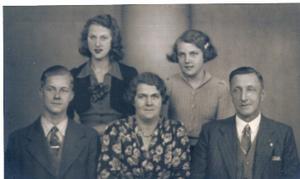
Taken at Edwards and Co. 216 High Street North, East Ham E.6 (1943)Esther and Betty Smith (Back Row) Henry Smith Junior with parents Amelia (Milly)and Henry Smith (Harry).
My name is Winifred Elizabeth Shillingford (my maiden surname was Smith). The war started a few days’ before my 10th birthday. I was born in East Ham Essex on the 12th September in the year 1929.
My father Harry Smith was already in the Civil Defence which was formed before the official declaration of War on 3rd September 1939. I have his Invitation to the Stand-down Dinner and Concert given by the County Borough of East Ham Rescue Service dated 28th July 1945. He was in the Heavy Rescue for all of that time. He never spoke of his experiences during those years of conflict but the men of the Heavy Rescue played a very important part in the Home Front Effort.
My mother was born in a small village in Norfolk and when the evacuation commenced she took me and two more friends to stay with my Aunt Lila and Uncle Harold (Ally) Hunt and my Grandmother (Elizabeth Harbour nee Wilson) in East Harling, Norfolk. My two friends were not very happy and after only a few days sent letters to their parents to say they wanted to return home. My mother came and took them back to East Ham. I was very familiar with my Grandmother’s home as my sister and my brother and myself spent all our summer holidays with her. The cottage did not have the convenience of running water or a flush toilet so I expect my friends would not have liked that at all!!!
I distinctly remember the inside of East Harling village school. My teacher's name was Miss Wiggett (she had previously taught my mother who was at the same school from 1908 to 1916). Strangely I cannot remember any of the lessons only that I went to school there. I took my 11+ but cannot remember the content of the exam at all — but I do recall going into the playground for a break. When I sat the 13+ exam after returning to East Ham I can remember one test paper which I think you would call an intelligence test. You had to pick out similar shapes or sequences of numbers etc. I do have a programme dated 1940 for a Speech Day held at Harling Council School and I won a Class Prize which was presented by Lady Chrichton-Browne. Although my Mother and Brother spent several months with me at my Grandmother's I cannot recall any special event in the cottage which included them. I can remember doing my ironing with a black metal iron which was heated next to the open fire. I was very good at knitting and I used to spend the long dark winter evenings knitting garments for nearby neighbours. I expect they gave me a few coppers for my trouble. There was a neighbour who lived just across from my Grandmother's in a thatched cottage. The path was lined with box privet which had a very distinctive smell — he had a small sweet and tobacco shop which probably used to be his frontroom. The sweets were put into threecorner bags and the top flap was folded over. This was at the beginning of the war but later on Wool and Sweets would have been rationed. You were able to buy darning wool which was cut into long lengths. One of the War Mottoes was ‘Make Do and Mend’.
I do have a distinctive memory of listening to the news on the wireless and in the background I sometimes heard the sirens sounding in London. Another sound I remember vividly was the deep throaty noise of the Flying Fortress planes, manned by the US Airmen, which flew regularly over East Harling on their way to and from the bombing raids over Germany etc.
I can remember going to the small general store which sold everything. My ration book number and Identity card Number was TSDF 159 4, my Grandmother and Aunt and Uncle would have been the same but the last number would have been 1, 2 or 3. These must have been issued after I went to live in East Harling as my Parents, Brother and Sister had a different sequence which was CANS 24 1,2,3 or 4. The ration book was very important and had to be taken to your local grocer to obtain your rations. It had to be marked off and you were allowed a certain amount of rationed food each week. I always remember it was one shilling’s worth of meat per person per week (5p). Clothes coupons were cut out and removed by the shopkeeper. It was during the war years that the weight of a large loaf of bread was reduced from 2lbs to l 3/4lbs. One can never forget the oblong cardboard box which contained our gasmask. You had to have it tested to make sure it was airtight and this was done by holding a piece of card near to the bottom of the mask and as you breathed in your inhaling would hold the card in place. (I think I have that right).
I can recall the milk being delivered by pony and trap and ladled from the milk churn into a waiting jug. The baker used to deliver the bread and sometimes a small cake. If you were very lucky you would find some fruit in your slice of cake.
During the time my mother was with me in Norfolk I sometimes used to go with her to Larling where she worked as a cook and general domestic help for a business couple. The wife was Headmistress in Larling School and the husband was a poultry farmer and kept hundreds of chickens in sheds. I used to go with him and help to collect the eggs. In front of each hen box was a wire mesh, and every time you collected an egg you had to move the wooden peg up one, to keep count if the hen was a good layer! Presumably if it was not it had to go! I suppose in my ignorance I thought little of the comfort of the poor hens.
My Mother and Brother Henry spent about a year with me and also my Sister Esther came for a few week's respite from the Blitz in London where she worked as a telephonist for Lambert Brothers. I do remember that one of the teachers at the village school a Mr Buck took a shine to her (he had a car which was unusual in those days). I think they did go out a couple of times but my sister already had a steady boyfriend Ernest whom she married in February 1944. While my brother was staying in Norfolk he went to work in Attleborough at Bulmer’s Cider factory. During one day a lone German Bomber decided to unload his bombs over Attleborough and they fell on the Cider Factory. My brother escaped the building down a staircase filled with smoke but unfortunately one man was killed.
I returned to East Ham in April 1942 and continued my schooling at Hartley Avenue School. The memory that stays with me on that occasion was how small and cramped the terraced houses appeared — all squashed together with no room to breathe. For a few days in 1943 I kept a diary on 24th January I made the entry “Couldn’t go to church because of time bomb in Barking Road. Went to see Grandma”.
On 19th February 1944 my sister Esther married her sweetheart Ernest Murray Barley — he had recently returned from the fighting in North Africa where he served in the famous “Desert Rats” under Montgomery (in time to join the D-Day forces although we did not know that then - we were all relieved to have him home safely). In spite of the rationing of food and the clothes coupon restrictions we managed to celebrate the wedding. My mother was a dressmaker and the material for the five bridesmaids was acquired from Green Street Market at Upton Park. My sister did buy her Wedding Dress from the West End and as my mother was working at a Baker’s shop in East Ham we were very lucky to have a real wedding cake. Neighbours rallied round and gave up some of their rations for the reception which was held at our home in Lawrence Road. My brother was best man and was home on leave from the RAF but he should have gone back to camp on the 18th February. He took a chance and went AWOL for 24 hours and of course was given detention when he got back to his barracks.
On 6th June 1944 the historic D-Day Landings began. My new brother-in-law was drafted to France on D-Day six. My brother was in the Air Force but still training for Air Crew as a rear-gunner. On 16th February 1945 he was posted to 106 Squadron at RAF Methringham and engaged in Operational sorties to Germany and Denmark in Lancaster ZN/G “G” for George — Motto — “George Can Do It”.
A few days later on 12th July 1944 the first VI better known as the Flying Bomb or Doodlebug landed on South East England. We used to get an Air raid Warning for these Bombs as they could be spotted on the coast as they approached England and one could quickly get to the nearest Air-raid shelter. When the V2s were launched in September 1944 they only took a few minutes from launch to impact to reach their destination. No warning could be given for these rockets and I remember our family slept down the Air-raid shelter which was in our back garden every night. That would be myself, sister and mother and sometimes my father when he was off duty. My sister also had to be engaged in the War Effort and she worked at Plessey in Ilford making Aircraft radio sets and then transferred to Gants Hill as a Capston Machine Operator. Before this she was working at Lambert Brothers in London until May 1942 which covered the period of the dreadful Blitz which started in August 1940 and carried on for several months. Not only London but many other major cities in Britain were heavily bombed.
My out-standing memory of the D-Day era was the continual stream of Army Trucks filled with soldiers that made its way down East Ham High Street to the Woolwich Docks. The grateful residents threw food and cigarettes into the back of the trucks. I was working as a Saturday girl in Allardyce Baker’s shop in East Ham High Street and had a first hand view. I was attending a College in West Ham at the time and when the Siren’s sounded we had to go down to the basement where the Laboratories were situated and sometimes were greeted with obnoxious smells from the Students’ experiments.
We had a map on the wall in our “middle room” in Lawrence Road and as our troops advanced across France and eventually into Germany we moved our row of pins. The Russians were advancing into Germany also and the gap between the two armies gradually became smaller as both armies advanced towards Berlin. My sister still has this map.
My memories of the end of the war are not very clear. I certainly remember dancing in the street but cannot remember who with or which particular road. I do remember our Street Party and the tables stretched down the middle of the road outside our house. I do wish we had photographs of this wonderful occasion but cameras were not an every day possession in 1945.
Betty Shillingford - Saturday, 15 October 2005
© Copyright of content contributed to this Archive rests with the author. Find out how you can use this.


 Recommended story
 Story with photo