

- Contributed by
- actiondesksheffield
- People in story:
- Vivienne Smith, George Smith
- Location of story:
- England, Italy, Germany, Poland and Pantelleria
- Background to story:
- Army
- Article ID:
- A4451618
- Contributed on:
- 13 July 2005
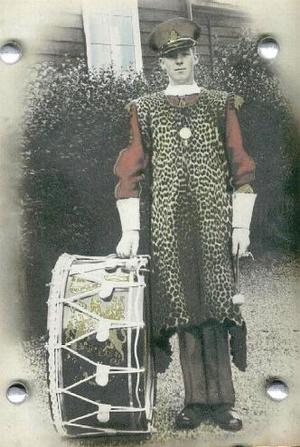
George's Army Picture
This story was submitted to the People’s War site by Bill Ross of the ‘Action Desk — Sheffield’ Team on behalf of Vivienne Smith, and has been added to the site with her permission. The author fully understands the site's terms and conditions.
=====================================================
Part Two is at: A4474244
My husband joined the army in 1937, and in 1939, he was in France, stationed at Lille. He came out through Dunkerque, for which he was awarded a medal because he came out the right way. Those who didn’t come out that way, didn’t get a medal.
After that, I lost track of him because I didn’t know where they’d let them go. I’d heard that there were some refugees from Dunkerque in Sheffield. I wasn’t married to him at this time, just courting. His sister came by one day and told me to write to him. I said, “Well, I don’t know where he is.” I found out however, that he was stationed up in Scotland, so I started to write to him. He used to come here to visit when he was on leave.
It got to 1943, and he was still in Britain. He thought, “Oh, we’ll not have to go away now, the war will soon be over.” It seemed to have been going on a long long time already. Anyway, after the third time of asking, I said, “Alright, we’ll get married.” So we were married in February 1943. The next news that came was that he had to go back to Scotland; he sent me a card in a letter. On the back of this card, he’d written, “Do you believe me now?”
The note came from a ship, the ship that he went back to Africa on. He was on the water when he rang me again. That was only a week after we’d been married. I’d seen him for four days and I never saw him again until the war was over. That was a long time, from 1943 to V.E. Day.
In 1943, I got to know that he had been taken prisoner at Anzio Beach, in Italy. He’d written and told me that he’d been to Africa, where he’d landed, and he went on to Tunisia, where the eighth army came off, and George was with them. Some of the Eighth Army joined up with the First Army, which George was with. They went across to a place called, Pantelleria, which is a little island off Malta. From there, they went to Italy where there was such a big fight going on. They were trying to get the Germans out of a convent, but they didn’t succeed in evicting them. My husband and the other men, who were on Pantelleria, were squashed; they hadn’t a chance. Whoever didn’t die there was taken prisoner. They were taken up to Rome, and from then on, I never heard another word from George.
The War Office sent me a note that said, “Missing, presumed prisoner of war.” Following this, I received 42 letters from people who had been in Rome, and who had seen these soldiers marching past. They were shouting to them, “Number ---- ---- ---- etc.”, followed by my address and my name. A lot of these people picked it up and they wrote letters to me. I then wrote to the War office and asked them if they had any information, and they said, “No.” They said that we could take this as information and “………would you please not write to us, unless it’s the soldier himself or we tell you where he is?”
I was still working for Huddersfield Corporation, and being married, I wasn’t made to do any other job; I could choose my job through the army. My sister had to go in the army, and my brother and two cousins were in. But I could stay with my job because I had taken a man’s place, so I was in Huddersfield Corporation for the full six years’ duration of the war.
When the war was over (it was V.E. Day), and I’d had no word from the army, or anywhere else, until a policeman came to Huddersfield Corporation and asked for me. He said, “Mrs. Smith?” I said, “Yes.” He said, “Vivienne Smith?” I said, “Yes.” “Right,” he said, “ you’ve got to go home.” Well, home to me at that time was in Huddersfield, which was where I lived, but I would still go home to see my mum and dad, when I could. The policeman said, “No, you haven’t to go there, you’ve got to go HOME!” I said, “What, to Wombwell?” So, I set off with a few more women who were coming this way. We couldn’t get a bus because there weren’t any running, because of it being V.E. Day. We practically walked it to Barnsley, which we did by stopping for frequent rests. A man picked us up in his van at one stage, and in that van, he’d had meat, raw meat. I can tell you that it really did smell. There were four or five of us sitting in that van, sitting on paper of course, but even so, there was still a smell. Eventually, we got to Wombwell Town Hall. I kept wondering if my dad was ill or something, because he worked at the pit. I didn’t know anything, so, I walked through my mum’s back door, and who was sitting at the table enjoying his tea? My husband.
They had sent a telegram to my mum’s house, my home address, but the policeman wouldn’t give me any information, he just told me I had to go home. And that’s how I found my husband, whom I hadn’t seen since February 1943 until V.E. Day; we were virtual strangers. After that, he still wasn’t out of the army; he was still in the regular army, so he had to go back up north for a while.
He’d been a Prisoner of war from the fourth of February 1943, to the seventh of May, 1945. He was demobbed in 1946 and they put him on paid reserve, so technically, he was still in the army. He did get a job and from 1946 to 1950, he was paid all of that time, but in 1950, they sent him a letter saying that he had to report to Bury St Edmunds in Suffolk, and from there, he went to Korea. He came home from there in 1951 or early 1952.
So, to recap, he had been in a Prisoner Of War camp from him being captured near Rome, then he was taken through Germany to another camp, then into Poland, where he finished up in Upper Silesia, and all that time, I never knew where he was.
I have a photo of George and me together, he in his uniform; we had gone to my brother’s wedding in London. My brother was taken to London to help replace doors and windows, so that people could move back into their houses. He was able to join the army because of his sight, so he went there with a building firm from round this area. They had him fetching bodies out of rooms, y’know, people who had been killed by the bombings. That task was in addition to sorting out the windows and doors etc. But he still lives in London; he stayed there after the war.
George was retired from work at the age of 49 and he died from a chest illness ten years later. One doctor said that it could have been caused by his being in Korea, but we didn't do anything about it. I went back to work; George received 8 medals which are displayed in another posting, located at: A4474244
............................................
Addendum: A4535219
Pr-BR
© Copyright of content contributed to this Archive rests with the author. Find out how you can use this.


 Recommended story
 Story with photo