

- Contributed by
- Wymondham Learning Centre
- People in story:
- Alex Whitelock
- Location of story:
- Netley, nr Southampton
- Article ID:
- A3803717
- Contributed on:
- 18 March 2005
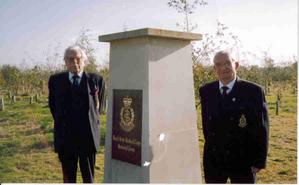
Alex Whitelock at RAMC Memorial Arboretum in Staffordshire, 2003
This story was submitted to the BBC People’s War site by Wymondham Learning Centre About links on behalf of Alexz Whitelock and has been added to the site with his permission. The author fully understands the site's terms and conditions.
On the 17th July 1943 I had to report to the Royal Victoria Hospital, Netley, near Southampton. It was an old Victorian hospital built during the Crimean War. A railway line ran directly to the hospital from Southampton docks with a station for ambulance trains to bring patients to. A tunnel leading from the station platform into the main hospital corridor allowed patients to be kept under cover as they came off the trains.
I’d only been at Netley a short while when, along with a large number of other ranks, I found myself on the station platform at 1.00 am helping to unload an ambulance train full of patients from the Middle East. I’d not seen a home ambulance train before and was surprised to see how comfortable they were. They had every amenity; bunk beds with sheets, pillows and so on, a kitchen for drinks and meals, toilets and everything else necessary for the patients’ comfort.
When the train arrived, we paired off with stretchers and carried the patients into the tunnel where the doctors and nursing sisters decided which wards they were to go to. It was very heavy work. One nursing sister patient was so heavy it took four of us to carry the stretcher.
Once patients had been treated and assessed as fit to be moved, they ‘d be moved to hospitals nearer their homes until they were well enough to return to their units or were discharged as ‘unfit for further service’. On a given day, all other ranks who could be spared would report to the main square with haversack rations collected from the main kitchen to escort departing patients to hospitals all over the country. The Chief Ward Master would be there with his administrative team to supervise the loading of patients into ambulances.
The journeys could be quite harrowing. On one occasion, I took a patient who’d had half his jaw shot away, to Truro in Cornwall. At Padstow he said, “I live just near here.” I persuaded the station master to let us get off for a while so he could see his family and catch a later train on to Truro.
He lived in a little terraced cottage overlooking the sea. When I knocked on the door his mother threw her arms round him and there were lots of tears. She rushed off to get relatives and friends who were all very pleased to see him. After about an hour I said we must go and we caught the next train for Truro.
We were welcomed by the matron and he was sent off to his ward. Matron escorted me to another ward where she told the sister, “This is the soldier we are giving a bed for the night.” Staff Nurse said, “I’ll run you a bath and then bring you a dinner. Here are clean pyjamas and a dressing gown.” It was five star treatment!
Next morning, after breakfast, I thanked them all for their hospitality and went to catch the train to Paddington. I crossed London by tube to Victoria, went by train to Southampton and then by bus back to Netley.
© Copyright of content contributed to this Archive rests with the author. Find out how you can use this.



 Recommended story
 Story with photo