

- Contributed by
- internetaction
- People in story:
- Noor-un-nisa Inayat Khan, George Cross, MBE, Croix de Guerre
- Location of story:
- Occupied France
- Background to story:
- Royal Air Force
- Article ID:
- A3585017
- Contributed on:
- 27 January 2005
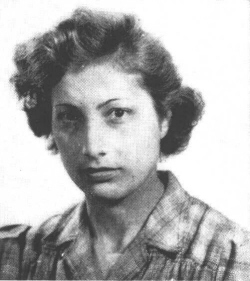
Noor-un-nisa Inayat Khan, George Cross, MBE, Croix de Guerre
Noor-un-nisa Inayat Khan, George Cross, MBE, Croix de Guerre
The birth of Noor Inayat Khan took place on January 2nd, 1914 in the Kremlin; a strange place indeed, for an Indian Princess and direct descendant of Tipu Sultan, the last Muslim sovereign of South India. Apparently, the Tsar Nicholas II, his country troubled by internal unrest and impending war, was seeking spiritual solutions to the problems facing his regime. Consequently, the influential Gregory Rasputin, invited the father of Noor, who was a Mohammedan Mystic, to visit Holy Mother Russia, in order to share with the Emperor's family and court, his Sufistic doctrines of peace and love.
After a time, however, prompted by a concern for the safety of their family, Pir Inayat Khan and his American wife, the Begum Sharada Ameena (formerly `Ora-Ray Baker` of Albuquerque, N.M., a distant cousin of Mary Baker Eddy, the originator of Christian Science) decided to depart Moscow during the events leading up to the Bolshevik Revolution of 1917.
Following many adventures, they arrived in Paris, where Noor enrolled in the Ecole Normale de Musique, eventually gaining employment as a writer of children's stories for Paris Radio. The arrival of World War II, however, again caused this peaceful family to flee their adoptive country.
Settling in London, Noor, wanting to do her part in the overthrow of Totalitarianism, became an Assistant Section Officer in the Women's Auxiliary Air Force, seconded to the Women's Transport Service. Her familiarity with France and fluency in the language were qualities very much in demand by the British War Office at the time. The continent had been occupied by `Axis` forces and the future held in store several more precarious years for the beleaguered occupants of Hitler's 'Fortress Europe'.
After undergoing extensive training in the Special Operations Executive, Inayat Khan was the first woman operator to be infiltrated into enemy occupied France,on 16 June 1943. During the weeks immediately following her arrival, the Gestapo made mass arrests in the Paris Resistance Groups to which she had been detailed, but although given the opportunity to return to England, she refused to abandon what had become the principal and most dangerous clandestine position in France.
She was a `wireless` operator and did not wish to leave her French comrades without communications and she hoped also to rebuild her group. The Gestapo did their utmost to catch her and so break the last remaining link with London. After three and a half months she was betrayed, taken to Gestapo Headquarters in the Avenue Foch and asked to co-operate. She refused to give them information of any kind and was imprisoned in the Gestapo HQ, remaining there for several weeks, and making two unsuccessful attempts to escape during that time.
She was asked to sign a declaration that she would make no further attempts but refused, so was sent to Germany for 'safe custody' (the first agent sent to Germany). She was imprisoned at Karlsruhe in November 1943 and later at Pforsheim, where her cell was apart from the main prison as she was considered a particularly dangerous and unco-operative prisoner. She still refused to give any information either as to her work or her comrades. On 12 September 1944 she was taken to Dachau Concentration Camp and shot on the following day.
Noor Inayat Khan's George Cross was published in the London Gazette on 5 April 1949. She is also honoured on the Runnymede Memorial in Surrey, for those RAF personnel with no known grave.
Excerpted from URL: http://noor.ipfox.com/About links
© Copyright of content contributed to this Archive rests with the author. Find out how you can use this.



 Recommended story
 Story with photo