

- Contributed by
- Genevieve
- People in story:
- Ronald Gamble, Jack Chester
- Background to story:
- Royal Air Force
- Article ID:
- A7010713
- Contributed on:
- 16 November 2005
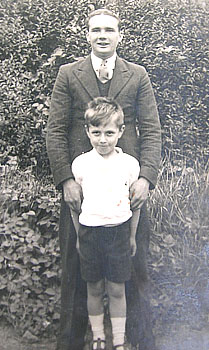
Ronald Gamble with his big brother Jack
My name is Ronald Gamble, I’m 73 this year.
My first memories of the War being declared are actually on Sunday the 3rd September. We were all gathered around the radio set (an old Cosser) listening to the Prime Minister announcing the fact that we had gone to war. I remember turning to my Father and asking him, “What does that mean?” He replied, “It means that a lot of people are going to die. It’s not going to be very nice.” We were particularly worried because my brother Jack had joined the R.A.F in 1938: he’d passed out and was serving with a squadron. The day after war was declared he was on operational duties dropping leaflets to reassure the Poles that we were with them.
He had quite an eventful life with the R.A.F: After Dunkirk he came back - he came on leave and he looked very, very tired, very frightened. He then went back to his squadron and we didn’t see him again until the Christmas time of 1940. The Battle of Britain had finished by then and he’d been there. He said “I’m transferring to 220 Squadron, Coastal Command”. It was a new squadron; (I think they were resting them after the Battle of Britain).
One day I asked him, “Do you think we’re going to win this war?” He answered, “Only if the American’s come in, we just haven’t got the wherewithal, we haven’t got the supplies, we haven’t got the operational means to make ammunition and things like this. It’s the men and it’s the supplies and it’s the American economy that will make it work: but I can’t see them coming in.”
He went back off leave for the New Year, but 15 days later we had a telegram to tell us he was missing. He’d joined his squadron, and they’d gone out on their first patrol: they’d gone after the U-boats in Norway so it seems. His fiancé who was working on operations control heard the last transmission and apparently the voice signal had gone from what they call strength nine to strength zero in seconds - that meant the plane had gone in. We had the telegram to say he was missing believed killed, and two weeks later we had a letter confirming the worst — it said that due to the length of time missing he was presumed dead — he was only 19 when they went missing on the 16th January 1941 — his 20th birthday would have been in the following April. He never had a grave of course, but he is on the Runnymede Memorial.
My mother never gave up hope about my brother. She pestered the Red Cross in 1947 asking if anyone had been rescued. But I doubted very much if anyone would have survived in the Fiords — In Norway in January they would have been even colder. I was in Air Sea Rescue and I knew that if they’d hit the water and stayed in just a few moments then hypothermia would set in and they’d just have died instantly — that’s it.
I joined his squadron 10 years later (as a tribute to him I suppose). In 1950 I went into the RAF and after my initial training I went to Cranwell and later on joined his squadron. I served in Malaya during the Communist uprising and in Korea: I had five years in the RAF.
This story was submitted to the People’s War site by Becky Barugh of the BBC Radio Shropshire CSV Action Desk on behalf of Ron Gamble and has been added to the site with his permission. Mr Gamble fully understands the site's terms and conditions.
See more of Ron's stories:
- 2) The Totty Sisters
- 3) To have loved and lost
- 4) Jack’s last letter
- 5) The hazards of bird watching
- 6) It was a strange time really…
© Copyright of content contributed to this Archive rests with the author. Find out how you can use this.


 Recommended story
 Story with photo