

- Contributed by
- pete probst
- People in story:
- REGINALD KENNETH PROBST
- Location of story:
- Bath
- Background to story:
- Civilian
- Article ID:
- A4011913
- Contributed on:
- 05 May 2005
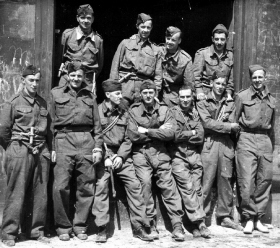
Reg, third from left on front row. With the Home Guard, 1942
I spent quite a time with the Home Guard and did some training at Taunton and Infantry training at Birmingham where we did a one week course on street fighting, climbing up the face of three storey buildings and swinging back down to the ground. The methods we used were probably developed into the modern abseiling. We also had the explosives trainer from the guards to give us some training on anti tank explosives. After this we were given a box of anti tank bombs to try. We went up to the Downs to the East of Bath and a couple of stalwarts carried a glavanised water tank all the way up. We located ourselves in a small old quarry. The Home Guard Captain a rather large portly chap in his fifties, took charge and explained that we could use five bombs which meant we could use one on each face of the tank. We then set about operations on the first bomb. It was a glass bottle rather like a laboratory flask, the bulbous end being about 6 inches diameter and in the neck was the time fuses. It was wrapped in sacking which was dipped in some sort of glue.
We all watched as the Captain threw it at the side of the tank. He let go and ran for cover. We all dived for our prearranged cover. A few seconds later and a God Almighty bang boomed out; we waited a moment as the shock wave passed over us and then got up to look. There was a pall of smoke about but no sign of the tank, we eventually found it up in a tree hanging in ribbons of galvanised iron. We decided that would do for the day, we would put the rest of the bombs in store for another evening.
At the office, I did some design work and examined some sites for possible protective measures against invasion forces in small groups coming into small fishing harbours. I got down to detail work on automatic mounting and retracting flame throwers for erection on breakwater ends using shore supplied fuel tanks, with engine, pump, pipeline and electrical ignition, but the tide of war was moving out of the emergency defence stage and I do not think this defensive measure was ever developed and put into practice.
With the change in the war I joined the airfield section and went out on land surveys for the construction of new airfields for carrier based aircraft. One was at Inskip a location near Preston on the Blackpool side. I went to speed up the survey and get it done before Christmas as heavy snow was falling, slowing down the work. I stayed at the “Ship Inn” at Elswick with a colleague Johnny Johnson. It was better weather, but the pub was kept fairly warm, the kitchen girl was a marvel and always had a fire blazing in the kitchen when we came down for early breakfast, she remarked that she could always light it with one match. I came down extra early one morning and watched her as she raked out the cinders then scrumpled up half a newspaper and placed it at the bottom, then broke open two fire lighters and spread them on the paper followed by a bundle of firewood and then poured a jam jar of paraffin over the pile. One match at the bottom and in a second the whole fireplace was a roaring inferno. We always started away from the house fairly warm.
It snowed on and off all the time, but we worked on, one occasion I had to get a check on the far end of the site down at the end of a lane and I borrowed the pub’s bike, I rode down to the bend in the lane - it was quite twisting, and when I got around the corner, I came to a drift. I picked up the bike and carried it over the drift, another few yards, and another drift. I finally carried the bike about 80% of the distance just to measure up a patch of land about as big as a back garden.
Maggie’s sister was getting married in London and it was a rush early one morning, leaving Elswick Johnny and I plunged into the snow to get to Preston. The snow filled our boots and even the pockets of our heavy oilskins. We were fortunate that a convoy of army lorries with a staff car following came along, the car driver was on his own and was glad to pick us up to keep the back of his car from sliding all over the road. We managed to get a shared room in a sleazy hotel called Cookson’s Commercial in Preston and I remember having to wash in a corner of the curtained off landing. The trains were in a hopeless state and it took me all day to get to Bath to collect my things for the wedding. I caught the early morning train to Paddington and then the ‘Met’ out to Wembley Park where I fortunately found a Taxi and arrived just in time.
The office now started looking at the proposed designs of tank landing craft and tank landing ships. This required examining the requirements, finding the right slope of foreshore and how to hold the boats in position whilst loading tanks and troops and also while refuelling and supplying water. One requirement was to ensure that a hard standing ramp was available to take tyre or tracked vehicles down the beach and on to the boat loading ramp, it had to be solid and yet flexible. Someone came up with the idea of making slabs rather like ‘Bournville’ chocolate divided up into blocks about 9” x 9” made up into individual slabs of about six feet by three feet and reinforced with high tension steel wire running through the slab in both directions coming out and back into the slab through each of the small rows of blocks. It worked a treat and when laced into a roadway surface the slabs pegged together through the loops, it conformed with the sand below giving a reasonable surface. “Dolphins” were also designed that would give maximum bending without failure and quite a lot of information was gathered on ships berthing that was of great use in future dock, jetty and harbour constructions.
I was organising the embarkation hards from Southampton and Hastings. A short time before D Day I had to travel along the coast and check every point and compile a plan with all the information and roads for the use of the Hardmasters and the army transport groups.
We had a fortnight to do the job and then a few days to make corrections so that the necessary sets of prints could be got ready and distributed to the people that needed to know. I promptly packed and went to Southampton having collected a packet of rail travel warrants. With only rail transport available, all buses having been reduced to an absolute minimum, one had very awkward journeys to make in getting from site to site and it was going to be a tight timing. Having checked a site in the town itself, I moved down the coast and arrived at a site now Little Hampton having stayed the night at Fareham. It was while measuring up and making the final checks that a large American type shooting break arrived with a group of men; one was a cashier, one the driver and the other chap was security. I asked the driver and guard where they were going as they might be able to give me a lift somewhere. They said that it was the wages cashier paying the workers on the sites and thought they should not give me a lift. I showed my credentials and Admiralty Pass and told them what I was doing. We went over to the cashier and talked to him and it became clear that he was paying out the wages for all the sites along the coast up to Hastings and he agreed I could come providing I completed my checks in about the same time as he did his pay out. The security man offered to help me.
We set off, and the whole operation went like a dream. We finished up at Hastings at about 8.00.p.m. They were staying the night and carrying on along the coast on the following day. I said goodbye, caught the London train and was back to my parents house by about midnight.
I decided to stay in London a day and spent the time trying to look up old friends and also Scouting colleagues, but everyone seemed to be involved in the War and I returned to Bath arriving late the next afternoon. I phoned the office to let my Chief know I had returned. He was a peppery old ex-oilman from the Middle East; I announced myself and he replied “What’s gone wrong - where the hell are you?” I told him I was finished and would be back in the office in the morning. “The hell you wont” he replied. “None of the others have done more than a quarter of their area, and MacGreggor (on the Hastings and Thames area) has been arrested and we are trying to get him released”. “If you come back now you will make them all look fools”. He finished up with “Go and dig for victory on your allotment for a week and come back, there will be nothing much for you to do until we are all together”.
I stayed out of the office for the week and then returned. I was, even then, first back, but there were problems such as accounting for the time. I saw the Chief and he insisted I keep it straight and put in for hotel subsistence for the whole period and charge the fares I would have paid. As he said “The good Lord sent you the good luck and it would be an act of bad grace not to enjoy your good fortune.” The others were soon back and we got down to compiling the sets of different plans for the areas and groups of plans for the more senior officers in charge. Finally we had one complete set locked in the archives, one complete set for General Eisenhower and we did a bound copy for the King’s Archives and we sat back .
We had another indication of the coming invasion when the army designers asked for our advice about the huge concrete oblong boxes that were going to be floated across the channel and sunk to form a breakwater and we were the authorities on the action of the sea. In fact, we had in the office Bob Mimmiken who was one of the first to make a study of wind, tide and waves. We convinced the army group to increase the reinforcement as the likelihood was of severe stresses if the weather was a bit rough and it is very fortunate they did. The harbour was called “The First Machine” and the various parts were called Lemons, Oranges etc. and Mulberry was the centre floating unloading platforms with the floating roadway to the shore. The name Mulberry caught the public imagination and the other names of the parts have been forgotten. With this work I was also doing the setting out and technical control of a repair slipway being built on the River Taff opposite Cardiff docks. It was a twin slip that could haul two landing craft up out of the water for repairs. Unfortunately a meat ship with lambs carcasses had been sunk in the river and the carcasses of meat were rotting on the mud flats, also a horse slaughter house on the banks combined with a glue factory built up a stench that was frightful, beyond belief.
I mention this job as the first time I arrived in Cardiff I was met by the Foreman who had booked me into the Central Hotel, one of the top floor rooms, and I left my case in the foyer to be taken up and went off to the site with the foreman. After finishing for the day we joined the contractors for a few drinks and eventually I got back to the hotel fairly late. I collected my key and went up to my room.
There was no toilet or sink and I wanted to pee. I went out into the corridor but could not find anywhere. I went back to the bedroom, but did not like the idea of leaving a pot full for the chambermaid, so I went to the window and looked out. It was a back room and overlooked the sidings of the railway and all was black and silent below. I could not wait any longer and with great relief let go. After a second a great clamour rang out and I quickly realised I was peeing on a corrugated iron roof six floors below, so cut the stream off at the source. It seemed to go on clanging long after I had stopped. I looked down and nobody seemed to be about so to hell with it I finished the job.
The Cardiff job was finished successfully but not without trouble. We had an assistant Civil Engineer of little experience in charge and never quite understood tides especially in the Bristol Channel area where tides could range up to 40’ with currents running at high speeds. He went out fishing in the river at high tide and took no notice of the time. Suddenly he realised he was travelling down river, and row as hard as he might, the tide was carrying him away faster every minute. Fortunately we were aware and called up the Tug Master who was dredging for us. He told us to hold on while he consulted the tide tables and refusing to set off in his motor boat told us that we would find him coming ashore tomorrow at about 7.00 in the morning at Barry. He did and was collected in the morning.
Another time the assistant Civil Engineer wanted to move a compressor from one jetty to another and decided to do it on a pontoon. He and the contractors mechanic rolled the compressor on to the pontoon and made it fast to the bollards on the quay, they then came in to get some rope to pull the pontoon across and decided to have a cup of tea. Our foreman suddenly realised the pontoon, tied up tight was beginning to lean as the water level dropped with the falling tide. The assistant and mechanic rushed out and jumped onto the pontoon and roped up the compressor, the foreman ran out after grabbing an axe as he, being local, knew it would soon tip over so he cut the ropes and the pontoon floated away down river. We called up the Tug Master to help out, but all we got from him was “…. him and the mechanic. You know where to find him tomorrow, I will collect the pontoon when I’ve got time”.
They had a harrowing night, floating down the fairway to Cardiff docks, with ships slipping past all blacked out but as predicted the returning tide deposited them at Barry. I attended the hand over of the work we had done on the slipways, a Landing Craft was duly hauled up each slipway and was glad to be clear of the job.
Maggie and I had occasional holidays in London visiting the families and on one occasion, I was asked to be best man to one of Maggie’s colleagues in the Research Department, whom I also knew very well; Johnny May stayed with us now and then on leave periods. He was originally a conscientious objector to war but later changed his mind and become a bomber pilot. His mother had stayed with us a short while, as relief from the bombing in London, but predictably she did not get on with Maggie and was not asked a second time. The wedding was at Pinner Church but Johnny and his family were complete agnostics. I am mentioning this because at the Church, Johnny and I were already seated in the front pew when his mother and father came in and sat down behind us, and then his father in a just audible whisper turned to his wife and said “I say dear, there is no upstairs.” I was astonished that anyone could live so long without finding out that a Church being a high building was not divided up into floors. Any other event of the wedding now escapes me.
© Copyright of content contributed to this Archive rests with the author. Find out how you can use this.







 Recommended story
 Story with photo