

- Contributed by
- davidhardie
- People in story:
- John Hardie (1920-1985)
- Location of story:
- Europe, India and Africa
- Background to story:
- Army
- Article ID:
- A9005212
- Contributed on:
- 31 January 2006
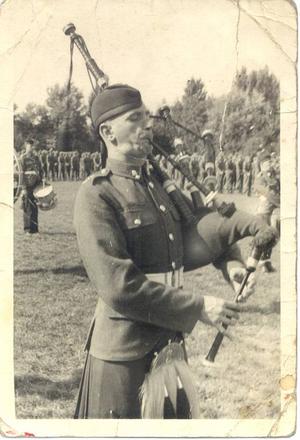
Fusilier Piper John Hardie (1920-85). Corps Commander's Parade, Landesbergen, Germany, September 1946.
The Auld Man’s War
These are some potted and very much abbreviated stories told by my father, John Hardie, who like his four other brothers were professional soldiers before the outbreak of WWII and fought throughout those fateful years. My father was a company piper in the RSF.
India September 1939.
“The sergeant marched up tae tell us that the war was finally on and that we had to get cracking. We were ordered to polish the helmets, burnish the regimental swords and to blanco the webbing - oor first day at war!”
My father first saw action in Ethiopia against Mussolini’s war machine.
“We’d be in convoy in the desert for days on end, hardly seeing a camel, let alone an Eyetie. For some reason, we always had Tam who had a stammer, as our look-out for enemy aircraft sitting atop the leading vehicle. By the time he said “P-P-P-P-P-P-Plane!!” We were all cowering underneath the trucks or in the nearest ditch.”
“Although some of the Italians fought very hard, a lot of the time you’d hear them long before you saw them. Inevitably a vehicle would break down in the desert and every Eyetie thought he was a better mechanic than the rest. So we’d come across a stationary Italian convoy with most of them underneath a truck with the others arguing over which spanner to use. We’d round them up and they’d still be arguing as we marched them off to a POW camp!”
“The British employed Sudanese tribesmen to raid the Italian supply camps and lines of communication. These were tall warriors with fuzzy hair, armed with auld muskets and long knives. They could go on for days almost without food or water. They put the fear of God into the Eyeties and would collect the ears of their victims and hang them around their necks as trophies. This was stopped by the British as being too barbaric for modern war!”
My father’s unit was then sent to Britain via South Africa to take part in Combined Operations.
“We were on a troopship bound for Durban when the convoy’s main escorts, including the cruiser HMS Devonshire, were called away to help hunt the Bismark. Fortunately we got to port safely. Durban was great with glorious beaches and we didn’t want to go any further. Unfortunately we got another set of escorts and finally got to Blighty in the summer of ’41.”
“I tried to join the paratroops when we got home. We used to wear these cork helmets and long smocks. We had to fall through a hole in the back of a Whitely bomber. You could see the previous man go down while you sat on the rim. Only if he was in trouble and his ‘chute failed, could you refuse to follow — that was the rule, during training exercises at least. I was kicked out when I sprained my ankle. The slightest weakness and you were considered unfit for the paras in those days.”
“Combined Ops training was done up in Scotland — mainly around Inverary. We spent months jumping in and out of boats in all weathers and all times of the day or night — scrambling up and down nets, assaulting enemy pill boxes and the like. We were billeted with some Seaforths who only spoke Gaelic, except their Corp. who would translate the officer’s orders and read out the messages on the barrack room door. We didn’t know it at the time, but a lot of the early D-Day ideas were first tried out during this phase. I saw and auld Matilda tank fitted with skirts launched from the front of a landing craft. It struggled in the water for a minute or so only to sink like a stone with the poor sods inside.”
Preparations for D-Day began in earnest in late 1943 in the South of England.
“I finally ended up back with the RSF again, as a company piper. We were billeted in a massive camp in a middle of a forest somewhere down South. There were thousands of us, with tanks, guns and trucks. How Jerry never caught on about the invasion still baffles me. The battalion CO was a big highlander who went everywhere with a shepard’s crook and his dog, Robbie the Bruce on a lead attached to his wrist. Our platoon was lead by a one “John the B” where the B never stood for Baptist! In our platoon was wee Alec who was not the brightest in the firmament. He was short and bald and believed us when we all suggested that horse manure smeared on his head would bring back his locks. John the B stood while we were on parade looking at us trying to find the source of that bloody stench! Alec was drilled over to the guardhouse and hosed down.”
Taking the Mick out of the CO was an everyday pastime. He was from MacDonald stock and we pipers would always start up “The Campbell’s are Coming” when we was in earshot, only to get a clout from the crook! When up in front of the CO on a charge and after it was read out, he would turn to his dog and say “Now what should we do about this little man, eh, Robbie?” If the mutt barked — that was you on jankers for a month — at least! Just before D-Day Robbie escaped and we were ordered by John the B to find the CO’s dog. Everyone of us swore that we’d put a bullet in it if we found the mongrel. Unfortunately it was hiding behind the NCO’s mess and the CO and his faithful Robbie were re-united.”
OVERLORD.
“We had so many practise embarkations and real operations, only to be called off that, by June we were all sick to the back teeth of getting ready for the Big One. We had to get our kit ready in short order and Alec and Pongo who were fly to all this, filled their haversacks with a couple of bricks. Only when we were halfway across the Channel was the awful truth revealed. We landed in Arromanches in Gold beach late in the day, very late in the day. Our landing craft was bobbing in the water as the shells from HMS Warspite flew overhead like dustbins. The beach was very calm when the ramp came down. The sailors said that they’d get us so close that we wouldn’t even get our feet wet. Wee Alec was first off, only to sink up to his neck! We were all soaked when we finally got to France. We staggered onto the almost deserted beach with our kit, rifles and Bangalore torpedoes, which were never used. We waited for the rest of the battalion to arrive over the next days and moved onto forward positions near Bayeux. M-C would be astride his bren-gun carrier urging his wee batman with a bash of his crook on his batman’s helmet.”
“The main fighting was inland and it was vicious. All the time were being stonked and sniped at. We heard of a massacre by the SS of Canadian prisoners, by some châteaux inland. There was also a big stink about some tiger tanks knocking hell out of one of our tank brigades south of Bayeux. We got caught in a minefield on the way to some wee place called Tilly (a daft name for a place to fight over). Talk about “Tiptoe through the tulips”! Along the lane, a laddie in the leading squad was blown to pieces by a mine. His body arched through the air only to land by us as we passed. Just a heap of bloody flesh and webbing, that was still groaning and never seemed to stop.”
“We had our big push at Fontenay-le-Pesnil. After advancing through fog, we were pinned down for over 12 hours under a cross. We just shoved our guns out, pulled the trigger and hoped for the best. Jerry threw everything he had at us and it was hand-to-hand for a long time. We finally got into the village before dark and flushed more of them out — mainly fanatical SS Hitler Jungen. We lost a hell of a lot of laddies at Fontenay. We buried most of them by the cross. A few days later M-C himself had his head nearly blown off by a shell. His wee batman cradled the big highlander in his arms and cried his eyes out. We buried him at the cross along with the others. There were many patrols around Fontenay and Rauray. Our patrol got ambushed by a long wall. Here one of two brothers got it bad in the stomach, with his “Billy”(brother) trying desperately to hold the guts in. This was the only time I witnessed something that could have been from a Hollywood film, with someone having a conversation with his brother while dying.”
After Normandy there were still mopping up operations while chasing the retreating Germans.
“We moved into the fortress of Le Harve after surrounding it for over a week. We were supported by flail tanks to cross the mine fields and by Crocodile flame-thrower tanks to knock-out the pill-boxes. Jerry assault teams used flame throwers on us in Normandy but as soon as they lit up, everyone fired at the source of the flames and nine times out of ten it stopped. The Crocodiles had the height, range and armour to use flame properly. The screams of men hit by the flaming jelly were almost inhuman. I’ve never heard anything like it before or since, and it’s a sound I’ll never forget to my dying day”.
“We were given leave in Belgium. We were billeted in barracks just on the outskirts of Brussels in fact. This was a great place, beer, mussels and chips, steaks, bints, the lot. We soon were skint. Pongo found a tailor outside the barracks who was interested in buying army blankets. We would wrap them around ourselves and hide them under our greatcoats and march past the guardhouse, saluting a suspicious John the B. We were sweltering, but later freezing when we got back to barracks after a night on the town.”
“Later on in the forward area, we were sitting in a ditch brewing up when some Yanks moved up along side. We just watched them setting up their canteens that were towed by trucks and the flaps went down revealing the cooks ladling out the grub. We would swap their stuff for our Bully Beef which they loved and also traded jackets and fur hats for our boots, which they held in high esteem for some reason. One day we were invited to their mess and served the most enormous steak, only to have it smothered in molasses — ruined!”
Northern Europe.
“We were dug in around a farm overlooking Jerry in a nearby farmhouse with a wood behind. We were there for a number of weeks, with the weather either raining, sleeting or both! This was a rare billet — little happened here except for the odd stonk or two by either us or Jerry. We would watch them every morning bringing up milk to their positions in a cart with the old Jerry puffing on a clay pipe. Sleepy hollow — right enough! We had chickens, eggs, wood for the stove, bacon and the odd brandy or two. There was even a piano and one of us was classically trained. Peter, his name was I think. He would play Rachmaninov while we all sat round the stove with the dixies brewing tea. Even Jerry seemed to enjoy it. One day we were in a barn washing ourselves in a large barrel when in came wee Alec pulling on a long rope. The rope had a horse on the end of it. Unfortunately the horse was blind and panicked when it came in. It kicked over our barrel and stampeded out causing a major din. Jerry started stonking the place and our artillery stonked them. It was tit-for-tat all day and that put an end to our Sleepy Hollow.”
“Fighting Jerry was one long hard slog. He could always retreat to prepared defensive positions set up by slave labour. He would then counterattack. The Wehrmacht Panzer Grenadiers and their Paratroops were their best. They would attack in a very measured way, probing all our weaknesses. In battle it was sheer chaos. You tried to keep your head down almost all the time. Getting stonked was the worst. There was nothing you could do except pray, to God, Allah, Buddha, anything that would help out. War is never glorious, it’s monotonous and uncomfortable. After a long hard march, we’d dig in and just when you were eating burnt sausages with the rain coming off your helmet and on to the plate, we’d get the order to move up, and the whole process started again. Looking back on it, the Yanks were supreme at attacking — they would throw everything at Jerry, nothing was spared. Yet we were better at holding a position and grinding them down. The problem with the British Army was that it always tried to do things with the minimum of men. They would send in a battalion, when a brigade was needed or only a company when a battalion was required. This made for slow advances, if at all. Thank Christ for the artillery! We had the best gunners in the world.”
“We started to push in early ‘45. We would find lots of dead Jerries lying there with a baked tattie or turnip half gnawed. Most of them we took prisoner. During one rapid advance, we all had to drop things and move sharpish. Unfortunately, I left my pipes behind in the farm we were occupying at the time. I managed to get a dispatch rider to take me back down the road, but we were stopped at a roadblock by some Canadians. They thought it very suspicious — two blokes on a motorcycle coming from enemy lines talking about finding bagpipes in corny Scottish accents. They could not believe that the British had advanced so far and were about to take us around the back of a wall and shoot us, when their CO confirmed our advance and they let us go on our way. I gave them a blaw on my pipes as we past them on our return, but we didn’t wait for their reaction.”
“It was a bright spring day. We were marching in file along a road. Over the last few weeks, Jerry seemed to be packing in right, left and centre and we were spending most of our days mopping up prisoners. Fighting was an occasional, and fortunately brief, break from the monotony. Some trucks came trundling towards us with scots laddies from the HLI, I think on board. “Fur f*** sake dinnae go up there”, a few shouted as they past, the others just stared into space. We still marched on. We’d seen many massacres of prisoners and slave workers, bodies partly dressed, piled into ditches. We’d though that was what was up, maybe few more corpses than usual….maybe it was some of our aine laddies…POWs. Then there it was……….in a large clearing…….dark buildings and barbed wire fences. There were people standing, sitting and lying around. Dark shadows, skin and bone in human form. There was a strange stillness about the place, despite the MPs and orderlies running around marshalling us away. The stench was overwhelming; a sickening smell of rotting bodies and excrement……but it was the faces of the bairns….indescribable.”
End of the War
“When it ended it was an anti-climax. We were just sitting by a ditch and told that Jerry had packed in. We were thankful that we could just lie back, stretch out and have a “beadie” (cigarette) without wondering if somebody would snipe at you. Being billeted in Germany was great; you could get anything for a fag or two. Most of us had a couple of Jerry bints to do the “dhobying” (washing) and for other services. We felt like conquering heroes. One time we past an “auld sweat” Jerry on crutches and knocked them from under him. I regretted that. That poor joker had given his all for his country, perhaps more than we ever did for ours.”
“Some pipers, me included, were temporarily transferred over to England for the big Victory Parade. We weren’t greeted as heroes — I got kicked off the bus in Southampton Docks for carrying my kit bag. We were stationed in Aldershot — home of the Guards, to prepare for the parade. Turning up at the Mess, we were turned away. The cooks said it was for “Trained Soldiers Only”, meaning we didn’t have the extra two weeks basic training that new Guards recruits get. I guess that says it all.”
© Copyright of content contributed to this Archive rests with the author. Find out how you can use this.


 Recommended story
 Story with photo