

- Contributed by
- magsrey
- People in story:
- Peter Dolan
- Location of story:
- London
- Background to story:
- Civilian
- Article ID:
- A5948111
- Contributed on:
- 28 September 2005
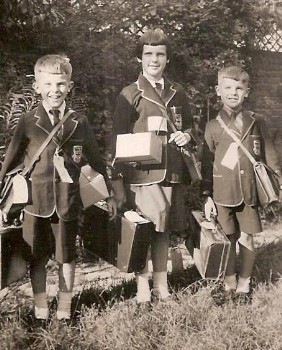
Peter, Margaret, and Paul Dolan prepare to be evacuated to Suffolk
A SMALL CHILD’S WAR: PART 2
The Second World War as remembered by
Peter Dolan sixty years later
By mid 1942 the blitz was over and we came back to London. By then my father had built a reinforced concrete shelter in the garden. There would be a few raids during the night. The air raid warning would go and my mother would wake me up and would then go to wake my sister by the time she got back I was asleep in bed again. We would then wrap up in thick coats and go down the garden to the shelter. Mostly the raids did not last very long and we would go back to bed as soon as the all clear sounded. We did not mind as when there was a raid in the night we did not have to be at school until 10am the next morning.
Food was rationed: butter, sugar, tea, meat, clothes. We all had our own little jars of jam, sugar and sweets and I think my mother was very pleased when I stopped taking sugar in my tea as my father had a very sweet tooth. I can remember my mother using her precious ration of clothing coupons to by me a shirt when I joined the scouts. One evening during a rough game of 'British bulldog' it got badly tom and my mother burst into tears when I got home.
I was always envious of the boys at school who had big brothers in aircrew. They all came to school in lovely leather flying jackets and I was sorry that I could not get one. But then when at morning assembly the headmaster asked us to pray for Bernard Saunders or Antony Stenhouse or Terry Gillam whose brothers had just been shot down over Germany or Holland or somewhere we realised there was a price to be paid for those lovely flying jackets.
In 1944 we knew that the Second Front was going to happen soon. There were signs everywhere 'Open the second front now'. We would see huge formations of American bombers going out on daylight raids to Germany and we would count the planes on their return and know how many had been shot down. The losses would be quite heavy and for every aircraft there was a crew of about ten. I used to go home for lunch as I lived very near to the school and if my mother needed anything I would nip down to the local shop for her. Tuesday the sixth of June 1944 was a lovely warm sunny June day and I enjoyed the short walk home. As soon as I entered the front door my mother shouted out “They have landed!”. Wow, such excitement, everyone glued to the radio. Our newspapers had only four pages then due to shortage of paper. Every page was filled with invasion news and pictures. We lived beside the docks and within days all roads leading to the docks were filled with convoys of lorries, bren gun carriers, armoured cars, antitank guns, all making their way to the ships. My father could not do his rounds as the roads were all blocked. I got across the road in a brief interval between convoys to do some shopping for my mother and could not get back across for two hours and I was most annoyed when my mother told me off for taking so long! The soldiers were all happy and if a convoy stopped it was not long before somebody brought them out a cup of tea or a sandwich.
About a mile from us was a very large area of ground known as Wanstead Flats. It was part of Epping Forest but it had no trees and as it's name implies it was perfectly flat. It had a battery of anti aircraft guns in one comer but the rest was used as an assembly area for D Day. All the convoys would assemble there and be briefed prior to D Day. There was great security to stop any news of the invasion escaping. After a while the convoys were less frequent, and suddenly we found the Flats were full of German prisoners of war. They had all been captured in Normandy. These were the first real live Germans we had seen. We had read of them, of all the atrocities they had carried out in the countries they had captured. We remembered when they had seemed well nigh unbeatable and they had frightened us very much. And now here they were prisoners wandering aimlessly round the prison camp in tatty soiled uniforms. We felt sorry for them and people collected comforts for them. Oh we silly, soft English.
On the 16th June at ten minutes past six in the morning we were bombed out. The bomb landed ten gardens away from us. The only houses left standing in our road was ours and the one next door. We were in the shelter. We heard the guns firing and then heard this tremendous roaring sound that got louder and louder as it got nearer and nearer and then came an almighty bang. The shelter lights went out. There was a continuous noise from all the houses falling down and then the air became filled with a thick choking dust that filled our mouths and prevented us seeing more than a few yards. No one spoke. We were so appalled at whatever had happened, and then out of the darkness came the familiar voice of my mother, “Are you all right Peter? Are you all right Margaret?”. My father was out in the garden spraying the beans. He did not have time to get to the shelter so he threw himself down against the garden wall. His first words were “The house has gone!”. This was accepted without comment. We felt the important thing was that we had all survived. He said it was a German bomber that had been shot down, so we all said prayers for the crew! He went outside to give aid to the injured. My best friend at school was Tommy McLavin. He was the eldest of a family of five children and they lived down the road from me. When my dad next came in he said he was afraid that it looked like the plane had landed on their house and he did not think they could have survived. I did not cry, but I felt very sad. It seems very selfish all these years later but
I think we had too many problems surviving ourselves to waste time crying. Later that day when a lot of the confusion had been sorted out it was found that only fourteen people had been killed and that my friend Tommy had not been killed, but was in hospital with his family. It was also announced that it was not a crashed plane that had landed on us but a V1 a flying bomb! It was the second one to land on London. It had hit a tree as it glided in otherwise it would have been much nearer to our shelter and I might not now be around to write this! They then started to come over at regular intervals. Sometimes at hourly intervals ,sometimes at longer intervals. There was no point in sounding the warning. Life had to go on and you could not stay in the shelter all day. If you were out shopping and a 'doodle', as we nicknamed them, was heard coming you just laid down in the road or behind someones garden wall. We got used to them. We would watch them chugging across the sky. It was alright all the time the engine was going, but as soon as the engine stopped the bomb tipped and started gliding to earth. If it was coming in your direction you headed for shelter quickly.
One day ,about September 1944, we were sitting in our garden. We heard a flying bomb coming. We went into the shelter and to our relief it chugged over our heads. It was someone elses problem now. But to our horror it came round again and it did the same thing twice more before crashing on an old cinema about a mile away. We were sweating. We thought the Germans had a new secret weapon. We knew that if they all did that we would be very worried indeed. It turned out that it was not a new weapon but the usual one that had it's steering mechanism damaged by British gunfire. About September or October 1944 we got the first of the Germans new weapon that was supposed to destroy our morale. It was a rocket that the Germans called the V2. It caused about the same amount of damage as the V1. It had the advantage that it traveled high in the sky and then plunged down at great speed onto its target. If it landed on you, you were dead before you knew it. If you heard the explosion you knew it had missed you.
Up till February 1945 we were bombarded by day and night with V1s and V2s. The rescue services were overloaded. I was by now 13 years old and with other young people I was allowed to go to nearby incidents and help. We formed lines across the wreckage. The heavy rescue teams who dug for the trapped passed the debris to us and we passed it hand to hand away from the site. Two incidents remain in my mind. The first was one cold January night in 1945. A rocket had landed in Kitchener Rd, Forest Gate, and blown down a row of houses. A gas pipe had caught light And the firemen were trying to put it out. The problem was that the water was freezing as soon as it hit the wreckage. The other problem was that the trapped people were in the cellars and were in danger of being drowned by the water needed to put the fire out. The other incident was during the day. A V2 had landed on the Carlton cinema in Green Street, Upton Park. We were doing our usual job of passing the debris when we noticed some 'Brass' had arrived to visit the scene. I recognised the Mayor from his chain of office but there were some people there in naval uniform and some ladies in smart clothes, unusual during the war. They were speaking to various rescuers and then drove off. It was only later that I learned it was King George VI and Queen Elizabeth. They toured London visiting all the sites of serious incidents totally ignoring the bombs that were continually coming down. We thought they were very brave. Another great character who did wonders for morale was Winston Churchill, the Prime minister. Not only did he tour all the badly bombed cities but his wonderful speeches were listened to by all the nation. The day after one of his speeches everybody would say, “Did you hear Churchill last night?”. He worked wonders for morale.
By early 1945 the V bomb launching sites were being destroyed by the RAF and the number reaching London was diminishing rapidly. There were no more German planes coming over and we were told we need not black out our windows any more. We felt the end of the war was not far away. On May 7th 1945 all the ships in the London docks started to sound their hooters. It was an almighty sound. The next day it was announced that the Germans had surrendered. We were at peace again in Europe. The war was a tremendous experience, some was good, some was bad, we had seen death, and we had seen destruction. In adversity we had seen the good side of people and we had seen some bad. Whether we had gained or lost from the experience I cannot sixty years later really judge. It certainly pulled the nation together. Everyone talked to one another and helped one another, but was this worth all the lives that were lost and damaged?
Peter Dolan
3rd January 2004
© Copyright of content contributed to this Archive rests with the author. Find out how you can use this.


 Recommended story
 Story with photo