

- Contributed by
- SaintMichael
- People in story:
- Jack Stead and Margaret Hitchcock
- Location of story:
- Bournemouth
- Article ID:
- A2630611
- Contributed on:
- 13 May 2004
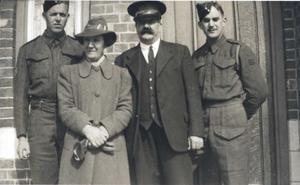
Mr. and Mrs. Stead and two of their sons, outside the North Cemetery Lodge, Bournemouth, during WWII.
Jack and Margaret both grew up in Bournemouth, Jack at North Cemetery Lodge, where his father was cemetery superintendent; Margaret in Holdenhurst Road, where his father was a wholesale grocer connected to 'Bournemouth Markets'. Around the time that Margaret's family moved to Beechey Road, Jack got a job with Gray's builders' merchants, which backed onto Margaret's former home, but it wasn't until after the war that they met and married. These are some of their memories of Bournemouth during the war.
Jack: I started working in [the Holdenhurst Road] area I suppose in 1935/6 when I started work in Oxford Road. That’s where 'Grey’s' were, just behind [Margaret's] house. Now the house where [Margaret had] lived, fronting Holdenhurst Road: I assume it was empty during the War, because when War started, and we had to start fire-watching, I was in the group that was frie-watching the block, Holdenhurst Road, Saint Paul’s Road, Oxford Road, Lansdowne Road. And we started the meet in the Railway Hotel for our first meeting, which was on the corner. And eventually we used the two downstairs back rooms of [Margaret’s] old house where we used to stay for the night, one was just for sleeping in, the other was for making tea and having a smoke in.
Margaret: 'Sherry and Haycock’s' the timber merchants went there after we left.
Jack: Now 'Hooper’s', where I worked, which was 'Gray’s' at that time, used to station a warden there. There was a big long, two storey warehouse right up through from front to back, separating that yard and our yard, and it was full of tea, it was a food store because the warehouse had been taken over during the War by the Ministry for storage. And one night we had a bomb drop on our yard, blew the site out, blew all the back out, and all this tea exploded, and covered one of our lorries, which was in the driveway outside. Our old yard was more or less smashed to pieces, our showrooms, because there were bits and pieces of tubing and stuff all over the Lansdowne - blown up from our yard. And we took over part of the yard where [Margaret’s] father had been, which was then 'Sherry’s', because they didn’t have much in the way of timber, and [they] stayed there then ‘til after the War and I came back. It was a shock being bombed, but you got used to it in the end.
Margaret: [By then we had moved to] Beechey road, when [German planes] went right up Saint Leonard's Road, and they flattened all those houses - that was a landmine. There were three that night, they were dropped from an aircraft on the end of a parachute, you didn’t hear them coming, they floated down, one landed in R. L. Stevenson Avenue in Westbourne - flattened that area. Another dropped on Alma Road school, flattened that, the third one dropped on Malmesbury Park, and flattened hundreds [exaggeration] of houses all round there. That’s when we lost our windows at Beechey Road, we had beautiful stained glass windows in the landing, and they all went; they all came in.
Jack: When I went to work the following morning, the whole length of Charminster Road was just one sheet of broken glass. They tried to repair living accommodation so that you could carry on living in it more or less at once, but they didn’t repair anything immediately. There was almost no new building going on at all.
Margaret: At Beechey Road . . . one day when a plane was coming over, [my mother and my sister] Madge ran out into the garden to look at this plane (we did some silly things during the War) and said “Oh look! It’s got crosses on it!” And then it dropped its bombs, which was rather nasty of it. They used to jettison them really, on the way back. At the end of the War, when they’d had their time, they used to send in these low-level raids just to cause trouble. They were called Bydekker raids, and it was usually fighter-bombers, which would fly low over the channel, right down at water level, swoop over the cliffs, drop their bombs and turn and go away again. One plane might drop about five bombs, but the fighter-bombers usually had one each. The night 'Beale's' was bombed was a Saturday night, that was a miracle really, because 'Beale's' was a very, very busy shop. Then one Saturday afternoon I remember they were coming back from a raid, from somewhere, and they came in from Westbourne, and I had taken my niece Christine down to the upper part of the Lower Gardens, to sail her boat in the river. And this thing came up the town, and it strafed with machine gun fire right up the town, it was very low, and everybody scattered and dived in under the bushes in the Gardens, I pushed Christine down to the ground, and laid on top of her.
Jack: 'Woolworth’s': they were firebombed completely, that’s where 'Boot's' is in The Square now, it was completely gutted, that was just one incendiary bomb dropped on it. 'The Metropole' went that day. West Cinema was bombed. I think it was bombed the same night as 'Beale's', ‘cos I think once again there was nobody in there, and we all felt it was a sort of a miracle, that they bombed it on a Saturday night, Sunday morning. It was a small cinema, I remember being in there several times. The Electric up Poole Hill, just above Marks and Spencers, that was a small cinema too . . . I was in there watching a film, and an air raid went off. A bomb dropped nearby, and the whole bloomin’ place shook, I couldn’t get out fast enough.
Margaret: Oh you’re lucky, I was in Eastbourne when we had the air raid come on, and we weren’t allowed to leave the cinema. I was in there for about four-and-a-half hours.
Jack: Oh at one time that was true, at the beginning of the War you couldn’t go out on the streets when the air raid siren went. They soon altered that though, because it brought everything to a halt.
And then my great grandparents cottage on the corner of Castle Lane was used during the War by the ARP for (as far as I remember) practise in escape and getting people out of burning buildings. They didn’t burn it, but it was eventually knocked down. It was a double thatched cottage, quite a long one. That was there, till after the War.
During the War they used to have fire watching in the [North] cemetery [Lodge, where we lived] I don’t know what they expected to catch fire, but they did. There were two men out every night, and of course my father being an old soldier from the first war, when the siren went, he couldn’t stay indoors, he had to go out, with the lads you see. And one night there was activity, and there were aircraft around, ‘cos we used to get a lot over Bournemouth, more often that you’d get the bombs, it was a way in for them, and a way out.
And Mum got out of bed and looked down, and there was Dad down along the drive, stood to talk to two of the lads, and she got back into bed. And WHUMP! A bomb went off across the road from the cemetery gates. It was a gap where there were two houses put eventually, and it was a tip, dropping down towards Queen’s Park Avenue, and the bomb dropped down there. Blew all the glass out of the front of our house, Mum leapt out of bed, went to the window and looked down, couldn’t see Dad, and panicked like mad. What had happened, they’d all dived under a tree! All three of them, as soon as they’d heard this bomb come down. If you look at the North Cemetery there’s biggish trees all up the drive, sort of drooping pines of some description, well, they were only small then, and the boughs were low, and they’d dived underneath.
I wasn’t there then of course [I was in India, but] I was there often, and I was laid in bed night after night, before I was called up, during ’40, when there was a lot of air raids going on. And we used to wake up long before the plane, you could hardly hear it, and I’d listen, and think I’m sure that’s an aircraft, and eventually you could hear it, droning in, heavily laden with bombs, straight off the sea, going north. One night Coventry had a terrible raid, they were going for about three hours non-stop, and then about an hour later you had them all coming back again. And that’s often when we got the odd bombs, they had a few bombs left on board, and before they actually crossed the coast they let them go.
My father . . . went to the local pub, 'The Fiveways'. Where we always used to go when we came home on leave during the War, we’d go down 'The Fiveways' with Dad. Everybody knew Dad down there. He used to go down, have a couple of pints and come back. That’s where he met a crowd of Yankies who didn’t believe that his moustache was real, my father never shaved his upper lip in his life, he had a really big 'Old Bill', it wasn’t waxed, it was a big bushy moustache. And these Yanks used to get down there, and one night (Dad always sat in the same chair in the saloon bar down there) and they came over one night and said “Excuse me sir, my buddy asks if your moustache is real.” And Dad said “it is.” And he said “Can I pull it?”, and he pulled it to prove it, and of course it was. He said yes, and they got pally ever since. I never knew them. They were all billetted round the cemetery area, round that part of the world. Well there were servicemen all over the town, all over the country you see; billetted in empty halls, and some in houses and whatnot.
The old BBC transmitter station [was] at the back of our garden in Bushey Road . . . [it] was the Bournemouth Radio receiving station, with these masts up and a big hut in the middle. The building itself was a big long army-type hut . . . [it] was taken over by the army during the war and used as their cookhouse . . . for whatever group of servicemen there was . . . we had the, Lancashire Fusiliers Regiment stationed in the area once.
[The ones Dad had met in The Fiveways] used to come up home and have a bit of supper with my Mum and Dad. And then they used to give them all sorts of stuff from their cookhouse, bits of meat, joints of beef and whatnot. And they all went over on D-day and were all killed: all six of them - we heard afterwards.
© Copyright of content contributed to this Archive rests with the author. Find out how you can use this.




 Recommended story
 Story with photo