

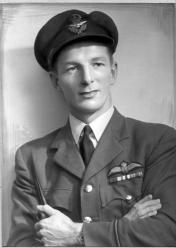
P/O Les Bellinger
- Contributed by
- LesBellinger
- People in story:
- PILOT: LES BELLINGER (ENGLISH) NAVIGATOR: JOHN (SCOTTIE) MCBAIN (SCOTTISH) BOMB AIMER: LES GARDNER (ENGLISH) WIRELESS OPERATOR: NAXIE BURNS (NEW ZEALANDER) FLIGHT ENGINEER: JOHN PRITCHARD (WELSH)REAR GUNNER: SANDY EWEN (SCOTTISH)
- Location of story:
- Norway
- Background to story:
- Royal Air Force
- Article ID:
- A7770909
- Contributed on:
- 14 December 2005
A TRUE STORY OF THE FIRST OPERATIONAL
UNDERGROUND SUPPLY TRIP TO NORWAY.
38 GROUP
295 SQUADRON
‘A’ FLIGHT
RIVEN HALL. ESSEX.
Norway Supply Chapter 3
“Skip, we have used half our fuel.” I had been expecting this news. Climbing with full load in these conditions played the devil with fuel consumption. However we had a big bonus, plenty of height.
“Scottie, can you give me an E.T.A (expected time of arrival) for the dropping zone?”
“Should be there in twenty minutes Skip.” Hm, that’s forty minutes flying time over the limit, longer if we drop. If we drop, and I thought that extremely unlikely, we shall be a few tons lighter but we have to climb over the mountains again, it looks like a diversion to Kinloss our old O.T.U.
“Scottie, have you the maps out for Kinloss.”
“Aye Skip, and it will save us at least one and a half hours. I’ll make out a flight plan.”
“Thanks Scottie.” Trust Scottie to think ahead.
We were now at 13600 feet, the highest we and ‘K’ king have ever been, the violent turbulence had eased for some time but it was still pitch black outside and king was floundering. We had hit the dreaded super cooled water droplets and already I had to make massive column control movements to keep ‘K’ king level on course. I could feel the ice breaking away from the hinge points and partly jamming the controls. We hadn’t much more time.
It was at this point that I said my prayer.
“Lord, we have a few problems and really need your help.” Almost immediately the action to take seemed clear.
“Scottie, I’m changing course 30 degrees to starboard.” “John, I’m increasing power on the three good engines to just below take off boost and revs and holding it for five minutes.” The lightning had moved to the port of our track and so turning to starboard seemed the sensible way ahead.
I couldn’t risk dropping a wing to turn; the loss of lift would have changed the delicate flying balance. I had to gently skid king around on a flat turn with rudder pressure. It seemed to take a long time, but at last the repeater compass notched around onto the new course, and I was able to try to gently ease the nose of ‘K’ king down to gain extra speed.
At this point it was impossible to drop our containers. Opening the bomb bay doors would have destroyed the aerodynamics and we would have dropped like a stone.
The minutes ticked by and I was listening to the engines and by the same massive control movements was helping ‘K’ King to keep airborne. Gradually I sensed it was not quite as dark, and then things happened quite quickly. We had flown into an occlusion a bank of warm air forced up by the cold front.
John came onto the intercom shouting; “All engines clear Skip.” The banshee wailing died and vanished, and King began to fly again, gaining speed and climbing.
I reduced power to normal cruising and continued on course. It was definitely lighter and suddenly we brushed aside the clouds and burst into beautiful brilliant moonlight. What a relief. The memory of that moment remains with me just as clearly to this
day. Glancing around, on the port side we had the black, billowing cumulus clouds towering up into the heavens, but in front and all around as far as we could see was a flat glistening sea of white undulating cloud. It was a very special view.
“Turning onto original course, Scottie, and flying straight and level.” Les had already moved into the astro dome, and Sandy was there to pass the readings to Scottie. Minutes passed and then Scotties intercom crackled.
“Skip, we are there, the frozen lake dropping zone is over to port underneath that mass of cloud.”
“Thanks Scottie, there’s no point in wasting time, with 10/10 cloud and mountains underneath, we’re going home.”
“Scottie, at the moment, as you know, we are low in fuel, can you change your flight plan marking a turning point for Kinloss, an hours flight time from now. ‘K’ king and I have something up our sleeve, we might still reach base. Can you give me the new heading and I’ll turn onto course now.”
“Maxie, will you check on the call signs and frequencies for Kinloss, but don’t call them yet, there will be plenty of time later.”
“Ok Skip, no problem, I’ve been in contact with base and given the no drop signal.” Hm, they will be disappointed. Hope the Groupie and Bill made it. Right ‘K’ king we’ve got to do our stuff.
When we first joined our squadron we were issued with our own aircraft, this for us was ‘K’ King. My most interesting challenge was to fly King to use the least amount of fuel. This meant very careful selection of manifold pressures, propeller pitch settings and carb mixture. But also, and this was very important, the aircraft trim settings. With Stirlings I found, although they were reluctant to gain height,- in fact on our particular missions where we had to lose height to 500 feet we seldom climbed over 6000 feet,- Stirlings were also reluctant to lose height if you went about the right way
After a good deal of patient experimenting I found the design of the wings with their low aspect ratio was perfect for speed and retained height if the nose was inclined down at exactly the right angle. It was possible to gain and hold a high speed, reduce your throttle settings and manifold pressures quite substantially and lose very little height. It was remarkable and exhilarating.
As we settled on course for base, I set King for this best flying angle - I had an indelible mental mark on the artificial horizon, honed the trim settings to fly ‘hands off,’ reduced the power, made the final trim setting and having spun the gyros, clicked in ‘George’ the automatic pilot. By the greatest of good luck, or the grace of God, the cloud formation behind the cold front was tapering down and the flying angle of King and the tapering angle of the cloud matched perfectly. King was in his element, no vibration, engines quiet and yet we were moving fast in brilliant moonlight, seemingly to be gliding down a snow slide of cloud. “John, will you take a close petrol consumption check over the next hour. You must be certain of your figures, otherwise we must change course for Kinloss.”
“Les, how about coffee and sandwiches?.. Good lad.” I sat there munching and drinking while Les took regular astro shots for Scottie to plot. Half an hour passed and John broke the silence; “It’s looking good, Skip, can we hold these settings to base?” “Yes, down to the 2000 feet safety height, John, we’re at 12700 feet now so it should work out just about right.”
We still had our containers on board but we were hanging on to them unless something drastic happened. The engines had taken a beating, but at the moment by the sound of the exhaust they were almost snoring all was well.
Half an hour later John confirmed the petrol position as OK, and we really relaxed. Kinloss, our best hope, was almost certainly involved in that mass of cloud, and although there was an approach over the sea to the main runway, the wind would have to be in the right direction and the runways could be a trifle short for Stirlings. It could have been a tight squeeze.
It was over four hours later when I clicked out George and took over controls as we sank into deep cloud at 5000 feet, wet and mildly turbulent cloud but friendly and not a problem.
Scottie was on ‘GEE’ and it seemed very little time before we were
in contact with base, had confirmed our Q.D.M (course to steer) set our new Q.F.E., and were approaching the drome circuit lights switched to full brilliance.
“Control, K King, permission, please, to join circuit and land.” “Pleased to hear from you K King, you are on your own, no one else flying. Just let me know when you are on the final approach and I’ll have the crew wagon standing by.”
My gosh, we’re getting the red carpet treatment tonight chaps. As we peered through the cockpit screen at the rain twinkling in the runway lights 600 feet below, Les selected full flap and I called control;
“‘K’ King in funnel final approach.”
“All yours, ‘K’ King, by the way there is rum at briefing, I let them know you were in circuit.”
Rum at briefing, that didn’t happen very often. We taxied to our hard standing with the help of our patient, wet but cheerful ground crew, switched off engines, and then contrary to our normal practise, just sat in silence. My thoughts had wandered back to my plea for help, and the immediate answer. It had to be more than coincidence. Today, I am still convinced that help is always there if you genuinely need it and ask for it sincerely and clearly. I never mentioned my plea to the crew, it wasn’t the sort of thing you talked over, which in hindsight was a pity.
The meditation was broken by Phil, “Hi Skip, we want to get to bed, and the crew wagon’s waiting.”
“Sorry Phil, it was quite a trip, and the containers are still on board. We will tell you about it over a beer, but tomorrow, will you check the engines, they had a rough ride. By the way, thanks, you and your lads did a wonderful job.”
We left Phil and his crew to fix the waterproof engine covers, lock all the movable controls and various other tasks. We boarded the crew wagon and very soon had splashed our way to the crew room discarded our flying gear, and were now entering the debriefing room to be greeted by a small group of strangely quiet people. Piping hot, strong black coffee laced with rum was shoved in our hands with the welcome;
“Pleased to see you back, how was the trip, we understand you didn’t drop.”
“Just a moment”, I interrupted, “how did the Groupie and Bill Stewart manage?”
“Well S/LDR Stewart after an hours flying, developed severe engine vibration due to iced up propellers and had to return. Group Captain Surplice flew into severe ice conditions over the target area. He managed to control the a/c for his crew to bail out and they landed on the frozen lake. The Norwegian underground have taken care of them. Apparently there are no casualties in the crew. However it would seem that Group Captain Surplice went down with the aircraft. The underground will be searching the area and will radio back more information as it becomes available.
In the event, it was not until the spring and the thawing of the
snow, that Group Captain Surplice was found still at the controls
of the crashed Stirling. George, the automatic pilot, wasn’t designed for coarse movement of controls and so there would have been no chance for Groupie to reach the parachute exit hatch in the nose before the Stirling started its curving dive into the deep, snow filled ravine.
Meanwhile, by means not divulged, and we didn’t ask, the Groupies’ crew were returned by the underground to the squadron to resume there duties. Unfortunately, one man had lost two toes because of frostbite. One flying boot had fallen of f when his parachute opened, and although the underground reached them fairly quickly and found a bag for his foot, it was already too late, it had frozen on the way down.
Crews very seldom talked about trips unless they were easy ones, but when the Groupies crew returned Scottie and I had a quiet chat with the Groupies navigator.
“It was rough going”, he said, “but we were coping very well and hoping to break cloud over the frozen lake, when out of the darkness came this silent, invisible opponent, clear ice. You really have very little time, and before we could change course or take positive evasive action the Skipper called ‘abandon aircraft.’ We hated leaving him but we had no choice. But jumping out over the mountains in the dark and into cumulus cloud was no picnic, I wouldn’t want to do it again.
The next day after debriefing a squadron member just back from leave shouted across the mess, “The Norwegian trip, old boy, a piece of cake?” Scottie and I looked at each other before commenting;
“Well yes you could say that, ‘a piece of cake.’”
It was the following evening after the early morning debriefing. We had kipped down, awakened late afternoon, completed our ablutions, dined in a very subdued mess, and were now as a crew sipping our final beers in the local pub. We were relaxed and not in a hurry for we had no ops the next night, and were not even listed for a morning test flight.
Phil and his crew had mentioned during the evening that ‘K’ King was OK apart from some loss of power on the port outer engine. It had to be stripped for a check, and so with extra work to their normal daily routine they had reluctantly retired earlier.
At a moment when conversation was flagging and we were each occupied with our own thoughts John said, “We did well with the engines, Skip.
I had wanted to congratulate my crew for a job well done, but wasn’t quite sure how to approach the subject, until Johns comment gave me an opening.
“John, you were superb. I hadn’t discussed with you the possible extra time we had in hand for decoring the engines, I honestly didn’t think it would happen, but you didn’t flinch when we went over the 20 seconds with the high revs, although you must have known the consequences if I had it wrong. You carried on without comment as if it was a purely routine engine setting, and that took a lot of courage and discipline. Additional to that your petrol consumption figures for the trip back were ‘spot on’. It was a very professional effort.
In fact everyone in the crew were top class and I am very proud of you all. Scottie for his flight plans and anticipating our diversion to Kinloss, Les and Sandy for having paper and pencils to hand when the Saint Elmo’s Fire temporarily blocked the intercom, Maxie with the calm way he dealt with base and Kinloss, Sandy for making himself useful all the time, and Les, for his astro shots and after his front turret snow report, accepting without question that we were ‘pressing on’ instead of making the sensible turn back to base. However I promise not to place your lives at risk for weather reasons again. I now know the outside temperatures, to be avoided at all costs. We shall avoid them. Last night we faced all the weather perils, and with help came through. I always knew we were a good team, now in my book you are without question the
best. Certainly I wouldn’t change any one of you for all the tea in China.”
This was an unusual speech coming from me, and as I finished I thought the ending was a bit lame, but it was the only thing I could think of on the spur of the moment. However, everyone seemed very pleased, and finishing our beers we were in a exuberant mood, with a fair amount of good natured banter, as we ambled outside to head for base and kip.
As we approached base Scottie and I waved cheerio to the rest of the crew and were heading for our Nissan hut quarters when Scottie asked, “What help did we get Skip?” “One day I will tell you, Scottie, but not tonight.” There was silence for a few moments then Scottie said; “We’d go through hell with you Skip.” “Thank you Scottie.” It was my turn to feel very pleased, very proud, and at the same time very humble.
Postscript
In ‘Stirlings at war’ by Johnathon Falconer, published by Ian Allen, London, there is a reference to Group Captain Surplice.
‘Stirling IV LK171. (was) skippered by 32 year old Group Captain Wilfred Surplice DSO, DFC, Station Commander at Rivenhall Essex. Because LK171 was placed at the personal disposal of Surplice it did not carry the regular squadron code of either of the Rivenhall squadrons, instead bearing his personal initials, WES. These it bore until the day it crashed in bad weather on a supply drop to Norwegian resistance forces on the 2nd and 3rd November. Surplice ordered his crew to bail out after the Stirling iced up and became difficult to handle. All of the crew managed to escape from the doomed aircraft before it crashed into a mountain near Rjukan at Skarfjell, killing Surplice.’
© Copyright of content contributed to this Archive rests with the author. Find out how you can use this.


 Recommended story
 Story with photo