

- Contributed by
- helengena
- People in story:
- Eddie Gurmin
- Location of story:
- Germany, Poland
- Background to story:
- Royal Air Force
- Article ID:
- A4508002
- Contributed on:
- 21 July 2005
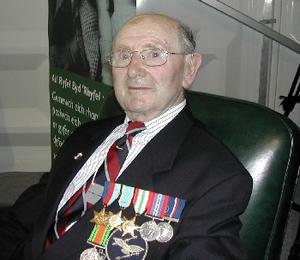
Eddie Gurmin in July 2005
This story is submitted by Helen Hughes of the People's War team in Wales, on behalf of Eddie Gurmin and is added to the site with his permission.
When I was captured, I was taken then….all RAF air crew went to a camp called Dulag Luft which was near Frankfurt where you were questioned. When you first went in there you were put into solitary confinement — they took away all your clothes, they gave you an old pair of trousers, to put on and they used to x-ray the clothes and go through them. We used to have two maps hidden in our jacket there on silk. A map of France and a map of Germany on silk and we also had a compass sewn into the band of our battledress. Well they found the maps, they didn’t find the compass thank goodness. Then they used to give us bogus Red Cross forms. They’d say “This is a form from the Red Cross will you fill it in” and I looked at it and said “Get knotted — I’m not filling that in” and this interpreter said “Come on, it’s a Red Cross form, fill it in” and what they wanted was the name of your squadron and every damn thing. So I said “I’m not filling that in” he walked to the door and opened the door and he looked back at me and said: “You know what this means don’t you?” I said: “No, what does it mean?” He said “If you won’t fill in any forms your parents will think you are dead.” Well of course, I was only twenty at the time and so I thought about that……and he had packets of Gold Flake cigarettes he said “Come on…have a fag” and of course, I don’t smoke, so I said “I don’t smoke mate — Keep ‘em” He came back to the table with his form and said “Come on, come on”. He gave me a pencil and I filled in my name rank and number and stood up and he said “Come on, carry on” and I said: “No, mate…that’s all you’re having” He was really annoyed. The following day they take you into the main camp. And when they had fifty prisoners there they moved you to a permanent camp. So I went to a camp called Stalag 3 E…that was my prisoner of war number 111. There were only 200 of us there. All RAF air crew. The Red Cross didn’t know we were there so we didn’t get any Red cross parcels. We were actually starving and freezing to death. We had one blanket each, we never took our clothes off for six months it was too cold. Two blokes had to sleep together otherwise you’d have died from hypothermia. Then we were getting a loaf of bread between eight men for a day, a cup of watery soup and a couple of spuds — that was your lot. We were so hungry I ate grass, I ate paper. There was one chap there, when he baled out he lost his flying boots so he had a tatty old pair of German army boots and he cut the tongues out and ate them. He ate the tongues out of his boots…we were that bad. They let us keep our flying boots. They took all our flying clothes off us, but they let us keep our boots …and then one night twelve blokes escaped…they knocked a hole through a big stone wall and escaped. The following day they came in and took our flying boots off us and gave us some old french sabots — it was just a bit of wood shaped roughly like a shoe, flat with a bit of catskin across the top. Then we started making a tunnel…actually from underneath my bed. So we started digging this tunnel and because I was Welsh and I was small they thought I was born in a coal mine, so I was stuffed down the tunnel left, right and centre. We were getting on with this tunnel, and thought we’d get it ready for August when it was warmer outside and there were apples on the trees and swedes in the fields…. And suddenly in April the Germans said “We’re moving you” and they were moving us to Sagen, the Great Escape camp. There were four barracks there…I was in barrack number two and that was where the tunnel started from. And we thought “Oh god, which barrack will they move first” ….and they said they were shifting half of us next week. Luckily they left the barrack with the tunnel in it…so we worked like hell, day and night…got the tunnel through…and the night before they shifted the rest of us we managed to get through the wire and break the tunnel and when they came into collect all the blokes they were 52 men short. Fifty-two men had got out through the tunnel, there were only 48 of us left. They got us on parade and they were bringing all the army and navy and air force units round there and all the civilians fetching them in and saying: “That’s what they look like ….now go out and look for them”. It was on the German wireless they had spotter planes overhead looking for them and the German civilians were spitting in our faces when they came in. It was raining, it was cold…they kept us there on parade without food, without water for 13 hours. Then the next day they took us to Sagen, the Great Escape camp. And in Sagen at that time, it was a big camp, with a big wooden fence down the middle and I was a warrant officer….they kept Commissioned Officers one side and non-commissioned officers on the other side. And we were there for 15 months. Then they decided to make it an all officers’ camp. So they shifted us…the NCOs… to a camp in East Prussia…a place called Heydekrug ….and we were in Heydekrug for about 12 months… I used to take part in the shows, we put stage shows on.
Then the Russians started advancing towards East Prussia trying to cut East Prussia off. So they got us down from East Prussia. And evertime we moved we were in cattle trucks, you know, they got us down from East Prussia in cattle trucks and they took us to a camp in Poland called 357 and we were only there for a month and the Russians were still advancing and they shifted us from there then, onto a camp called Fallingbostel in the middle of Germany. And that’s where I was when the camp was liberated. I ended up with TB. I was in the camp hospital …you’ve heard of the march — the great march. Well I should have gone on the march but before the march a German officer, a doctor and our own doctor, the prisoners doctor, Doctor Pollack, they came round examining everybody and they said oh no he can’t go he’s too ill. I had TB so I stayed in the hospital and the rest of the boys were marched out. I was released a bit earlier by the Desert Rats ….and the first tank into the camp — sitting on top of the tank was the chief reporter for British Movietone news . I asked him for his autograph …and he asked me “How long have you been a prisoner” I said “Four years” and he said “Good God”, he said “ and you’re still sane!” and I said “Well that’s debatable” and then I flew home from Germany. That’s the telegram my mother had when I was reported missing.
We were flown home from Germany, when I got home I wasn’t married, I didn’t have a girlfriend, I was completely free…but of course we’d been locked up. The RAF were locked up all the time we were never never never allowed out of the camp….so I was shy of girls, I really was. Anyway I met my wife on her twentieth birthday. She was the first girl I’d really spoken to and come October 1 2005..we’ll have been married sixty years.
© Copyright of content contributed to this Archive rests with the author. Find out how you can use this.



 Recommended story
 Story with photo