

- Contributed by
- The Berry-Hart Children
- People in story:
- Majorie Bird. Jack Bird, Jean Bird
- Location of story:
- Birkenhead
- Background to story:
- Civilian
- Article ID:
- A8020801
- Contributed on:
- 24 December 2005
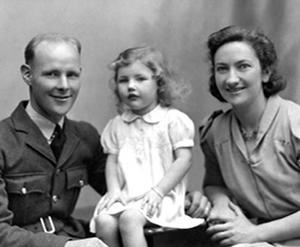
From left to right: Jack Bird, Jean Bird, Marjorie Bird (1941)
A Grandma’s World War.
As children we would always pester our grandmother to tell us about her adventures during the war. Often she would enthrall us with the story of how her house in Birkenhead had been bombed during the Second World War.
Born Marjorie Stones in 1915 in Lancashire, she later moved with her family to Birkenhead, where she married Jack Bird and had three children, and is now thrilled to have ten grandchildren and one great grandson. This is her story in her own words, just as she re-told us on her 90th birthday in June 2005.
For Tristan - her great-grandson.
"It was 1938, and I was 23 when I married Jack Bird and we lived in Birkenhead. I didn’t go to work because in those days married women couldn’t go to work, it was only single women and women who had lost their husbands who worked. It was about 1941 when the government brought it out, that women, who didn’t have a child under 5 had to do war work - well I had a child under 5 so I didn’t have to go.
"We lived in the same house as my mother and father and sister. My husband came home from work on the Saturday lunch time and my baby, Jean was 6 weeks old and he said 'There’s going to be a war so you’ll have to take her away to somewhere safe', so I went to my aunties’ at Weston Heath, Shropshire.
"The morning after I arrived, both my aunties insisted I go and listen to the radio at a friends house, and that’s when I heard Chamberlain declare war from that day. I only stayed a month because no Germans had come over in that month and I’d got weary of being away from home, so I put our things and the baby back in the pram and came home. That was the end of September- beginning of October. I was home for a year and during that year the raids started.
"Jack and my father built our Anderson bomb shelter. If you earned a less than a certain wage the government gave you an Anderson shelter or the money to build one. So we had one delivered, Jack dug the hole and put it in, then put all the soil on top of it and he brought some rape seed home from work and sprinkled it on the soil and then of course it grew and flowered very quickly. To get into the shelter there was a hole, and you had to slither yourself in. It wasn’t a big drop, and we could stand up in the middle of it. Inside we had a cot which was canvas sling for Jean to sleep in. We had two deck chairs and torches but no lights.
Jack was a painter and decorator at Bibbys. In the beginning of November he was called up by the RAF. He wanted to be a radio operator, and was sent to Blackpool for training.
"It was a Monday when he left. First thing in the morning I said 'Cheerio' and I cried and I cried all day, I felt so miserable and I thought, 'He’s gone and he’ll be up in an aeroplane and he’ll never come back and Jean and I will be on our own for the rest of our lives and she’ll never have any brothers or sisters - it’ll just be her and me'. Anyway, that was on the Monday and on the Saturday afternoon who should knock at the door but him - back again! He was on a six weeks course, in Blackpool, to be a radio operator on a plane, and he had sneaked out of Blackpool and hitched a lift with a lady and her daughter who brought him right to our door! So much for my misery! He came home another couple of weekends after that, sneaking out, I think they all did that as they were in digs. At the end of 6 weeks he didn’t pass both parts of the exam. He had been able to send the morse code, but hadn't been quick enough at writing it down when it came in. He had wanted to be a radio operator, and had even built his own radio, but when they wanted him to take the second part of the course again, he said 'No, I’ve tried and I didn’t succeed - so you can put me where you like'. I think he knew I didn't want him flying in planes! So they sent him to Docking, near Birchham Newton, Norfolk to a RAF satellite landing ground which brought in any planes that were damaged. He was on the fire crew for those damaged planes. If a plane came in they had three minutes to get the crew out before the plane blew up — one time it took them longer than that and the plane exploded and Jack ended face down in a corn field with his top teeth knocked out! He looked a sight when he came home.
"The Germans did bomb his RAF airfield one night, there were two hundred soldiers guarding the landing ground and billeted around the camp. They were Canadians who were exhausted from fighting on the continent, and had been sent to guard the airfield while they recuperated. The Germans dropped bombs on the farmhouse where those who were not on guard were sleeping, they were all killed, it was very sad news.
"Our house was bombed on March 12th 1942. The sirens went off at seven o’clock. My father didn’t want to come into the shelter, as he worked a long way away and he didn’t want a cramped night sleeping in the shelter, but my mother persuaded him to come in. I went down to the bomb shelter with my mother and father, and Mr. and Mrs. Sager from next door who didn't have an Anderson shelter of their own. The Germans had been over with some incendiary bombs and the fences surrounding nearby Tranmere Rovers football ground were on fire. It was all ablaze... all lit up. At nine o’clock another lot of planes came over. They must’ve seen the fires and, thinking it was Liverpool, they dropped a stick of five bombs over our residential area. One fell in our front garden and blew the house up, the very back stayed standing but the rest of the house was a crater. We heard the bomb coming down- they make a wheeeeee sound and then a terrible thud and the ground shook, then the explosion and then all kinds of things were thudding on top of the shelter.
Within the hour a policeman came and asked who we were and how we all were. Then he went off and came back with a tray with cups of tea for us all and a glass of milk for Jean, kindly provided by our neighbours the Smiths over the road. The next morning when we were allowed out we saw the front bedroom window frames were on top of the shelter.
"We then realised we had no money on us but I knew where my purse was in the house, so I crawled through the window and managed to get the cupboard draw open and get my purse - because we didn’t have a penny! One funny thing was that there was a stone slab in the pantry which had cracked, and on it were two pints of milk in a jug with a little lace cover still on it, and it hadn't spilt a drop.
"The first thing I wanted to know was why the crater seemed lined with deep pink? When I got closer I realised that it was our deep pink bedroom curtains which were in shreds and had floated down in to the crater. The staircase had fallen in on Jean’s pram and her pram was just flat! We went to Mr. and Mrs. Sager's house next door and when we opened their front door everything was covered in soot, on the floor of their sitting room was one of our pebble-dashed gatepost! It had fallen through their roof.
"Later we found out our neighbours on the other side had nearly been killed by the gas fumes when their gas pipes cracked.
"We were all stunned and it was March and cold. I thought I should get Jack home. Surely they’d let him home. I decided I’d take Jean with me. I went to the police station which was quite a distance away- anyway a landmine had dropped and a big area had been devastated and when I saw it and all the people wandering about I thought 'Oh my goodness, what has happened to us doesn't compare with what had has happened down there'. The police told me to go to the General Post Office to send a telegram. So I went and told my parents. There were no buses. So I stopped a car and a man gave me a lift. He dropped me off and then I saw the queue! It went out of the door and along in front of the Post Office. I joined the queue and more and more people came, gradually it was moving on, moving on. Listening to their stories was very sad, a lot of them had come from the north end of Birkenhead where the gasometer had been hit and blown up. I began think that we were jolly lucky once I heard those stories. Eventually it became my turn and I explained where Jack was and what had happened. The man told me that because of the censorship I couldn't say in the telegram the destination where we were going to go so I wrote 'House bombed. All safe. Gone to Betty’s'. Jack would know that I meant my sister who was in Shropshire. We hoped we would be safe there, but we didn’t really know.
Then my mother and Jean and I got the train from Rock Ferry station to Whitchurch near Brankelowe where my sister Betty was. Betty was about fourteen and off school because she was ill. She was very scared of the war and had been sent away from the bombing because she had a weak heart. Years later we found out she had a hole in her heart, which was why she was always tired and weakened.
"When Jack got the news he was in Norfolk near Sandringham. He’d been out all night dealing with a plane crash and he was sopping wet and he came back to base and then was given the telegram at the office. They let him go immediately and gave him a pass to leave. Because his overcoat was so wet a friend lent him his coat to come home in! They dropped him off on the main road at a policeman’s house and he had to meet a convoy of trucks going to the station. His pass was made out to Whitchurch, but Jack decided he wasn’t going to Whitchurch until he’d seen the house so he went to Birkenhead to see exactly what had happened. After the convoy dropped him off he hitched a lift to Manchester then got the train to Liverpool and then to Birkenhead. He had a good look to see what he could salvage. His beloved piano was gone, along with the rest of the house, and later he found out the keys of the piano had landed in the hedge of a playing field a hundred yards away on the next road.
He then hitched a lift to Whitchurch. He got there the in the early hours of the morning but didn’t wake us up, and just slept on the couch in the sitting room. Auntie Nellie came up to me in the bedroom in the morning and said 'Guess who's here!' - she told me Jack had come in the night. He had forty eight hours leave but it had taken him about a day to get to us. After he’d returned to Norfolk they gave him ten days leave to sort out where we were going to live and what we were going to do. In the meantime we remained at Brankelowe until we could go back to Birkenhead.
"For the first eight nights in May, Liverpool was bombed constantly, so badly that my mother joined us in Brankelowe. One of the bombs had hit an ammunition ship that was docked in the Mersey. There was all white dust in the air and my mother was worried that the Germans had put some chemicals in the bombs to hurt us so she’d walked to Chester to get the train to get to the countryside. As she was walking down the road a man stopped and gave her a lift to Chester. He told her the dust was from the ammunition ship, not from chemicals in the bomb. So she came to Brankelowe, stayed the night and then went back.
"After our house was bombed, my parents had been to Birkenhead town hall and registered that we were homeless. Jack had also made arrangements that any post for us would be redirected to his mother’s house. Jack and Dad had collected as many of our belongings from the crater and the ruins of the house as they could and our neighbour had stored them for us. Later on a friend of ours took our belongings and stored them at her house. It was about sixteen months later that another friend of my parents who worked at the council helped them to get a flat over a chemist's shop. The flat had been damaged but was repaired.
"It was then, I decided I would come home to Birkenhead to join my parents and we made do as best we could. It was there that my first son John was born in 1943.
We lived using the deck chairs from the bomb shelter for furniture and mattresses on the floor for beds. When my grandmother died, my father’s mother, she left her things to me because we’d lost our home and so we finally had a proper bed to sleep on, which we hadn’t had! It’s surprising how you can survive with nothing.
"There wasn’t anything much in the way of bombing then, the Germans did come over but not by us. There were some big guns near us and when they fired the ground used to shake. When that happened we’d go in our Morrison shelter that was like a big metal table. We didn’t sleep there and only twice we got in it - I think we’d got a bit brave by then, hardened to it. We struggled on - well you can’t have much less than nothing!
"When the war finished we still lived at that flat and we heard it on the wireless, we didn’t have a party, we just thought 'Thank God it’s over!!'."
Well, Tristan, we hope you’ve enjoyed our family story. Just writing down Grandma’s words for this web site makes us remember all our childhood visits to her cottage in Neston, Wirral, eating chocolate biscuits in front of the fire and sucking humbugs with Granddad while she told us this and many other stories ...
Your great grandmother is a truly remarkable lady!
With love from Tiffany,
the Berry-Hart Children,
and Jean Fieldsend (nee Jean Bird)
© Copyright of content contributed to this Archive rests with the author. Find out how you can use this.


 Recommended story
 Story with photo