

- Contributed by
- Wymondham Learning Centre
- People in story:
- Lilian Bean (Née Dickinson), Robert Bean
- Location of story:
- Norwich
- Background to story:
- Civilian
- Article ID:
- A3934901
- Contributed on:
- 22 April 2005
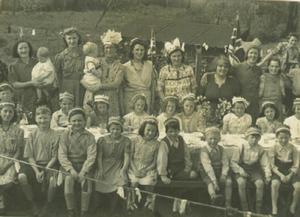
Foxley Close Peace Party
This story was submitted to the BBC People’s War site by Wymondham Learning Centre on behalf of the author who fully understand the site's terms and conditions.
I was born in 1911 and was 28, married and the mother of three children under five when war broke out. We lived in Heigham Street near the centre of Norwich. My husband Robert, who was in RAMC Territorials, was called up the night before war was declared, and after a spell in Colchester and near Durham, ended up in Liverpool dealing with the wounded coming in by ship.
Managing three young children without him wasn’t easy. They couldn’t understand why their father had gone away and kept asking for him. My four-year-old son was little scamp. Once he went and took some cheese sandwiches out of a man’s car and ate them. A few days later we were walking to the shops and he said “No cheese today, Mummy! No cheese today!”
I got very run down and nervous and on my doctor’s recommendation the local council arranged for us to move into a council house in Foxley Close, West Earlham, further from the city centre. When the bombing started the air raid shelter in the house we’d moved from got a direct hit, so we were very lucky to have been moved. When the first air-raid warning went my neighbour, Mrs. Tubby, came in to help me with the children. She looked so funny when she appeared at the door wearing her gas-mask — she thought we had to put them on every time the warning sounded. The children were issued with gas-masks with Felix—the—cat faces. We used to put them on from time to time and get the children to run about, to get them used to wearing them. There was a gas hood for the baby that covered it almost completely, with just it’s [his or hers?] little legs poking out. We never needed the masks, thank goodness.
After we moved to West Earlham I got pleurisy. One night the bombing was terrible, but I didn’t have enough strength to get the children into the bomb shelter. My mother had given us a big wooden kitchen table, and I got that against a wall, put cushions underneath, and took the children under with me to “play tents”. I kept them amused by telling them stories about when I was single, working on a gentleman’s farm. I used to go haymaking in summer. It was nice.
The bombing got worse and David, a young lad who lived next door, helped me to get the children into the shelter at nights. It had proper beds and we used to take in games for the children to play. There was a wall around the entrance with a fire-guard over the top.
One night we were inside and heard an odd “pop — pop — pop”. I didn’t know until next morning that they were incendiary bombs. One landed on the roof of our shelter, one on the roof of the house opposite and one got stuck in the roof of the shed next door. Not one of them went off. When I came out of the shelter next morning I saw that during the night someone had dug up my garden and thrown the earth over them to smother them. I remember coming out early one morning after a night raid and sitting on the wall with my four-year-old son, watching the sun come up. It was beautiful. Even though he was so young at the time, he can still remember it.
One night when we were inside the shelter I heard something rustling around outside.
“Who’s there?” I called.
“It’s only me — your husband!” I heard. His arrival was completely unexpected. His commanding officer, who was very understanding and kind, had given him a few day’s home leave because I was ill.
I didn’t really feel the food shortages. A friend and I would take our children to the local picture theatre and leave them there while we did our shopping. [Was this later in the war when they were older, or did the friend have older children who looked after the toddlers? What films were showing? Were they free?] I used to buy sixpence worth of beef and stretch it to make a shepherds pie and a pudding for the children. I’d buy twenty cigarettes for eleven pence ha’penny and post them to my husband in an envelope for about tuppence.
I’d never taken sugar in my tea, and when the children started drinking tea they didn’t like sugar in it, so I was able to give some of my ration to my mother, who was staying with my sister at Sprowston. I’d cycle over to see them sometimes. I’d just set off for home on my bicycle from Sprowston one day with other people on the road, when a couple of German aircraft appeared flying low above the road and opened fire on us. Machine-gun bullets flew all around and one little boy was absolutely terrified. I said to him “don’t worry love, lie down.” We lay down and the planes passed over. My mother rushed out of the house crying “Oh my God, they’ve got her!” but she was wrong — we were alright.
My children loved seeing the barrage balloons going up over Earlham Park. When things got a bit easier we used to take the children to play there.
My husband Bob had very bad arthritis. Both of his elbows became badly affected, and he was given a medical discharge. Just after he came home we both heard a faint, odd noise in the sky. We looked up, and saw what looked like a bomb with wings. Then the noise stopped, and it flew out of sight. We discovered later that it was a doodlebug, and that when the noise stopped that was a sign that it was about to explode. We’d had another lucky escape.
On V.E. day there was a street party in Foxley Close. My husband and I stood on the rise at the top of Cadge Road in the evening and watched all the lights come on in Norwich. It was a wonderful sight.
© Copyright of content contributed to this Archive rests with the author. Find out how you can use this.



 Recommended story
 Story with photo