

- Contributed by
- barbara_ash
- People in story:
- George Critchlow
- Location of story:
- Dunkirk
- Background to story:
- Army
- Article ID:
- A7410700
- Contributed on:
- 30 November 2005
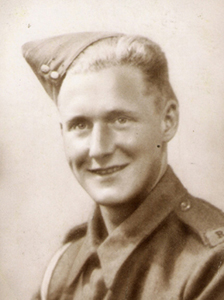
L/cpl George Critchlow, Royal Artillery
Lance Corporal George Critchlow
Gunner-driver, Royal Artillery
Army No. 881919
GEORGE CRITCHLOW — RESCUE FROM
DUNKIRK WAS HIS 21st BIRTHDAY GIFT
By his daughter Barbara Ash
MY father, George Critchlow, was a gunner-driver in the Royal Artillery, when he was posted to France, as part of the BEF, in May, 1940. Only two months earlier he had married his childhood sweetheart Marion, who was later to become my mother.
It was a few days before his 21st birthday that my father arrived at Dunkirk to snatch what refuge he could from the relentless bombardment that had turned the beaches into a charnel house for countless stranded Allied soldiers.
Like many of those round him, George would be ever reluctant to recall the horrific imagery he’d witnessed. In later life, no amount of coaxing by me, my older sister, Janet or his beloved Marion, could force him to recount his time on those terror-filled French beaches.
Only once did he briefly recall how he cradled in his arms a wounded comrade and had to watch, helplessly, as the lad drifted quietly into death. But, whatever personal memories George had of the utter mayhem and carnage surrounding him during those nightmare days at Dunkirk, he kept his own counsel.
George had been a boy soldier, a TA part-time professional, whose journey to the first frontline of World War Two had nothing much to do with any lust for heroics, though none who knew him every doubted his patriotism.
His march into the Army was a forced one, impelled by tragic family circumstances.
As the eldest of four children of a working class family in Harpurhey, north Manchester, the Critchlows had somehow muddled through the deprivations of the hungry 30s, until the man of the house, George’s dad, Ernest, died from TB in 1934.
Despite showing a talent for learning, at 15 it fell to George to become the family’s breadwinner and he took a job as an apprentice butcher. To supplement his meagre wages, George, then 17, took the decision to join the local Territorials.
Nearly four years later, on Dunkirk’s bloody beaches, the price for his devotion to King, country and, most of all, family was brought home to him in ways we cannot begin to imagine.
On the eve of June 4, his 21st birthday, George was one of the last to be repatriated from France. There were no greetings cards, celebratory drinks or back-slapping congratulations to mark his coming of age — only a cold, damp numbness and the awareness that rescue was the most priceless birthday gift of all.
Though George went onto serve in the jungles of India and Burma, he was typical of his stoical generation and never bemoaned his luck — he always boasted how fortunate he was to have had such a wonderful wife and family.
My father later served as part of Troop C, Q Battery, 311/129 Field Regiment, Royal Artillery, in Burma and ended the war in India. He was demobbed in 1946 and died in 1982.
Medals George Critchlow received: 1939-45 Star; Burma Star; Defence Medal; War Medal 1939-45; Dunkirk Medal; Territorial Medal
© Copyright of content contributed to this Archive rests with the author. Find out how you can use this.


 Recommended story
 Story with photo