

- Contributed by
- GrandmaSue
- People in story:
- Frederick John Cole
- Location of story:
- East Kirkby
- Background to story:
- Royal Air Force
- Article ID:
- A4147300
- Contributed on:
- 02 June 2005
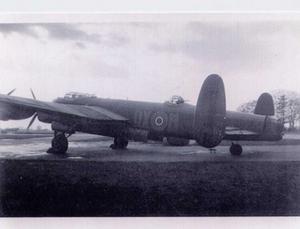
Lancaster DX-M LM626 (MIKE)Crew: Phil Ainley (Pilot), Doug Salisbury (Rear Gunner), Arnold McTrowe (Mid-Upper Gunner), Alf Fishburn (Wireless Operator), Fred Cole (Bomb Aimer), Les Bradbeer (Navigator), Harry Evans (Flight Engineer), Eric Blanchard (Flight Engineer) —7 trips, Ray Francis (Flight Engineer) — 13 trips
My World War II Experiences
by
Frederick John Cole
Part 4: 57 Squadron Bomber Command 1944
There were some unusual trips. We had a few ‘boffins’ about with theoretical ideas on how to improve bombings and so forth. On one trip we were sent to Kaiserlauten on the French/German border. Based there was a big circular of railway sheds and in a brief we were told that each bomber would have a coloured flare attached to the pins of the bombs to be dropped so that it could be clearly identified where the bombs were going. Well, this was fine and the target was as clear as a ‘bell’ and everything was great until the first bombs were dropped. Now you need to know that when you are ‘pumping’ an aircraft through a narrow gap in a comparatively short time and start dropping bombs it does not take much of the imagination to realise that the bombs were not only missing the tail but also just missing the side of the aeroplane! Actually the gunners and everyone in the aircraft were all shouting at once — I won’t tell you what a colourful language came out! Nevertheless we succeeded in completing the bombing run but there was one thing I am certain of - that demoralising exercise was never to be repeated again. I hope that the person or whoever thought up the idea was told it didn’t work!
On another occasion we were asked to try out a new ‘pilot’ type parachute that was strapped to the back as opposed to the traditional chute that was separate and clipped onto two ‘D’ rings at the front. Well, strap the parachute on and you could hardly move in the aircraft - that was the end of that idea! After that, someone came up with the idea of using electric jackets that could be plugged into the aircraft electrics to keep you warm - like toast!! - that idea didn’t last long either.
While our crew were based at Darmstadt we were using ‘H2S’, that is a radar-based technique where the target area is capable of being identified by the density of feedback on the radar screen. There was this one time when we spotted the exhaust of another Lancaster that seemed to be very close and so dropped the nose down sharply. In doing so the ‘astrodome’ flew off the machine, our navigator’s ‘curtaint’ went through the hole and it was ‘bedlam’ - What the navigator was saying was completely unrepeatable at this scary moment but it didn’t affect us as he decided to take some of the pressure off by reducing height.
We didn’t always fly at maximum height. Once on a trip when we were flying at 20,000 feet at maximum speed I do recall the time when I needed to go to the ‘loo’ and to do this you had to unplug your oxygen mask from the socket you were using and remember where the other sockets were along the aircraft for the return journey as the ‘loo’ itself was half way down the fuselage - well could I find the socket at the loo end? I ended up feeling giddy. Eventually I found it but I never tried to do the same thing again. Nothing like learning from experience I guess.
Of my experiences during this time I think the worst night was a mission to Munchen Gladbach. It was the night when most of the squadron were lost. The total Bomber Command losses that night were the worst recorded. Friday 19th September 1944 really was a black Friday.
After Black Friday another trip I should mention was a mission to Konigsberg in Russia. As I recall we were airborne for thirteen hours. It was an uneventful trip and I have always thought it was more of a gesture of support than a serious bombing operation. I say this because the weight factor was fuel and not bomb load.
One time we were sent on a daylight bombing mission over Belgium, the target was a large airfield and I remember that as we approached there was formidable attack fire with shells exploding all around us. We were flying not too far behind another Lancaster, the crew of which I knew very well - all of a sudden they just disappeared. A shell had caught the bomb load and the only evidence we had were bits and pieces in the leading edge of our wings. On the same raid I witnessed a bomb go straight through the wing of another Lancaster but it just kept on flying.
Towards the end of flying duties, I was sleeping “out“ one night at Woodbine cottage. Dot and I were awakened in the early hours by a car hooting outside. It was some of the crew yelling that we had been called for ‘Ops’! In the rush I had no alternative but to dress over my pyjamas! We returned in time for the briefing but shortly after the operation had been called it was, fortunately, cancelled.
I think that covers the variety of missions I completed but one thing I will say and that is about flying. In operations it was a wonderful experience in itself because you and the aircraft were identified together, you spoke to the aircraft and the aircraft was a part of you. You may have been apprehensive at times but never afraid and it always struck me, after the event, what a wonderful companionship we had as a crew and a weird sort of feeling of safety. I can’t find the words to explain it but it was something that, when you look back over the years and see the country in which I am now living - by gosh! ‘Things ain’t half changed!’
There we are, I had completed my missions, thirty-three in all and finished flying on 5th October 1944 when we did a last daylight trip to Wilhelmshaven. As a crew we had finished flying and I must have had some leave and Dot had leave, so we had arranged to meet in Skegness. We were to rendezvous at a railway station en-route at a certain time. I cycled to the Station but no train arrived, so I cycled back and on my return there was a message that Dot got through on lines that were not supposed to be used (I still don’t know how the devil she did it!), but it was a message to say that she was already in Skegness. Right, that was it, I quickly went to my billet to get my bike but it wasn’t there — the flipping batman had borrowed it! There I was hanging around and in the end he rolled up. I quickly retrieved the bike and started cycling from the camp towards Skegness. I hadn’t gone too far when a petrol bowser pulled up and asked me where I was going, so I told him. “Well” he said “I’m not supposed to do this” but nevertheless he fixed the bike on the back of the petrol bowser and took me nearly all the way to Skegness. He dropped me off at a nearby village and I cycled from there.
On arrival the first port of call was the railway station because I knew that if you got stuck for the night you could always sleep in a railway carriage. I started asking folk if they knew of or had seen Dot. I think it was the local butcher who was able to tell me where she was! The following morning we decided to go for a walk, it was a lovely day although a cold wind was blowing. Some people we passed commented, “Oh you found him, we’re so glad” etc. etc. Well it wasn’t long before we got on a train and went down to London and decided to spend a couple of days there. We stayed at the Great Russell Hotel (or was it the hotel in Great Russell Street?). It was great and on the second night we went to see ‘My Fair Lady’ - we got seats right up in the gods! I never felt so uncomfortable in my life because I can’t stand such heights when my seat is attached to the ground! Flying is a different feeling altogether, (Many years later we went to Toronto and stood at the top of the tower over Niagara Falls and I could hardly move! - “Nearer my God to thee” came a voice, “jump you silly b…!”)
Dot left London to return directly to Grimsby and I went back to Skegness - I’d left a bike somewhere there! Eventually I made it back to camp. Having completed all our missions the crew was split up and everything changed. I was asked to go and help loading incendiary bombs into the canister prior to being fitted to the bomb racks. That to me was a waste of time because I’d got a career to think about when I left the RAF. So, I went back and said I was not happy with the duties assigned to me and explained my career ambitions but that I would be quite happy to step in and help out on some administrative requirements if necessary.
That day I was down in the Adjutants’ office! The adjutant at the time was a sickly bloke, always off ill and I found myself immediately involved in the adjutants work under Wing Commander Holloway, a wonderful chap. He kept all the law books on ‘court marshal’ procedures etc. that I gradually picked up. Anyway, came the day when the adjutant was no longer there, I don’t know if he was discharged or what. By then I was holding the position of ‘Base Adjutant’. Now in order to get my memory into perspective, ‘55 Base’ was the central co-ordinating body for three stations, Strubby, Spilsby and East Kirkby itself. Between them there were four squadrons including 207 and 44 Squadron. Anyway, all the documentation from these stations came back to me, so I found myself being absorbed with all the paperwork and started to enjoy what I was doing and settled in very well. I was asked to stay on and so that’s what I did but by this time Dot was pregnant with John and had been discharged from the WRENS.
As I have already said we had been meeting in Stickney, organising ways of getting together when she was able to arrange a night or two off. As it happened, following the occasion we had met and Dot told me she thought she was pregnant, she had returned to base and was immediately called to go and see the First Officer. Her absence had been noted and demands were made to know where she had been, who with, at what address etc. etc. Poor Dot was in deep water. Her response was, “Well, I had to go and see my husband because I wanted to tell him that I think I’m pregnant”. Well that changed the whole scenario. In Dot’s words she said the First Officer jumped up at that and said, “But I saw you rowing in the regatta only the other day! You can’t go rowing when you are pregnant!! I don’t have children myself but my sisters have oodles of them and I can’t recall them ever doing anything like that”. Anyway, Dot was bundled off to the medical centre for a quick check-up and ‘bobs your uncle’ she was out of the WRENS!
Dot returned to Hereford and it wasn’t long before she started coming over to Woodbine Cottage in Stickney, where we had stayed before. She used to get bored and walk around a lot. Eventually the day came when John was “knocking at the door” for release. With the arrival of a new baby Dot had to stay in Hereford. He was still only a few days old when a cloud descended over our lives that we could not have foreseen. John, our wonderful, beautiful baby, had reached a critical situation where he was unable to absorb food, it was not going through him and he was losing weight rapidly. After a lot of trauma and dear Dorothy having to express her milk to literally keep him alive in intensive care, we were told to expect the worst.
In the meantime, with the ‘pulling of strings’ from Wing Commander Holloway I’m sure, the Squadron Commander, the Senior Navigation Officer and someone else, whose name I can’t remember, managed to fly me down to Madley in a Lancaster, a station just outside Hereford and from there I was then put on an RAF wagon that took me into Hereford. What a wonderful, wonderful gesture that was — those sort of things stay in your mind and memories of days and relationships that in modern times seem to have no parallel.
Anyway, on a particular day Dot was seen to go into Hereford cathedral where she prayed earnestly for John’s survival. When she left the cathedral and walked back to the hospital she was greeted by a buzz of activity and hurried to see John. “Its wonderful! A little miracle! Your son is responding - he is going to be alright”. From that day and much to everyone’s relief John gradually got better.
I had to return to camp but it wasn’t too long before Dorothy wanted to come up to be near me. How it happened I have no idea but we ended up staying in the schoolhouse at a little village called Revesby, not far from East Kirkby. The schoolmistress was called Mrs Beecham, a wonderful lady. I used to cycle to and from there, it was a place where I had to get off my bike and walk to get past the geese as I was going into the entrance of the village green - they were wonderful days. Dorothy found herself having to cook on an open fire and do all sorts of tasks that she had never experienced before and life for her was proving a bit difficult. Mrs Beecham made such a fuss of John. Actually she would scare the life out of me when she used to throw him up to the ceiling and catch him! But he loved it!
During this time I had received advance warning of a possible posting as ‘Wing Adjutant’ with a new unit that would be going out to Okinawa to participate in the bombing of Japan. No dates were given but there it was. Shortly after, I was assigned and had to go to Headquarters at Swinderbury near Lincoln with the wonderful title of ‘Camp Commandant’. I never really knew what the devil the job was all about; the Air Force was clearly, to my mind, in a ‘run-down’ situation. I was so bored that eventually I decided to assign myself to a training course at the RAF Officers Secretarial Training College that was based at Credenhill near Hereford. In a matter of days I had made my way down there (I forget when VJ Day comes), but any mention of the Okinawa posting had disappeared.
© Copyright of content contributed to this Archive rests with the author. Find out how you can use this.






 Recommended story
 Story with photo