
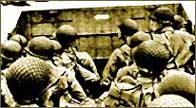
The American GIs were a crucial component in the defeat of the Axis powers - and they had to be tough to survive. Find out what made them tick - and how they kept going through thick and thin.
By Captain Dale Dye USMC (Retd)
Last updated 2011-02-17
The American GIs were a crucial component in the defeat of the Axis powers - and they had to be tough to survive. Find out what made them tick - and how they kept going through thick and thin.
They came late to the ballgame by British standards, but they came to play. They were crude, crass and lacking in military finesse according to Montgomery and other Allied leaders, but they won many more times than they lost.
They were a curious mixture of fervent volunteer kids and caustic older draftees. They were soldiers, sailors, airmen and marines from Iowa cornfields and Detroit assembly lines. They sweated through eight abbreviated weeks of basic training, and shipped out to help throw back the tidal wave of Axis aggression in Europe and the Pacific.
They were crude, crass and lacking in military finesse...
Life at war for the American GI was essentially long hours of hard physical labour, painful slogging under heavy weights and tedious boredom - interspersed with moments of sheer gut-wrenching terror.
It was a hard way to live, more like a hobo than a human being, and creature comforts of any kind were hard to find. They were always hungry and usually moving too fast for field kitchens and hot chow to catch up with the advance.
Stomachs shrank and often rebelled at the weeks of steady D and K rations, crammed with calories and carbohydrates, but tasting just a cut above cat food.
No matter what the weather, dehydration was always a concern. Marching made them sweat, and combat left them cotton-mouthed and croaking. Water was often what they could dip out of a shell-hole. Treated with iodine or halezone tablets to kill the bugs. It tasted...well, it tasted like nectar if you were parched and shaking after a firefight.
Of course, there was always French wine or Dutch beer to be liberated if a GI was storming through Europe. If he was island-hopping in the Pacific, a little Japanese sake was said to help kill the intestinal worms that infiltrated through cuts, jungle sores or shrapnel wounds.
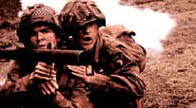 Reconstruction of US troops in action © GI Joe was never much for sartorial splendour in the field. Unlike some of his Allied cousins in uniform, regimental insignia and martial trappings were kept to a bare minimum.
Usually there was a patch on his left shoulder that told at a glance what division he served. A muted chevron or two - sewn or sometimes painted - on his sleeves gave some indication of his rank, but such markings rarely reflected his actual movements up or down the chain of command in a rifle platoon.
In fact, badges or patches tended to disappear altogether, as the GI traded in his original issue field uniforms for replacements at irregular intervals.
It was a wash-basin, cooking cauldron, emergency latrine, entrenching tool and even a deadly blunt weapon when combat came to close quarters.
On his head, the American GI wore a one-pound steel helmet. This was sometimes covered with netting for camouflage purposes. It was one of his most valued items of equipment.
That 'piss-pot' served a plethora of field purposes beyond keeping his head relatively free of enemy shrapnel. It was a wash-basin, cooking cauldron, emergency latrine, entrenching tool - and even a deadly blunt weapon when combat came to close quarters.
American combat uniforms were a combination of wools and rugged herringbone twilled cotton, designed to be worn in layers and usually in a number of non-regulation combinations. Uniforms for the field were designed with a lot of pockets which, given the sparse, uncomfortable nature of his load-bearing equipment, was an asset.
However, the uniforms were hot when they needed to be cool and cold when they needed to be warm. When a GI got wet, he tended to stay that way for a long time. In the immortal words of more than a few GI Quartermaster Sergeants: 'They ain't supposed to be comfortable, they're supposed to last.'
GI Joe's field boots were basically wartime versions of the rugged brogans familiar to farm labourers and other working stiffs who spent a lot of time on their feet. The rough-out half-boot was topped with a canvas legging that inspired monumental and creative cursing when it had to be laced in a hurry.
American paratroops were better served by the cherished Corcoran jump boot and, late in the war, virtually everyone in a line outfit managed to replace his brogans with a higher, buckle-top combat boot; discarding the legging.
There was no Goretex, waterproof poncho or other warm-fuzzy gear in GI Joe's haversack. He made do with an oven-like rubberised raincoat and a standard-issue green blanket, until they got wet and he tossed them aside to lighten his load.
And lightening that load was no minor concern. GI Joe rapidly learned that he could live without practically anything but weapons and ammo.
Fire discipline tended to deteriorate in direct proportion to the proximity of the enemy.
Whether he was armed with the M-1 Garand rifle, carbine, Thompson sub-machinegun or Browning Automatic Rifle, the American infantryman understood that the weapon was useless without rounds to fire, and in combat those rounds burned up quickly.
Fire discipline tended to deteriorate in direct proportion to the proximity of the enemy. So all that 'basic unit of fire for the infantryman' from basic training went right into the roadside ditch.
Basic webbing ammunition belts and pouches were supplemented by as many bandoliers as the soldier could carry without falling down. He stuffed spare clips and magazines in pockets or clipped them in any handy place.
He relied heavily on the Mk II fragmentation hand grenade to keep the enemy at bay or bleeding inside a machinegun bunker. So he gladly withstood the weight of grenades stuffed anywhere and everywhere they would fit.
Of course, he also needed his canteen - or maybe two if he'd run across a wine supply in his travels. He was rarely without his entrenching tool (shovel) or pick-mattock for breaking ground and digging foxholes. There was a bayonet or fighting knife and usually some sort of rudimentary pack for other items deemed absolutely necessary. However, GI Joe was vastly under-equipped by modern standards.
And that's the way he needed to be, in combat or on the march, because he also had to help with ammunition for his support weaponry. Machineguns were valued tools in infantry combat but they ate ammo at astounding rates.
Everyone pitched in to carry extra ammo cans for the .30 calibre. Bazookas were critical - if fairly useless - against enemy armour and extra rockets for them had to be carried. Small but deadly 60mm mortars were the rifle company commander's hip-pocket artillery and he wanted plenty of ammo for those tubes, even if his riflemen had to help carry it.
What's amazing but true is that virtually any American infantryman would also gladly add the weight of a pistol either a GI .45 or an enemy Luger or Nambu to his load. Call it a placebo or security blanket or a hold-over from the days of the Wild West, but GI Joe liked to have a handgun, even if he was unlikely to ever use it in combat.
There were, of course, nights and days on the battlefield just as there were back on the farm or in the cities of America. The difference was that in combat it didn't make any difference.
There were day marches to gain ground, followed by night marches to mask movement. There were night attacks and reconnaissance patrols to be run. There were listening posts and night defensive outposts to be manned. And there were sentry shifts to be stood with no regard for the exhausting activities during daylight.
Sleep became a rare and precious commodity, which GI Joe dreamed about - but only when he was wide awake, marching or standing his post. And then - amidst all this frustration, irritation and agony - GI Joe and his buddies ran smack up against the enemy and the pucker-factor ratcheted up to 'plus four' - or higher.
Small-unit offensive infantry actions on the squad and platoon level tended to fall into two basic types - meeting engagements, in which adversaries bumped into each other while on the march, and assaults on fortified positions.
Sleep became a rare and precious commodity, which GI Joe dreamed about - but only when he was wide awake, marching or standing his post.
The critical issue in each type of engagement was to establish fire superiority over the enemy. This would force them to go to cover or give ground, and then you could manoeuvre to his flanks or rear to take him in a vulnerable spot.
That's plausible, even admirable, on the sand-table, but in a firefight where rounds are snapping near your ears and the ground is being chewed by incoming rounds, the key is to conquer your fear and do something.
You've got to recover from the shock, force your head up from down, spot the threat and react to it. And that's where GI Joe beat his enemies in World War Two.
Americans are generally an aggressive, independent, self-sufficient lot, and nothing in their basic training for combat in World War Two was designed to stifle those characteristics. They knew from their rugged lifestyles on the farms or in their urban schoolyards that you had to be able to take a punch. Or throw the first one and make it count... in order to survive.
That's how they fought down there in the mud and the blood and the gore. While the colonels and the generals waved their hands over the maps, GI Joe waved his rifle in the direction of the enemy, and got the job done in a crude and crass manner without much finesse.
Dale Dye, Retired Captain of the US Marine Corps, had a full career in the US Marines, including extensive combat experience in Vietnam and Beirut. After retiring from this he went to Hollywood. A lifelong military film buff, he offered his military expertise to the film industry, and worked with Oliver Stone on Platoon and with Stephen Spielberg on Saving Private Ryan. He also became military adviser on the 'Band of Brothers' TV series - he appeared in the series as Colonel Sink, the commanding officer of the 506th Parachute Infantry Regiment of 101st Airborne Division.




BBC © 2014The BBC is not responsible for the content of external sites. Read more.
This page is best viewed in an up-to-date web browser with style sheets (CSS) enabled. While you will be able to view the content of this page in your current browser, you will not be able to get the full visual experience. Please consider upgrading your browser software or enabling style sheets (CSS) if you are able to do so.

