
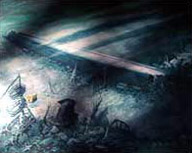
The sinking of the Scharnhorst was an enormous psychological blow for the German nation, at the height of World War Two. The wreck has recently been discovered on the sea bed, giving us new information about a gripping tale of war.
By Norman Fenton
Last updated 2011-02-17
The sinking of the Scharnhorst was an enormous psychological blow for the German nation, at the height of World War Two. The wreck has recently been discovered on the sea bed, giving us new information about a gripping tale of war.
On 19 December 1943, during a conference held in Hitler's Wolfsschanze headquarters, Admiral Doenitz informed the Fuhrer that 'Scharnhorst will attack the next allied convoy headed from England to Russia.' A week later, on 26 December, the Scharnhorst lay at the bottom of the Barents Sea, sunk off Norway in the Battle of North Cape.
Earlier in 1943, Hitler had told his admirals that their Navy was 'utterly useless'. All the heavy ships of the German Navy should be reduced to scrap, their guns removed and used for coastal defences. However Doenitz persuaded Hitler to send the battle cruisers Scharnhorst and Tirpitz to arctic Norway to harass Russian-bound convoys. However, an attack by British midget submarines badly damaged the Tirpitz, leaving the Scharnhorst to operate alone.
"Lucky Scharnhorst", as she was known in Germany, was a focus for national pride.
'Lucky' Scharnhorst, as she was known in Germany, was a focus for national pride. With her flared "clipper" bow and an extraordinary top speed of 33 knots, she had been described as one of the most beautiful warships ever built. 'Lucky', that is, until she was sunk by HMS Duke of York. On Christmas Day, Doenitz signalled Scharnhorst: 'The enemy is attempting to aggravate the difficulties of our eastern land forces in their heroic struggle by sending an important convoy of provisions and arms to the Russians. We must help'.
The Scharnhorst set sail, unaware that she was being lured into a carefully constructed Royal Navy trap with two convoys providing the bait. Shadowing the westbound convoy, and forming the anvil for the attack, was Force One - the cruisers, Belfast, Norfolk and Sheffield. The hammer was Force Two - the battleship Duke of York, the cruiser Jamaica, and four destroyers, which were approaching from the west. One of those destroyers was the Royal Norwegian Navy's destroyer Stord.
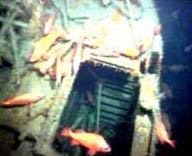 Scharnhorst wreck © The Royal Navy knew that the Scharnhorst was on her way, because members of the Norwegian Resistance had radioed that she had sailed. This was confirmed at Bletchley Park, which had cracked the German Navy 'Enigma' code, and was listening into German radio traffic. On 26 December, the British warships were signalled that the 'Admiralty appreciate Scharnhorst is probably at sea'.
That morning of the 26th, Scharnhorst was only an hour from the Murmansk-bound convoy. However, she was unaware that three British cruisers were approaching from the east. When they opened fire, Scharnhorst was taken totally by surprise, and a shell from HMS Norfolk destroyed the Scharnhorst's radar.
Scharnhorst was now alone and blind, facing a total of 13 Allied warships...
Scharnhorst made a second attempt to attack the convoy, and this time it was she who inflicted damage on HMS Norfolk. Admiral Bey, on board the Scharnhorst, had orders from Doenitz to withdraw 'if heavy forces encountered'.
So he decided to withdraw to Norway, and use to the full her speed advantage of five knots. The British ships could only hope to shadow her at ever-increasing distances, rather than pursue her. To preserve his speed advantage, Bey released his slower destroyer escorts to make their own way back to Norway.
Scharnhorst was now alone and blind, facing a total of 13 Allied warships, as four additional destroyers had now joined the cruisers. For the radar-less Scharnhorst, a ten-gun broadside from the Duke of York announced the arrival of Force Two.
Scharnhorst radioed that she was 'surrounded by heavy units'. But 'Lucky' Scharnhorst still had her greatest weapon - speed. Well on the way to escaping, she signalled Doenitz: 'Scharnhorst will ever reign supreme'.
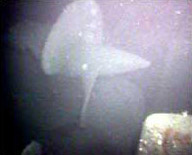 Scharnhorst propellors © However, her escape bid was foiled when one of her boiler rooms took a direct hit, slowing her dramatically. She signalled: 'To the Fuhrer. We shall fight to the last shell'. On board HMS Duke of York, Admiral Fraser ceased firing, and ordered his combined forces to attack with torpedoes.
The destroyer HMS Saumarez was hit, and 11 British seamen were killed outright. A total of 55 torpedoes are fired at Scharnhorst, and 11 found their target. It was as good as over. The commander of Scharnhorst broadcast to his crew that 'I shake you all by the hand for the last time'.
The Scharnhorst had disappeared when HMS Belfast attempted to deliver its second torpedo attack. Admiral Fraser signalled: 'Has Scharnhorst sunk?' and a destroyer replied that she has already picked up survivors.
Fraser then signalled Home Fleet Headquarters 'Scharnhorst sunk'. 'Grand. Well done.' replied the Admiralty. In his official Dispatches, Admiral Fraser stated that 'no ship saw the enemy sink' but, regardless of this, he proceeded to record an official position for that sinking.
I shake you all by the hand for the last time
Almost 60 years later, a Norwegian underwater survey vessel searched the 25 square kilometres of the seabed surrounding that official position. However, the wreck wasn't found. In the Public Record Office in London, the actual navigational log of HMS Duke of York Admiral Fraser's flagship, records an entirely different position for the sinking from that shown in the official Dispatches.
However, is it any more credible than the official position? None of the logs of the other ships taking part in the battle give any positions for the sinking, but there is a unique method to check the accuracy of the log position.
This is a computer driven warship simulator at the Royal Norwegian Navy's Naval Academy in Bergen. It is similar to an aircraft simulator, but with a warship's bridge replacing the flight deck. In order to recreate the battle, the Bergen computers were loaded with navigational data from the log of the flagship, along with her documented performance data.
A virtual Battle of North Cape could now be fought. The simulator transforms itself into the bridge of HMS Duke of York as it was at noon on 26 December 1943. At this time, the exact position for HMS Duke of York is precisely recorded in her navigational log. From now till the sinking of Scharnhorst, the simulator will reproduce every movement of HMS Duke of York.
Seven hours later, at the climax of the re-fought battle, the virtual Scharnhorst is sunk. The simulator's computers download a different area for the sinking - an area of the seabed approximately 20 sea-miles north of the position given in Fraser's official Dispatches. However, would a search of this new area of seabed be any more fruitful?
In September 2000, in an attempt to answer this question, HU Sverdrup II, an underwater research vessel operated by the Norwegian Defence Research Institute, sailed from Hammerfest in arctic Norway.
En route to its regular seabed mapping operations, Sverdrup had already surveyed the area indicated by both the simulator and the Duke of York's logbook. Having detected a large object on the seabed, she is now the sonar platform for a joint expedition by the BBC, Norwegian Television (NRK) and the Royal Norwegian Navy.
Seen for the first time in almost 60 years, Scharnhorst's hull lies upside down on the seabed.
The vessel's multibeam sonar produces an image of two objects, one 170m long, the other 70m long, and positioned at an angle to the first. Is it a wreck and more importantly, is it the wreck of Scharnhorst?
The total dimensions are consistent with those of the battle cruiser. However, it could be a geological feature on the seabed. The expedition transferred to the Royal Norwegian Navy's Underwater Recovery Ship, Tyr.
Sending down her ROV (Remotely Operated Vehicle), part of the mystery is immediately solved. It is a wreck - but is it Scharnhorst? The layout of the surviving weaponry, like torpedo launchers and gun-turrets, leaves no doubt.
Seen for the first time in almost 60 years, Scharnhorst's hull lies upside down on the seabed. Her main mast and her rangefinders are the right way up on the seabed some distance away. As is her entire poop deck, with the stern anchor still in place.
The hull shows extensive damage from both armour-piercing shells and torpedoes. HMS Duke of York fired 80 broadsides; and the Allied ships fired a total of 2,195 shells during the engagement. Some 55 torpedoes were launched at Scharnhorst, and 11 are believed to have found their target. There is now an explanation of why she sank so suddenly. A massive internal explosion - probably in an ammunition magazine below a forward gun turret, had blown off her bow. The entire bow section remains together as a mass of wreckage and armour, but separated from the main wreck.
Of the Scharnhorst's total crew of 1,968 men, only 36 survived. Many of those had been ordered to abandon ship, but were left behind in the water when the Allied ships quickly departed the area. Remembering the incident, Rex Chard, Navigating Officer on one of the destroyers, remarked, 'in sea-warfare one is always very sorry for the sailors. It's the ships you're after - not the men. It could have been you.'
Of the Scharnhorst's total crew of 1,968 men, only 36 survived.
John Hale was on board the cruiser Jamaica when Scharnhorst sank:
'We were all of the same mind. We had to win. Our hearts have mellowed now, but in wartime those hearts are hardened. It was their ship, their pride and joy, and after the Home Fleet had finished with her, she was at the bottom of the Barents Sea.'
In 1940, off Norway, the Scharnhorst and her sister-ship Gneisenau sank the aircraft carrier HMS Glorious and her escort destroyers Acasta and Ardent. 1,519 men were lost from the three ships. Although there were 38 survivors, none had been picked up by the German warships.
Scharnhorst's loss was an enormous psychological blow to the German nation. Equally important to the Allied war effort, the routes of the Murmansk convoys were now much more secure. The loss of the Scharnhorst marked the beginning of the end for the era of the big gun. In future, aircraft-carriers would dictate the outcome of major naval engagements.
Books
Enigma: The Battle for the Code by Hugh Sebag-Montifiore (2000-01)
The Death of the Scharnhorst by John Winton (1983)
Scharnhorst and Gneisenau: The Elusive Sisters by Richard Garrett (1978)
Very Special Intelligence: The Story of the Admiralty's Operational Intelligence Centre - 1939-45 by Patrick Beesly (1977)
The Loss of the 'Scharnhorst' by A J Watts (1970)
The Russian Convoys by BB Schofield (1964)
Memoirs: Ten Years and Twenty Days by Gross-Admiral Karl Doenitz (1959)
The Drama of the 'Scharnhorst': A Factual Account from the German Viewpoint by Corvette-Captain Fitz-Otto Busch (1956)
Hitler and His Admirals by Anthony Martienssen (1948)
Producer Norman Fenton's interest in locating the Scharnhorst resulted from his successful search in the Arctic for the wreck of the Hull trawler Gaul, during a television investigation into the use of trawlers to spy on the Soviet Union's Northern Fleet. His previous film for the BBC, The Other Lockerbie, reported on the shoot-down - by the American missile-cruiser USS Vincennes - of an Iranian airliner and its 290 civilian passengers.




BBC © 2014The BBC is not responsible for the content of external sites. Read more.
This page is best viewed in an up-to-date web browser with style sheets (CSS) enabled. While you will be able to view the content of this page in your current browser, you will not be able to get the full visual experience. Please consider upgrading your browser software or enabling style sheets (CSS) if you are able to do so.

