Election
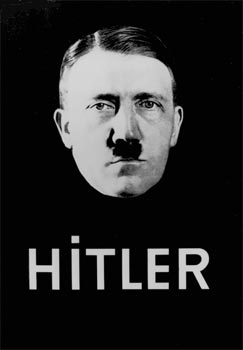
In the last days of the 1932 election campaign, amidst a sea of coloured election posters, the Nazis confidently produced a strikingly effective black-and-white election poster. It consisted of an image of Hitler's disembodied head, set in stark contrast to a black background. Below the face, written in white capitals, was just one word - 'HITLER'.
No electioneering slogan was thought necessary on this poster. The juxtaposition of face and name was considered sufficient to put across the necessary message. Hitler's familiarity, in an age when the mass media was only just being recognised as a potent political force, had largely been established by his astonishing election schedule. By taking to the skies in his Deutschlandflug, accompanied by the slogan 'the Führer over Germany', Hitler addressed major rallies in twenty different cities within a period of only six days.
The umbilical bond between the members of Hitler's 'charismatic community' became so closely identified with the absolute authority of its leader, that when Germans voted in elections in the 1930s the ballot card referred not to the NSDAP but to the Hitlerbewegung ('Hitler movement').
Propaganda for the masses had to be simple, and appeal to the emotions. To maintain its simplicity, it had to put over just a few main points, which then had to be repeated many times. Once in power the Nazis took control of the means of communication by establishing the Reichministerium für Volksaufklärung und Propaganda ('Ministry for Popular Enlightenment and Propaganda') - or RMVP, under Dr Joseph Goebbels.