
V-bombs and boy soldiers: the unlikely partners relied upon to save the crumbling Third Reich. Louise Wilmot examines Hitler's increasingly desperate attempts to turn the tide of war.
By Louise Wilmot
Last updated 2011-02-17
V-bombs and boy soldiers: the unlikely partners relied upon to save the crumbling Third Reich. Louise Wilmot examines Hitler's increasingly desperate attempts to turn the tide of war.
In June 1944 Germany's military position in World War Two appeared hopeless. The situation on the eastern front was catastrophic, with the Red Army poised to drive the Nazis back through Poland. In the west, Allied forces had fought their way through southern Italy as far as Rome. In Britain, the task of amassing the men and materials for the liberation of northern Europe had been completed, and Operation Overlord had begun with the D-Day landings on 6 June.
Hitler ... refused to accept the inevitability of defeat.
Hitler, however, refused to accept the inevitability of defeat. Surrounded by acolytes, he blamed Germany's setbacks on incompetence on the part of his generals, and was convinced that the tide of war could still be turned. Above all, the German people must show the necessary faith and will. 'Providence', he believed, 'will bestow victory on the people that has done most to earn it!'
Hitler placed his hopes on two factors. Offensively, on the introduction of new 'miracle weapons' that would inflict massive damage on the Allied war effort. Defensively, on a tenacious rearguard struggle, bolstered by propaganda and mounted if necessary by boy soldiers.
Research into the military uses of rocket technology and jet propulsion had been concentrated at the Peenemünde research station since the 1930s, under the supervision of Wernher von Braun. In 1942 its scientists had successfully tested two new weapons, later known as the V-weapons ('V' stood for Vergeltung, or retaliation). These were the flying bomb, or V-1, and the long-range rocket, the V-2.
'V' stood for Vergeltung, or retaliation.
Technical problems delayed the deployment of these weapons until the summer of 1944. By then, Hitler had persuaded himself that they would cause such devastation in London that Britain and the United States would be forced to reassess their strategy. The Western Allies might even abandon their 'unnatural' alliance with Stalin and accept a separate peace, allowing Nazi Germany to concentrate its resources on defeating the Red Army in the east.
The first weapon to go into operation was the V-1, a jet-propelled pilot-less aircraft with a one-ton warhead and a maximum range of approximately 200 miles. It could be launched from ramps on the ground or, less reliably, from the air via Heinkel-111 aircraft. After the V-1 reached its target on automatic pilot, its engine cut out and it fell from the sky, giving those on the ground below only a few precious seconds to take cover.
The first ten V-1s were launched on London on 12 June 1944, and six days later 121 people were killed by a direct hit on the Guard's Chapel at Wellington Barracks. At the end of the month some 100 'doodlebugs' - as Londoners called them - were being directed at the capital every day. According to the writer Evelyn Waugh, they were 'as impersonal as a plague, as though the city were infested with enormous, venomous insects'.
According to the writer Evelyn Waugh, they [doodlebugs] were 'as impersonal as a plague' ...
On the basis of secret intelligence reports, the British government anticipated a prolonged onslaught that might cause 100,000 casualties each month, and even require the evacuation of the city. Yet as things turned out, their impact was far less powerful than the Germans had hoped, with some 6,000 Londoners killed by the end of the war, and another 17,000 injured. How did this happen?
One key factor was the Nazis' inability to manufacture enough V-bombs. Only 3,000 were produced each month, instead of the 45,000 the Allies had feared. And their deployment was hampered by RAF raids on launch-sites in northern France, ordered after information was smuggled to British diplomats in Switzerland by the French resistance fighter Michel Hollard.
Of the 10,000 V-1s fired at England, moreover, around a quarter crashed before reaching land, and over half the remainder were shot down by a combination of fighters, anti-aircraft batteries massed on the south coast, and the effective use of radar and proximity fuses.
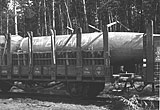 A V-2 rocket destined for England © In September the Germans switched the focus of their V-1 attacks to Antwerp, the chief supply port for Allied forces in Europe. The area sustained similar casualties, but was never put out of action. That same month, however, London came under attack from von Braun's much-delayed V-2.
This 14-metre-long rocket with a one-ton warhead marked the first use of ballistic missile technology in warfare. It was fired 60 miles into the stratosphere before its fuel supply was cut, and the rocket coasted along its preset ballistic trajectory to the target. The first V-2s, fired from launch-sites in the Netherlands, struck London on 8 September.
Hitler now hoped that the V-2s would be 'the decisive weapon of the war'.
Hitler now hoped that the V-2s would be 'the decisive weapon of the war'. The chief grounds for such optimism lay in the fact that the Allies could not defend themselves against the V-2, because the rockets travelled faster than the speed of sound, so the first sign of an attack was a massive explosion when they hit the ground. Yet, although the V-2s had killed more than 2,000 Londoners and damaged thousands of homes by March 1945, they proved no more able than the V-1 to change the course of the war.
The impact of the V-2 was limited by persistent production problems, with delays further increased by an RAF raid on Peenemünde in August 1943. And although thousands of concentration camp inmates were forced to work on the production lines at the Nordhausen underground rocket factory in the Harz mountains, no more than 700 rockets a month were ever produced.
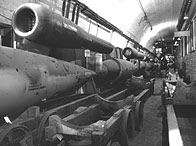
With the rockets at such a rudimentary stage, moreover, they inevitably proved unreliable. Many of them exploded before they reached their target, and a significant proportion went astray because their guidance systems failed. A third 'miracle weapon', a massive long-range gun sited on the French coast, was never fired before the site was overrun by Allied troops.
Looking back, it is easy to conclude that the resources and manpower devoted to the V-weapons programme - 200,000 workers on the V-2 alone - were wasted. But if they hadn't had so many production problems, they could certainly have caused considerable damage to British cities. And V-weapons were the forerunners of many later developments in weapons and space technology.
The rocket research of von Braun, in particular, was so ground-breaking that he and his team were taken to the United States at the end of the war to become an essential part of the American space programme. Their work for the Nazis, including their responsibility for the fate of the forced labourers, was conveniently forgotten. Von Braun became an American citizen in 1955 and director of the Marshall Space Flight Centre in 1970.
The rocket research of von Braun was so ground-breaking that he and his team were taken to the United States at the end of the war
The most fearsome new weapon of all - the atom bomb - was fortunately never available to Hitler. Although its scientists continued to investigate the military potential of applied nuclear fission, Germany's uranium research programme did not progress beyond laboratory level in wartime. Hitler was thus denied a lethal weapon that he would most certainly not have hesitated to use.
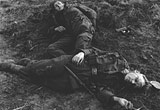 Hitler wanted every inch of Germany defended to the hilt © Once the search for 'miracle weapons' had failed, the only expedient left to the Nazis was fanatical defence against Allied invaders. Every city, every village, every street was to be defended to the last. Superior will, Hitler believed, could still compensate for an overwhelming inferiority in manpower and resources.
But how could Germany be defended when its reserves of fighting men were almost exhausted? It was unable to replace its losses on the eastern front, while the home front was dependent on seven million foreign workers. In the absence of men of military age, the regime was forced to turn new reserves of older men and, especially, boys.
... the only expedient left to the Nazis was fanatical defence against Allied invaders.
The main source of potential fighters was the Hitler Youth, the compulsory organisation for young Germans. In 1943, it provided basic infantry training to boys over the age of 14, while 15-year-olds were set to work in anti-aircraft batteries (where they were joined in the last months of war by some 35,000 members of the women's Labour Service).
In Spring 1943 the Waffen-SS, the armed wing of the SS/Police organisation, requested permission to recruit a special Hitler Youth formation for boys under military age. The 12th Panzer (Armoured) Division Hitlerjugend began training later that year. Most of its 10,000 volunteers were 17-year-olds, and although the division was led by officers who had risen through Hitler Youth ranks, some of its NCOs were boys who had no combat experience at all.
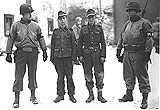 Boy soldiers as young as 10 were captured by the Allies © The division first went into action in Normandy in June 1944, shortly after the D-Day landings. Allied officers attested to the reckless courage of its soldiers, but within a month 20 per cent of them had been killed, with another 40 per cent missing or wounded. The combination of fanaticism and recklessness in the unit was responsible for several war crimes in Normandy, including the murder of Canadian prisoners of war.
Later conscripts were not even given full military training before they went into battle. In October 1944 the Nazis established theVolkssturm for all available men between the ages of 16 and 60. Badly equipped, and consisting mostly of men who were not suitable for normal military service, the Volkssturm was to lose some 175,000 men in its hopeless efforts to repel the Allies.
Boys as young as 10 and 11 were also pressed into service in the chaotic final weeks of the war. In April 1945 some 5,000 of them were sent into action against the Red Army in defence of the bridges in Berlin. Many did not survive. Hitler Youth members as young as 12 were among those awarded the Iron Cross by Hitler during his last public appearance in the Reich Chancellery, on his 56th birthday on 20 April.
... boys fought against battle-hardened soldiers ...
Elsewhere, too, boys fought against battle-hardened soldiers. In Munich, for example, American tanks were confronted by 10- and 11-year-olds, dressed in uniforms too big for them, carrying weapons they were afraid to fire. These boys were taken prisoner and survived the war, but thousands more were less fortunate.
There was to be no 'miracle' for Hitler's Germany. At the end, still unable to accept responsibility for the disaster, the Führer found others to blame. As always, he accused a mythical 'international Jewry' of conspiring against him, but now he turned also turned against his own people. The Germans themselves had been too lacking in will to deserve victory, he said in his final days - and they deserved the wasteland they were about to inherit.
Books
Hitler: Nemesis 1936-1945 by Ian Kershaw (London, 2000)
Nazi Science: Myth, Truth and the German Atomic Bomb by Mark Walker (Cambridge, Mass., 1995)
The Hitler Youth by HW Koch (London, 1975)
Rockets and Missiles by B Gunston (London, 1979)
The Oxford Companion to the Second World War edited by MRD Foot and ICB Dear (Oxford and New York, 1995)
Women in the Third Reich by Matthew Stibbe (London, 2003)
Dr Louise Willmot is Lecturer in History at the Manchester Metropolitan University. She is the author of several articles on resistance to German occupation in the occupied Channel Islands, for example in Bob Moore (ed.), Resistance in Western Europe (Berg, 2000), and has introduced and abridged a volume on the military theorist Clausewitz - Clausewitz, On War (Wordsworth,1997).




BBC © 2014The BBC is not responsible for the content of external sites. Read more.
This page is best viewed in an up-to-date web browser with style sheets (CSS) enabled. While you will be able to view the content of this page in your current browser, you will not be able to get the full visual experience. Please consider upgrading your browser software or enabling style sheets (CSS) if you are able to do so.

