
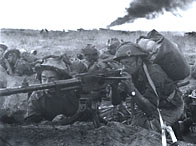
The name given to troops fighting in Italy implied cowardice and avoidance of the 'real' war in France. Richard Holmes examines the 'D-Day Dodgers' and asks whether our obsession with Normandy has distorted history.
By Professor Richard Holmes
Last updated 2011-02-17
The name given to troops fighting in Italy implied cowardice and avoidance of the 'real' war in France. Richard Holmes examines the 'D-Day Dodgers' and asks whether our obsession with Normandy has distorted history.
As the sixtieth anniversary of D-Day approaches, our thoughts are drawn to the diminishing band of warriors who made such an important contribution to winning World War Two and thus shaping the modern world - the Normandy veterans. But, although many of us will celebrate their achievement with pride and gratitude, could it be that by focusing on Normandy, crucial though it was, we risk missing a wider point?
... could it be that by focusing on Normandy... we risk missing a wider point?
This was a world war. The Allied soldiers who fought in Normandy could scarcely have done so without the costly efforts of the Allied navies to keep the Atlantic sea-lanes open. The Luftwaffe was a spent force by June 1944, thanks in part to its long attritional battle against Allied air forces. The Soviet army had ripped the guts out of the German army on the Eastern Front. Had Hitler been free to concentrate in the west, it is hard to imagine how an invasion there could have succeeded.
In addition, although the struggles against Germany and Japan were widely separated, the savage battles in the Far East, for example that of Kohima (just on the Indian side of the Burmese border), are too often forgotten.
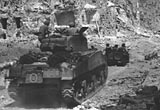 Only on their fourth attempt were the Allies able to break the defences at Monte Cassino © Members of another group of veterans will, I suspect, also have mixed feelings about the way in which Normandy threatens to scoop the pool of national gratitude. These are the so-called D-Day Dodgers. The expression originated in an ill-considered remark made by the Conservative MP Nancy Astor, and soon became a song, set to the tune of Lili Marlene.
The last verse went straight to the heart.
Although its veterans may recall the Italian campaign with mixed feelings, it seemed a sound venture at the outset. Allied victory in North Africa in May 1943 had left powerful forces in the Mediterranean theatre, and it was too early to use them in a cross-channel invasion of Europe.
... Normandy threatens to scoop the pool of national gratitude.
At the Casablanca Conference in January 1943, Churchill and Roosevelt had agreed that an invasion of north-west Europe would take place in May 1944 (although the Normandy landings actually took place in June of that year). In the meantime, the plan was to drive Germany's ally, Italy, out of the war - firstly by taking Sicily out of Axis control and clearing the sea routes through the Mediterranean.
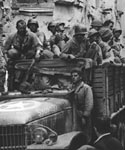 The Allies took Naples on 1 October 1943 © The first Allied airborne landings took place on the night of 9 July 1943, but it was not until 17 August that Messina was captured and Sicily secured. On 8 July, Churchill and Roosevelt had made a joint appeal to the Italian people to oust Mussolini, and on the 25th Mussolini was deposed.
Although the new Italian government, under Marshal Badoglio, still co-operated with the Germans, it opened secret negotiations with the Allies, and on 3 September, the day that Allied forces landed at Reggio Calabria, at the tip of the Italian toe, Italian emissaries signed an armistice.
So far, so good. The removal of Italy from the Axis was no mean achievement, and there was at least a chance that the fifteen German divisions in Italy would respond by pulling back northwards.
The removal of Italy from the Axis was no mean achievement ...
But if the Allies had been expecting the Italian forces to collapse, so too had the Germans, and they moved very quickly when Italy surrendered on 8 September. Italian units were disarmed, and were treated mercilessly if they resisted - the massacre of the Acqui division on the island of Cephalonia, the background to Louis de Bernières' Captain Corelli's Mandolin, was a cruel fact.
And the Allied landing in the Gulf of Salerno, south of Naples, on 9 September did not simply run into determined resistance, it also inspired spirited German counter-attacks, which briefly imperilled the Allies' hold on their beachhead. Although the Allies eventually secured Salerno, and began to advance northwards with Lieutenant General Mark Clark's 5th US Army on the west coast and General Sir Bernard Montgomery's 8th British Army on the east, the tenor of the campaign had been changed by these episodes.
This was to be no bloodless capitalisation on Italian surrender. It was instead a remorseless slog for Allied troops, through a countryside that might have been made for defence, in the face of dogged resistance capably directed by German Field Marshal Albert Kesselring.
This was to be no bloodless capitalisation on Italian surrender.
Italian rivers run to the sea from the central mountain spine, and the Allies moving up from the south found that each river had a ridge behind it, while behind that ridge lurked another river. Superior Allied air power put pressure on German lines of communication as the advance slowly progressed, but German skill at moving troops by night and repairing damaged roads, railways and bridges meant that this was never decisive.
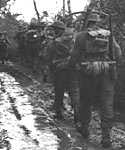 Wet weather in autumn 1944 hampered the Allies' progress © Command of the sea also enabled the Allies to mount amphibious hooks around German defensive lines. Unfortunately the landing-craft that would have been needed for such operations were urgently required for use on D-Day, and so, after the initial landings in September 1943, and with the exception of the ill-starred Anzio landings (just south of Rome) in January 1944, the potential trump card of amphibious warfare was not played.
By this time it was evident that Italy was now to play second fiddle to Normandy. In December 1943 Eisenhower, Allied commander in the Mediterranean, had flown to England to assume responsibility for Operation Overlord, and Montgomery had followed to take command of the ground forces.
... Italy was now to play second fiddle to Normandy.
The Allies had made steady progress up Italy that autumn, taking Naples on 1 October and crossing the River Volturno soon afterwards. The German Winter Line defences, however, running from the Garigliano estuary and on through the formidable Monte Camino, had caused serious losses amongst British and American infantry, and severe weather cost the Americans almost 50,000 non-battle casualties between 15 December 1943 and 15 January 1944.
Just behind the Winter Line the Gustav Line blocked Route 6, the direct road to Rome, as it wound through the little town of Cassino beneath fortifications on the hills above. And it was here, between 11 January and 12 February, that the British and Americans launched the first of four attempts to break the line.
Meantime, on 22 January, with the initial assault on Cassino already a failure, Major General John Lucas's US VI Corps, with British and American units under command, had landed at Anzio and Nettuno, behind the Gustav Line. Lucas played for safety, and although he was to be much criticised for doing so, it is clear that he had too few troops to take Rome, only forty miles away, and maintain his lines of communication to the coast.
Kesselring decided to attack the Anzio beachhead and also to retain the Gustav Line, and the scene was thus set for a series of bitter battles that reminded some participants of those of World War One. German Lieutenant General Fridolin von Senger und Etterlin, who commanded at Cassino, later judged that the battles there reflected most highly on the fighting quality of the German soldier in either war.
... the battles there reflected most highly on the fighting quality of the German soldier ...
At last, in mid-May, after much of the 8th Army had been swung south of the Appenines to generate a crucial superiority, the Gustav Line was broken. But the benefits which might have followed victory were squandered when Clark, disregarding the orders given him by General Sir Harold Alexander, Allied commander, thrust straight for Rome from Anzio, instead of striking eastwards to cut off the retreating Germans and thus allowing them to remain in the fight.
If it is hard to forgive Clark, it is easy to understand him. He knew that the Normandy landings would remove Italy from the front pages of the newspapers, and the leading elements of his army entered Rome on 4 June 1944, enabling a jubilant Roosevelt to declare: 'The first Axis capital is in our hands. One up and two to go!'
If the capture of Rome was a valuable propaganda coup, it did not alter the harsh texture of the fighting in the Italian campaign. Kesselring fell back to the Gothic Line, running from Pisa to Rimini, and although the Allies broke this in mid-September, they made slow progress amid the autumn rains.
They were not helped by the fact that the campaign in north-west Europe was now the main Allied effort, and many experienced units were pulled out of Italy to fight there. Despite this, the final Allied offensive in Italy began in April 1945, and on 2 May German emissaries presented themselves at Alexander's headquarters at Caserta to surrender.
... the campaign in north-west Europe was now the main Allied effort ...
The military commentator Major General JFC Fuller affirmed that the Italian campaign was one 'which for lack of strategic sense and tactical imagination is unique in military history', and Montgomery complained that he was never quite sure what its strategic purpose really was.
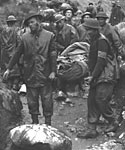 German defences at Monte Camino cost the Allies severely © It certainly cost the Germans more casualties (556,000) than it did the Allies (312,000), and it tied down German divisions that would otherwise have fought elsewhere, some of them no doubt in Normandy.
Yet the campaign left a sense of disappointment. Some Americans felt, as their official history put it, that "It is difficult to justify the heavy investment of Allied troops and material into the Mediterranean theatre during 1944..."
As for those who fought there, the British troops who had played such an important part resented the implications of the phrase 'D-Day Dodgers'. The French North African troops who battled so well in the mountains around Cassino were never taken to France's heart like their comrades of the 2nd Armoured Division which liberated Paris. Neither the New Zealanders nor the equally brave Canadians received quite the praise that they deserved. And few of the gallant Poles who took the dominant Monastery at Cassino, were able to go back to Poland after the war.
... the campaign left a sense of disappointment.
In the face of this, we ought not to allow bickering about the campaign's strategic purpose to obscure the efforts of those who fought in Italy. This year I shall make a point of remembering that, two days before the first Allied soldier landed in Normandy, Allied troops entered Rome. They had already been fighting in Italy for nine long months.
Books
Cassino: The Hollow Victory by John Ellis (London, 1984)
Fatal Decision by Carlo D'Este (London, 1991)
'Five Armies in Italy' by Richard Holmes in Time to Kill: The Soldier's Experience of War in the West 1939-1945 edited by Paul Addison and Angus Calder (London, 1997)
Fling Our Banner to the Wind by John Horsfall (London, 1978)
Richard Holmes is professor of military and security studies at Cranfield University. His books include The Little Field Marshal: Sir John French and Riding the Retreat, and he is general editor of The Oxford Companion to Military History. He enlisted into the Territorial Army in 1965 and rose to the rank of brigadier. He was the first reservist to hold the post of Director of Reserve Forces and Cadets in the Ministry of Defence, until he retired in 2000.




BBC © 2014The BBC is not responsible for the content of external sites. Read more.
This page is best viewed in an up-to-date web browser with style sheets (CSS) enabled. While you will be able to view the content of this page in your current browser, you will not be able to get the full visual experience. Please consider upgrading your browser software or enabling style sheets (CSS) if you are able to do so.

