Operations in France
Operations in France
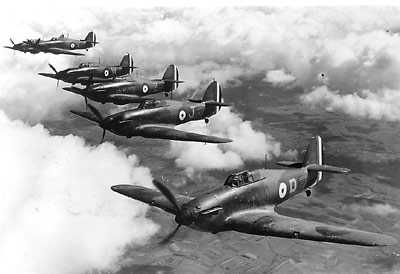
In October 1939, the squadron moved to Vassincourt, where it became a part of the AASF, ready for operations over the front line. This force included ten squadrons of Fairey Battle light bombers, together with the Hurricanes of 1 and 73 squadrons, which were to escort them and to provide protection.
On 30 October 1939, the squadron's Pilot Officer PWO 'Boy' Mould shot down a Luftwaffe reconnaissance Dornier 17, which was the first RAF fighter claim over France. However, opposition in the air was rare during this 'phoney war' period, and by the end of the year only four victories had been claimed.
During the spring of 1940, clashes with the Luftwaffe became more frequent as the weather improved, and by 20 April the squadron 'bag' had risen to 23, for the loss of five Hurricanes and one pilot killed.
On 10 May 1940, the great German offensive in the west (which rapidly became known as the blitzkrieg, or 'lightning war') began. Wehrmacht airborne troops landed in Holland and Belgium, as German tank columns and infantry crossed the frontiers into these neutral countries. At once elements of the French northern armies and the BEF moved forward into Belgium to intercept these invasions.
Meanwhile strong formations of Luftwaffe bombers and fighters launched a series of surprise attacks on Allied airfields, catching many units on the ground. 1 Squadron was fortunate not to be one of those caught, but was swiftly in action, flying many patrols and engaging in frequent fights with opposing formations.
Although almost always outnumbered, the squadron's well trained and experienced pilots did well from the start, and by the close of 13 May had claimed some 40 German aircraft shot down, for the loss in action of nine Hurricanes, but of only one pilot - young Pilot Officer Billy Drake, who was shot down and wounded by a Messerschmitt Bf 110. He baled out of his burning Hurricane, but did not rejoin the squadron until after its return to England.
On 14 May it became clear that German forces had made their way through the Ardennnes forest - thought by the French to be virtually impassable to armoured units - and were in the Sedan area, threatening to outflank the massive fixed defences of the Maginot Line, and to tear a great hole in the Allied lines. French and RAF bombers were thrown in here in a desperate attempt to stop the rot, but huge losses were suffered to Luftwaffe fighters and flak (anti-aircraft fire).