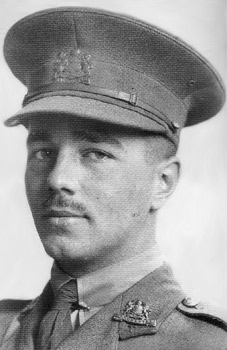
Wilfred Owen
In order to see this content you need to have both Javascript enabled and Flash installed. Visit BBC Webwise for full instructions
- We'd found an old Boche dug-out, and he knew,
- And gave us hell, for shell on frantic shell
- Hammered on top, but never quite burst through.
- Rain, guttering down in waterfalls of slime
- Kept slush waist high that, rising hour by hour,
- Choked up the steps too thick with clay to climb.
- What murk of air remained stank old, and sour
- With fumes of whizz-bangs, and the smell of men
- Who'd lived there years, and left their curse in the den,
- If not their corpses ...
- There we herded from the blast
- Of whizz-bangs, but one found our door at last, --
- Buffeting eyes and breath, snuffing the candles.
- And thud! flump! thud! down the steep steps came thumping
- And splashing in the flood, deluging muck -
- The sentry's body; then, his rifle, handles
- Of old Boche bombs, and mud in ruck on ruck.
- We dredged him up, for killed, until he whined
- "O sir, my eyes - I'm blind - I'm blind, I'm blind!"
- Coaxing, I held a flame against his lids
- And said if he could see the least blurred light
- He was not blind; in time he'd get all right.
- "I can't," he sobbed. Eyeballs, huge-bulged like squids',
- Watch my dreams still; but I forgot him there
- In posting next for duty, and sending a scout
- To beg a stretcher somewhere, and floundering about
- To other posts under the shrieking air.
- Those other wretches, how they bled and spewed,
- And one who would have drowned himself for good, -
- I try not to remember these things now.
- Let dread hark back for one word only: how
- Half-listening to that sentry's moans and jumps,
- And the wild chattering of his broken teeth,
- Renewed most horribly whenever crumps
- Pummelled the roof and slogged the air beneath -
- Through the dense din, I say, we heard him shout
- "I see your lights!" But ours had long died out.
- Wilfred Owen - a short biography
- 'My subject is War, and the pity of War. The Poetry is in the pity. Yet these elegies are to this generation in no sense consolatory. They may be to the next. All a poet can do today is warn. That is why the true Poets must be truthful.'
Owen wrote these words in a planned preface to a book of poetry that he never saw in print. He died on 4 November 1918, on the battlefield at Ors. The news of his death reached his parents, Tom and Susan Owen, on 11 November 1918: Armistice Day. A single volume of his work, entitled Poems by Wilfred Owen, was published in 1920 by Chatto & Windus. It was edited by Owen's friend and mentor Siegfried Sassoon, whose influence on him was profound. The collection earned Wilfred the posthumous accolade of 'the poet of the war'.
Wilfred Edward Salter Owen was born 18 March 1893 in Oswestry, Shropshire. After his school days he took a four-year course as a pupil-teacher. Then in 1913, he spent two years in France, as a language tutor.
War was declared in August 1914 and in 1915 Wilfred wrote to his mother, 'I don't want to wear khaki ... But I now do most intensely want to fight.' In October he volunteered and was sworn into the Artists' Rifles. Eight months later he was commissioned as second lieutenant in the Manchester Regiment, and in December 1916 he left for the Western Front.
After a last luxurious night in a Folkestone hotel, Owen was quickly plunged into the realities of active service, and suffered the horrors described - only three weeks later - in a vivid letter to his mother.
In May 1917, Owen was diagnosed with shell-shock, and he was sent to Craiglockhart War Hospital, near Edinburgh, in June. Here he met Siegfried Sassoon. On 22 September of that year Owen sent a final version of his poem 'The Sentry' - as heard here in audio extracts - to Sassoon, who made sure that it was eventually published.
Wilfred Owen was awarded the Military Cross following his actions on 1-2 October 1918 at Joncourt on the Beaurevoir-Fonsomme Line. Confirmation of the award came after his death.