Ready for war?
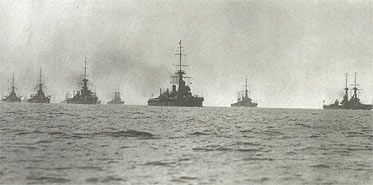
Ready for war? The British were the winners in the pre-war naval race with Germany. At the outbreak of war, in August 1914, the British Grand Fleet had 20 big gun dreadnought and super dreadnought battleships, and four fast battle cruisers, against only 13 German dreadnoughts and three battle cruisers. Although the cautious Admiral Jellicoe, the commander of the Grand Fleet, worried about the relative strengths of the two forces, in fact the Grand Fleet remained superior to the German High Sea Fleet throughout the war.
The threat from torpedoes and mines had led the British to adopt a strategy of distant blockade, basing their major units in Scotland, notably at Scapa Flow in the Orkneys. In this way they shut the Germans up in the North Sea, controlling the access of merchant shipping to Germany and preventing German surface warships from having access to the world ocean.
Neither side was willing to risk their fleets, the British because their superiority already commanded the world ocean, the Germans because they faced almost certain defeat against the whole Grand Fleet. In the background was the restraining influence of Kaiser Wilhelm II of Germany, who took a particular interest in his ships and did not want to lose any. With such caution on both sides, a new Trafalgar was unlikely.