The growth of a system
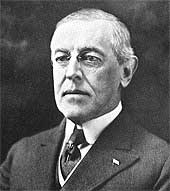 President Wilson; America failed to ratify the League Covenant © Unfortunately, Wilson's thinking about the way that self-determination would work in the real world, and about getting his idea for a 'community of power' off the ground, remained vague. Partly this was to avoid alarming US isolationist opinion, but in any case, when the League Covenant was agreed at the Paris peace conference in 1919, the US Senate refused to ratify it.
How the League would have worked with American participation remains one of the great 'what ifs' of modern history. As it was, the direction of the system was left in the hands of states - primarily Britain and France - whose altruism was questionable and whose economic resources had been crippled by the war.
Yet the League of Nations did work surprisingly well, at least for a decade after the war. By December 1920, 48 states had signed the League Covenant, pledging to work together to eliminate aggression between countries. A series of disputes - between Germany and Poland over Upper Silesia, between Italy and Greece, and between Greece and Bulgaria - were resolved under its auspices.
Though relatively minor, these were just the kind of incidents that had in the past triggered regional conflicts - and indeed World War One itself. There was a widespread belief, or hope, that the League's prestige was growing incrementally. Methods of investigating disputes, and helping to keep the peace, were regularised.
Another crucial function was the establishment of Mandates to bring all the territories that had been liberated from German and Turkish rule, at the end of the Great War, to eventual self-determination. In Iraq, Syria and Lebanon, the process seemed to be moving steadily forward. (In view of its subsequent history, the formal admission of Iraq to the League in 1933 was indeed premature.) The machinery of the League organisation grew more substantial, and the secretariat began to carve out the basis for a quasi-independent role, although this was unplanned and unlooked-for by the old great powers.
The proliferation of League activity, however, carried risks: as one of its founders, Lloyd George, put it, 'it had weak links spreading everywhere and no grip anywhere'. 'Grip' ultimately meant the capacity to use force. When the crucial concept of collective security was put to the acid test in the 1930s, it dissolved. Once big powers started to challenge the status quo, as Japan did in Manchuria, the League found it practically impossible to reach a clear verdict on who was guilty of 'aggression'.
Or, still more disastrously, in the case of Italian pressure on Abyssinia, the guilt was clear enough but the key powers, Britain and France, were unwilling to antagonise the guilty party because of their wider strategic fears. The failed attempt to impose an oil embargo on Italy demonstrated that any credible system of economic sanctions was far distant.
Death and transfiguration?
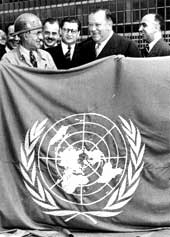 Displaying the UN flag, New York, 1949 © Like the proverbial old soldier, the League never died, but rather faded away. Between the humiliation of seeing one of its members, Austria, taken over by Germany in 1938 without even a formal protest, and the absurdity of expelling the USSR after the outbreak of World War Two in 1939 (an event that neither the USSR nor the League were involved in), all that remained were such wraithlike undertakings as the British Mandate in Palestine.
When the Allies finally began to prepare for the end of World War Two, they rejected any idea of restoring the League, and instead moved to establish a new organisation, the United Nations (UN). The structure of the United Nations was to give a much stronger position to the traditional great powers through the UN Security Council; the most significant thing about its creation, perhaps, is that this time the USA did not back away.
A significant number of the old League's aims and methods were transmitted into the new organisation in 1945. Among these were not only such low-key but effective institutions as the International Court and the International Labour Organisation, but also the working assumptions of the secretariat, and some key operations - including those that would soon come to be called 'peacekeeping' operations.
The UN may have almost stumbled sideways into its peacekeeping role, but the motive and sustaining force in the process was the survival - and the strengthening - of the expectation of international involvement in the preservation of global security. Gradually this came to include the defence of human rights as well as the resolution of territorial conflict. The UN's first attempt to resolve a serious conflict, in Palestine in 1947-8, was unsuccessful, even disastrous: it failed to implement its own partition plan, and its special mediator was assassinated.
None-the-less, UNTSO (the UN Truce Supervision Organisation) opened the gates to a wave of - often bafflingly labelled - successors: UNMOGIP, UNEF, UNOGIL, UNFICYP, UNIMOG, ONUMOZ, UNPROFOR. Some, like the observer force in Kashmir, have remained active for 50 years: not evidence of brilliant success, admittedly, but evidence of hard necessity and a degree of usefulness at least.
Other UN organisations had a shorter but more spectacular life: notably the Operation in the Congo (ONUC) from 1960 to 1964, which prefigured the alarming future for missions to states that were dissolving into civil war. In the Congo, the UN found itself using military force against Katangan rebels to preserve the unity of the state of Congo - a departure from the principle of strict neutrality which has usually been thought vital to the success of its peacekeeping missions.
Dealing with such internal conflict was a far more ambitious and demanding task than the traditional role of assisting consenting states to observe ceasefires. In effect it showed that the UN might need to take governmental responsibility in some situations.