The 'canuck'
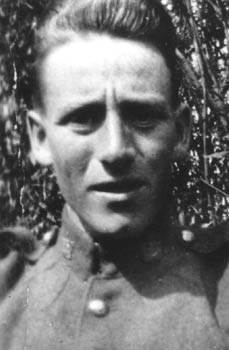
Private Andrew Munro, 'Bomb-proof Andy', 50th (Calgary) Battalion, Canadian Expeditionary Force
The Canadian Andrew Munro was born in Britain but had lived in Canada since the age of two. He was 22 years old when he joined the war as an infantryman, leaving behind his job as a bank clerk.
His steady outlook served him well and he survived the war to be discharged in 1919. Having said that, he made it through some 'tight corners' (as he put it) against all odds, and eventually became known in his company as Bomb-proof Andy.
Private Munro's letters home were less frequent than his British contemporaries' due to the length of time it took for correspondence to reach his family in Calgary, Canada - this must have been hard for him as he once wrote to his father '...a fellow gets lonesome and that's when a letter from home, above all, does wonders'. His letters show resilience but gradually weariness does set in. Nonetheless he was proud of his Battalion and Canada and constant in his written displays of affection for his family, including his little sister Connie who always got her own set of kisses.
What his correspondence does reveal is a healthy scepticism of the righteousness of the war and the authorities who shaped its destiny. But he was also aware of the system of censorship that was in place and had to curb his desire to give a full picture to his parents: 'I cannot give you much news Dad, as they are getting too strict, so I would rather you got a letter with little or no news than none at all.'
Often his requests are practical and typify the nuances of each soldier's needs in the trenches. While in training he writes to his father, 'Oh say Dad will you send me that safety razor and also some blades? The piece of "hoop-iron" the army issued me for the purpose of shaving is strictly on the hummer, so if you do not need that razor I could use it...It will be handier when we go to the trenches too for I guess a fellow has to be able to shave standing on his head there.'
Two years into the war he got a chance to express himself freely. In December 1916 he was issued a pass and returned to England to visit relatives. Without the censors looking over his shoulder he was able to write a long and frank letter home:
Now I am in England I am going to write you a few little things. Suppose you had an idea that we were on the Somme in the midst of the very heaviest of fighting, where the Canadians have won undying fame for themselves...but our losses are heavy indeed, although not to be compared with those of the enemy. The 50th of old is practically extinct, and there are only about 30 of us who are really "originals" left. Do not know how I managed to come through it. Was blown up once, buried once, and thrown down by concussion of bursting shells, and bombed by Fritz in the bargain. That was an awful day I had. I was not a bit nervous during it all, even when I went through humane barrage 3 times, but after I got back to billets my nerves could stand it no longer and I collapsed.
To add to this he described his frustration with the army's regulations: '...never once did the boys grumble. It is when we go back for a rest and buttons have to be polished etc...for inspections by some "big guns" who hand out lots of Hot Air, of which the boys have long since gotten tired.'
Munro was generally cheerful but even he admitted to an occasional fit of the blues. His courage and determination seemed to be strengthened by his pride in the Canadian troops and their reputation: 'Yes, the Canadians have a record that is second to none.'
By the time he was discharged in 1919 after training in the No. 6 School of Aeronautics, Clifton, Bristol, he considered himself 'quite "climatized" - [a] regular old soldier... Some of the boys call me "Bomb-proof Andy", but of course I know that our lives are in the hands of the One, who alone looks after us. We cannot help realizing it in a place such as this.'