Communications in war
- Communications in war
- The ability to communicate effectively is crucial in warfare. On land, voice commands have always been used to direct operations, sometimes supplemented by musical instruments and banners.
At sea in the 18th century the British Navy developed a language for communication between the crews of separate ships using flags - a system famously employed by Vice Admiral Nelson at Trafalgar. In the 19th century, semaphore, another visual system, and the telegraph, which used the new discovery of electrical current, greatly improved strategic communications on land and sea.
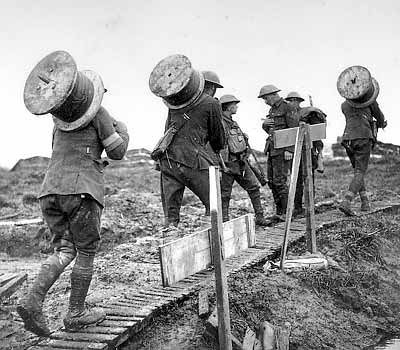
Tactical communications made a further leap forward with the development of the telephone in the 1880s. It was used in the trenches of World War One, but depended upon the laying of land lines, as the illustration here shows. These early telephone systems were not mobile, so radio (a development from the telegraph, and then known as the 'wireless' because it was not dependent on external electrical wiring) played a crucial role in communications - although radio sets were not very portable either.
In the 1920s, radios became smaller and more portable, leading to an improvement in tank tactics as communication between vehicles became possible. The same was true in the air and at sea, and even infantry were equipped with man-portable radio sets. Although these were not infallible, they enormously improved inter-operability of all arms.
As telecommunications developed, the late 20th century saw the development of computer and satellite technologies, creating what is known as a Revolution in Military Affairs (RMA) - the results of which can be seen in the wars being fought in the world today. Despite these achievements communications in war can, and often do, still break down - often due as much to human as to technological failings and errors.