Mobile artillery
- Mobile artillery
- The tank, developed during World War One, was essentially a mobile artillery piece, capable of acting in close support of infantry. Men had long dreamed of such a machine. Leonardo de Vinci imagined it 500 years before its eventual appearance in 1916. The development of the internal combustion engine was crucial to its viability, although the first machines were very crude and prone to breakdown. The tank with single gun turret became the classic design in the early years and the look remains essentially the same today, although modern tanks carry infinitely more sophisticated machines.
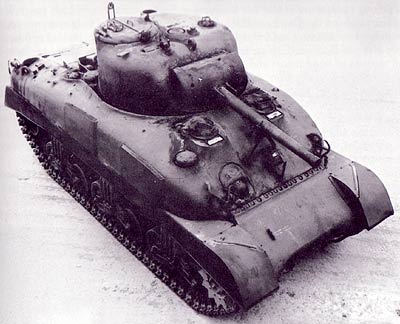
The Sherman tank, illustrated here, was named after the famous American Civil War general William Sherman, and was an invaluable weapon in World War Two. Produced cheaply, quickly and in huge numbers (50,000 by the end of the war), it was a testament to American inventiveness and productivity. The British Army, which was ill-served by its own machines, benefited enormously from its introduction in 1942, just prior to the Battle of El Alamein.
Crucially, the tank's 75mm gun could fire both armour-piercing and high-explosive rounds, providing a previously difficult to achieve tactical flexibility. For the crucial Allied invasion of Normany in 1944, one in four of the Allies' vehicles was given a 17-pounder gun, which enabled it to beat all opponents - except the German Panthers and Tigers. It did however have one main weakness, its lightly armoured petrol tank, which resulted in it catching fire easily. Germans dryly referred to it as a 'Tommy cooker'.