The horse in war
- The horse in war
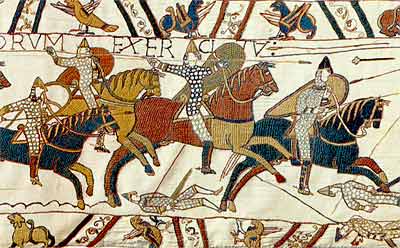
- The Norman cavalrymen shown here on the 11th-century Bayeux Tapestry represent the impact of horse power on warfare. Their prowess at the Battle of Hastings in 1066 helped to change the fate of England, leading to the victory of William the Conqueror.
Horses were first domesticated on the grasslands of western Asia, and used initially to draw chariots (c.1700 BC). Examples of their uses from the earliest times can be seen in depictions of Egyptian pharaohs, who are often shown riding down their enemies, bow in hand.
Around 900 BC the Assyrians had themselves portrayed riding bareback, with archers and spearmen working in teams. Then the invention of stirrups increased the riders' momentum, and thus the impact of such cavalry. Stirrups first came to Europe via the Asiatic Avars around 600 AD, but do not seem to have been widely adopted in the West until the ninth century.
Around 1100, improvements in horse furniture - taller saddles and double-girthing - led to the development of the technique of jousting with lances. This enabled knights to unhorse an opponent by sheer impact, the man and horse united as a missile.
Stories of horses and knights riding over enemy foot soldiers are much exaggerated, though. Horses are far too intelligent habitually to impale themselves upon infantry spears. It was the confidence and cohesion of the footmen who faced the cavalry that was the main factor in determining the outcome of any confrontation.
The knight on horseback played an important role as the image of warfare for hundreds of years. Then the increased effectiveness of battlefield archery from c.1350, and the development of gunpowder weapons from c.1500, reduced their battlefield role once more to that of auxiliary to the infantry - as it had been at the time of the Romans.