
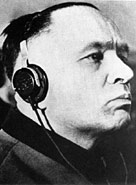
Auschwitz is a place of unparalleled horror and the site of the largest mass murder in history. Laurence Rees looks inside the mind of the man who built and ran the camp.
By Laurence Rees
Last updated 2011-02-17
Auschwitz is a place of unparalleled horror and the site of the largest mass murder in history. Laurence Rees looks inside the mind of the man who built and ran the camp.
What sort of man was the commandant of Auschwitz, the site of the largest mass murder in the history of the world? A place crammed with suffering, where acts of nightmarish atrocity were everyday occurrences. Try to conceive of the person capable of holding down such a job. Who do you see?
There is no record of him ever hitting - let alone killing - anyone.
At a guess, you are picturing someone like Amon Goeth, commandant of Plaszow labour camp in Poland, memorably portrayed in Schindler's List by Ralph Fiennes - an irrational, sadistic monster who took pleasure in personally inflicting torture. Someone utterly different from the people you encounter in everyday life. But if you imagined such a person was commandant of Auschwitz, then you're wrong.
According to Whitney Harris, the American prosecutor who interrogated him at the Nuremberg trials, Rudolf Höss appeared 'normal', 'like a grocery clerk'. And former prisoners who encountered him at Auschwitz confirmed this view, adding that Höss always appeared calm and collected. He is the greatest mass murderer the world has ever seen, and yet there is no record of him ever personally hitting - let alone killing - anyone at the camp.
Höss lived with his wife and four children in a house just yards from the crematorium in Auschwitz main camp, where some of the earliest killing experiments were conducted using the poisonous insecticide Zyklon B. During his working days, Höss presided over the murder of more than a million people, but once he came home he lived the life of a solid, middle-class German husband and father.
It is this apparent 'normality' that ultimately makes Höss a much more terrifying figure than an unhinged brute like Amon Goeth. It compels us to try - in so far as it is ever possible - to understand him and the historical circumstances that made his murderous career possible.
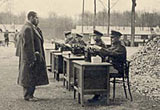 Registration at Dachau © Like most ardent Nazis, Höss's character and beliefs had been shaped by his reaction to the previous thirty years of German history. Born in the Black Forest in 1900 to Catholic parents, Höss had a domineering father who insisted on unquestioning obedience.
He served in World War One as the youngest NCO in the German Army, experiencing a desperate sense of betrayal at the subsequent loss of the war. In the early 1920s, Höss joined the paramilitary Freikorps to help counter the perceived communist threat on the boundaries of Germany, before his involvement in violent right wing politics led to his imprisonment in 1923.
The most urgent need was to understand why Germany had lost the war.
Many, many other Nazis were forged in a similar crucible, not least Adolf Hitler. For Hitler, Höss and others on the Nationalist Right, the most urgent need was to understand why Germany had lost the war and made such a humiliating peace. And in the immediate post war years they believed they had found the answer.
Was it not obvious, they felt, that the Jews - with their alleged Communist sympathies - had 'stabbed Germany in the back'? It didn't matter that large numbers of loyal German Jews had fought and died during the war. Nor that thousands were neither left-wing nor Communist. It was much easier to make the Jews a scapegoat for Germany's predicament.
Höss claimed to have little quarrel with individual Jews. The problem for him was the 'International World Jewish Conspiracy' - the anti-Semitic fantasy that Jews secretly held the levers of power and sought to assist each other across national boundaries. He later wrote: 'As a fanatical National Socialist I was firmly convinced that our ideals would gradually be accepted and would prevail throughout the world... Jewish supremacy would thus be abolished.'
Höss joined the Nazi party in November 1922, shortly after it was founded. Heinrich Himmler, an ardent Nazi talent spotter who knew Höss from the early days, invited him to become an active member of the SS. Höss accepted and in November 1934 arrived at Dachau concentration camp in Bavaria to start his service as a guard.
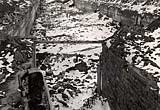 Ruins of crematorium and gas chamber at Auschwitz © tDachau in the 1930s was not a place of mass extermination. The majority of prisoners sent there were released after a stay of imprisonment of around a year to eighteen months. Intense mental and physical suffering were inflicted on the prisoners, many of whom died, but it was easy for Höss to rationalise. He felt it was important to imprison and forcibly 're-educate' the internal opponents of the Third Reich.
Höss's three-and-a-half years at Dachau were to play a defining role in shaping his mentality. Above all else, it is where Höss learnt the essential philosophy of the SS, as preached by Theodor Eicke, the first commandant of the camp - hardness: 'Anyone who shows even the slightest vestige of sympathy towards [the prisoners] must immediately vanish from our ranks. I need only hard, totally committed SS men. There is no place among us for soft people.'
His experience at Dachau and Sachsenhausen offered a clear blueprint.
Höss was a model SS man and rose through the ranks, eventually being promoted to Rapportfuehrer, chief assistant to the commander of Dachau. In September 1936 he was made a lieutenant and transferred to Sachsenhausen concentration camp, where he remained until his elevation to commandant of the new concentration camp at Auschwitz.
This then was the man who arrived at Auschwitz in May 1940. He now felt ready to take on his biggest challenge - creating a new concentration camp from a handful of vermin-infested barracks. His experience at Dachau and Sachsenhausen offered a clear blueprint.
During his first year at the camp, Höss oversaw the expansion of Auschwitz from a poorly-resourced but brutal concentration camp for Poles into a source of slave labour for the construction of the giant synthetic oil and rubber factory at nearby Monowitz. It was also readied for the arrival of selected Soviet prisoners of war in July 1941.
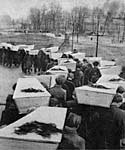 Funeral procession of Auschwitz dead © It was to murder these 'sub-human' Soviet prisoners, as well as to kill those considered 'unfit' to work, that Zyklon B was first used at Auschwitz. It was Höss's deputy, Karl Fritzch, who first thought of using the readily available insecticide to kill human beings.
Höss records that he personally attended an early gassing experiment: 'Protected by a gas mask, I watched the killing myself. In the crowded cells death came instantaneously the moment the Zyklon B was thrown in. A short, almost smothered cry and it was all over.'
Höss was an active innovator in the way he organised the killing process.
While the evidence is that death could be far from 'instantaneous', Höss was nonetheless 'relieved' that this new method of killing had been found so he would be 'spared' a 'bloodbath'. He saw his subordinate's innovation as an 'improvement' - a method of murder that would cause less psychological damage to his men than killing by firing squad.
At Auschwitz-Birkenau, a new camp being built two miles away from the main camp, Höss oversaw the conversion of two cottages into makeshift gas chambers. By 1943, a total of four purpose-built crematoria with attached gas chambers had been completed. These killing installations would eventually contribute to the physical destruction of one million, one hundred thousand people, a million of whom were Jews.
Höss's long career in concentration camps prepared him step-by-step for the moment when the gassings began at Auschwitz, thereby allowing him carry on, calmly and faithfully, organising the killing. He was never faced with one sudden, stark command that he should commit mass murder.
But Höss was no mere 'robot', blindly following orders. He was an active innovator in the way he organised the killing process. On a number of occasions he even felt able to criticise his boss, Heinrich Himmler. Höss knew he never needed to fear terrible retribution if he criticised an order because, strange as it may seem, the Nazi leadership allowed functionaries lower down the chain of command openly to use their initiative and voice their views. He believed wholeheartedly in the overall Nazi vision, and this meant he felt free to question the details of its implementation.
Höss was behaving in a similar manner to many former Nazis who, unlike him (Höss was executed in 1947), survived to be integrated back into post-war German society. But there is something about the mentality of the Nazis that seems at odds with the perpetrators who flourished in many other totalitarian regimes. I have met and questioned perpetrators from all three of the major totalitarian powers - Germany, Japan and the Soviet Union. Having done so I can confirm that the Nazi war criminals I met were different.
In the Soviet Union the climate of fear under Stalin was pervasive in a way it never was in Germany under Hitler until the last days of the war. Such was Stalin's malevolence that no one was safe from the knock at the door at midnight. But in Nazi Germany, unless you were a member of a specific risk group - like the Jews, the Communists, the 'Gypsies', homosexuals, the 'work-shy' - you could live comparatively free from fear. The central truth still holds that the majority of the German population - almost certainly right up until the moment Germany started to lose the war - felt so personally secure and happy that they would have voted to keep Hitler in power if there had been free and fair elections.
The mentality of the Nazis seems at odds with the perpetrators who flourished elsewhere.
Such was the intense insecurity of those who perpetrated crimes at Stalin's behest that they often didn't know the reasons for the suffering they inflicted. The former Soviet secret policeman I met who bundled Kalmyks into exile in Siberia had committed a crime because he was told to, and knew that if he didn't then he would be shot, so he trusted that his bosses knew what they were doing. He said he had been 'acting under orders' - the justification so commonly ascribed to Nazis. When Stalin died, the policeman was free to move on and leave the past behind.
Then there were the Japanese war criminals who committed some of the most appalling atrocities in modern history. In China, Japanese soldiers split open the stomachs of pregnant women and bayoneted the foetuses. They tied up and used local farmers for target practice. They tortured thousands of innocent people in ways that rival the Gestapo at their worst. And they were pursuing deadly medical experiments long before Josef Mengele at Auschwitz.
The Japanese soldiers of World War Two had grown up in an intensely militaristic society; had been subjected to military training of the most brutal sort; had been told since they were children to worship their Emperor (who was also their commander in chief); and lived in a culture that elevated the desire for conformity into a semi-religion.
This is encapsulated by the veteran I met who, when asked to take part in the gang rape of a Chinese woman, saw it less as a sexual act and more as a sign of final acceptance by the group, many of whom had previously bullied him mercilessly. Like the Soviet secret policeman, many Japanese veterans attempted to justify their actions almost exclusively by reference to an external source - the regime itself.
Something different appears in the minds of many Nazi war criminals. Not just Rudolf Höss, but also members of Nazi killing squads who shot Jews in the Soviet Union. Even today, many of those I have interviewed are not sorry for what they did. Indeed they almost appear proud of their actions.
The easy course would be to hide behind 'acting under orders' or 'brainwashed by propaganda' excuses, but such is the strength of their own internal conviction that they don't. It is a loathsome, despicable position - but nonetheless an intriguing one.
Many of those I have interviewed are not sorry for what they did.
Contemporary evidence shows that this frame of mind is not unique. At Auschwitz, for example, there is not one recorded case of an SS man being prosecuted for refusing to take part in the killings. On the contrary, the real discipline problem in the camp - from the point of view of the SS leadership - was theft. There were even suspicions that Höss himself was personally profiting from the murders.
The SS at the camp thus appear to have agreed with the Nazi leadership that it was right to kill the Jews, but disagreed with Himmler's policy of not letting them individually enrich themselves from the crime. The penalties for an SS man caught stealing could be draconian - almost certainly worse than for simply refusing to kill.
Men like Rudolf Höss and many of his SS colleagues were not automatons, mindlessly responding to the commands of their masters. Their role is at once more complex and more troubling, for it reveals that one of the worst crimes in the history of the world was committed - to a large part - not by those touched with obvious lunacy like Amon Goeth, but by human beings who calmly and coldly thought through their actions, and then made possible the murder of millions.
That knowledge alone makes this a history that should be studied now and in the future, and is a warning for us and for those who will come after.
Books
Final Solution: Origins and Implementation edited by David Cesarani (Routledge, 1997)
The Holocaust: A History of the Jews of Europe During the Second World War by Martin Gilbert (Henry Holt, 1987)
The Nazis: A Warning from History by Laurence Rees (New Press, 1999)
The Racial State: Germany 1933-1945 by Michael Burleigh and Wolfgang Wippermann (Cambridge University Press, 1991)
The Path to Genocide: Essays on Launching the Final Solution by Christopher R Browning (Cambridge University Press, 1995)
The Origins of the Final Solution: The Evolution of Nazi Jewish Policy September 1939-March 1942 by Christopher Browning (William Heinemann, 2004)
Auschwitz: The Nazis and the 'Final Solution' by Laurence Rees (BBC Books , 2005)
Laurence Rees, writer and producer of the six part BBC/PBS series 'World War Two Behind Closed Doors: Stalin, the Nazis and the West' is an award winning historian of World War Two and the Third Reich. His previous book 'Auschwitz: The Nazis and the ''Final Solution'' won the British Book Award for History Book of the Year in 2006 and the television series of the same name won him a Grierson Documentary Award. He has written five other history books including, 'Nazis: A Warning from History', 'War of the Century', 'Horror in the East' and 'Their Darkest Hour'. 'Nazis a Warning from History', 'War of the Century' and 'Horror in the East' were also successful television documentary series - all written and produced by Laurence Rees.




BBC © 2014The BBC is not responsible for the content of external sites. Read more.
This page is best viewed in an up-to-date web browser with style sheets (CSS) enabled. While you will be able to view the content of this page in your current browser, you will not be able to get the full visual experience. Please consider upgrading your browser software or enabling style sheets (CSS) if you are able to do so.

