
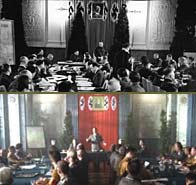
Drama offers a powerful means to explore events that haven't been captured on film but as Detlef Siebert explains, the need for absolute accuracy outweighs any other consideration.
By Detlef Siebert
Last updated 2011-02-17
Drama offers a powerful means to explore events that haven't been captured on film but as Detlef Siebert explains, the need for absolute accuracy outweighs any other consideration.
In most factual television programmes, dramatic reconstructions serve as backcloth - or 'wallpaper' in filmmakers' jargon - to illustrate interviews or narration. And some of the drama scenes in the BBC's six-part docu-drama series, 'Auschwitz - The Nazis and the Final Solution', are used in just this way.
Many dramatic scenes in the series, however, take on more than just a supportive role for other content, and tell their own story through dialogue. This is because the programme makers aimed to take the viewer into the real world of the Nazis, to provide insights into their motives and decision-making - insights that no interviewee could provide.
The drama reconstructions of the BBC, however, had to be as close as possible to the historical reality.
There are, of course, countless feature films based on actual events and characters of World War Two, which also take the viewer into the Nazi world. Films such as Schindler's List, Hitler: The Last Ten Days (with Alec Guinness in the role of the Führer), or Conspiracy: The Meeting at Wannsee (with Kenneth Branagh as Reinhard Heydrich), to name but a few.
Although many of these films are very well researched, they are essentially fictional works. Since they are, above all, intended to tell a story, they inevitably use a good deal of artistic license, at the expense of factual accuracy.
The drama reconstructions of the BBC, however, had to be as close as possible to the historical reality. Any fictional elements or factual errors in the drama scenes would have compromised the integrity of the entire series. The historical accuracy of set design, cast and dialogue was therefore of greatest importance.
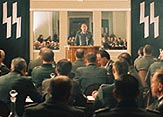 Reconstruction of Himmler's 1943 speech which described the Jews' destruction as a 'page of glory in our history' © In a few cases, this was relatively easy to achieve. The second episode, for instance, shows the Nazi governor of occupied Poland, Hans Frank, giving a speech at a conference of senior officials, in December 1941, about plans for the mass murder of the Polish Jews. Both a transcript of the speech and an attendance list of the conference survived the war, so the programme makers knew exactly what Frank said and who was there when he said it.
The location where the speech was given was also known, and a researcher managed to unearth two photos of the actual occasion, which enabled set designers to re-create the exact look and feel of the place.
Such a degree of verisimilitude would have not been possible if the scene had been filmed in English rather than German.
For a similar reconstruction in episode four - Heinrich Himmler's infamous speech to SS generals in Poznan/Posen in October 1943 where he describes the destruction of the Jews as 'a page of glory in our history' - it was even possible to draw on an audio recording of the speech. The actor playing Himmler used the recording for an extensive rehearsal, and very skilfully adapted the Nazi leader's characteristic way of speaking.
Such a degree of verisimilitude would have not been possible if the scene had been filmed in English rather than German. But to remain true to the factual reality, all drama in the series was shot in the original language of the historical event, for transmission with subtitles.
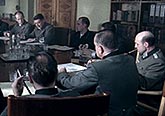 Reconstruction of a meeting at which Nazi officials decided that millions of Soviets would be allowed to die through starvation © However, it has to be said that the available documentation for the speeches by Frank and Himmler is unusual. For most historical events, the source material is far less comprehensive and reliable. First-hand word-by-word accounts of historical dialogue are extremely rare. More often than not, the programme makers had to rely on reports or minutes, most of which offered merely summaries of what was actually said.
To give one example: in the run-up to the German invasion of the Soviet Union, a committee of Nazi officials held a meeting, in which it was determined that for the German Army to be able to requisition enough food for themselves millions of Soviet people would have to be starved to death. It is a historically significant meeting - but the only record of it is a note of a few lines.
It is a historically significant meeting - but the only record of it is a note of a few lines.
To be able to reconstruct the dialogue, it was necessary to look elsewhere for supplementary sources. Researchers studied memoranda and other documents that the leading members of this Nazi committee wrote at the time of the meeting, and in which they set out their plans for the occupied Soviet territories. This allowed the drama director to compose a dialogue of direct quotes from documents that reflect the thinking of those present at the meeting.
Yet although every single word spoken in the resulting drama scene was based on primary sources, the scene could never be more than an approximation of the historical event - a fact that is made clear in the commentary that introduces the scene.
As any historian knows, historical sources are imperfect material and can rarely be taken at face value. It's not just that most historical records are incomplete - they may also be misleading and unreliable. Before any historical source can be used, the circumstances in which it was produced and the possible motives of its author have to be taken into consideration.
This is particularly true for post facto testimonies, such as memoirs, affidavits, or interviews, where the time gap between historical event and testimony puts an additional question mark over the factual accuracy of the source.
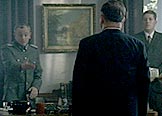 Reconstruction of a meeting at which Eichmann offered Jewish Hungarian leader Yoel Brand the exchange of Jews for Allied trucks © As a general rule, the programme makers trusted historical sources only if they could be confirmed by other documentation or academic research. For the reconstruction of some historical events no first-hand contemporary records were available, but only the post-war testimonies of former Nazis. These were therefore treated with utmost caution - most of them are, for obvious reasons, self-serving and often omit incriminating but essential details.
It was obvious on which sources to base the BBC drama reconstructions.
For instance, several drama scenes in episode five look at Adolf Eichmann's role in the deportation of Hungarian Jews to Auschwitz in 1944. The drama director compared Eichmann's numerous post-war testimonies on Hungary with contemporary records and with the post-war testimonies of others who knew him at the time - people such as SS officers and activists of the Jewish community in Hungary.
Whereas their testimonies confirmed each other and were also supported by additional documentary evidence, Eichmann's accounts proved to be completely unreliable. It was obvious on which sources to base the BBC drama reconstructions.
Historical drama reconstructions require as much judicious interpretation of the available sources as any treatment of historical events in scholarly works. No academic historian can be absolutely certain of offering an unquestionable, definitive account of historical events. All they can offer is a reasonable interpretation, which can be backed up through references to primary sources.
Historical drama reconstructions require as much judicious interpretation of the available sources as any treatment of historical events in scholarly works.
Filmmakers are in the same position, and can offer no more than the academics can. But, like historians, they can provide source references in their scripts to present the evidence on which their reconstruction of historical events is based.
Books
Final Solution : Origins and Implementation edited by David Cesarani (Routledge, 1997)
The Holocaust : A History of the Jews of Europe During the Second World War by Martin Gilbert (Henry Holt, 1987)
The Nazis: A Warning from History by Laurence Rees (New Press, 1999)
The Racial State: Germany 1933-1945 by Michael Burleigh and Wolfgang Wippermann (Cambridge University Press, 1991)
The Path to Genocide: Essays on Launching the Final Solution by Christopher R. Browning (Cambridge University Press, 1995)
The Origins of the Final Solution: The Evolution of Nazi Jewish Policy September 1939-March 1942 by Christopher Browning (William Heinemann , 2004)
Auschwitz: The Nazis and the 'Final Solution' by Laurence Rees (BBC Books , 2005)
Aktion Reinhard Camps: The most comprehensive website on the death camps in Poland.
Holocaust History Project : A website dedicated to the refutal of Holocaust denial, offering a useful collection of essays and documents.
Detlef Siebert was the drama director for the BBC TV series 'Auschwitz: The Nazis and the 'Final Solution'. Before that, he produced and directed the Timewatch programmes 'Himmler, Hitler, and the Third Reich' and 'Bombing Germany'.




BBC © 2014The BBC is not responsible for the content of external sites. Read more.
This page is best viewed in an up-to-date web browser with style sheets (CSS) enabled. While you will be able to view the content of this page in your current browser, you will not be able to get the full visual experience. Please consider upgrading your browser software or enabling style sheets (CSS) if you are able to do so.

