
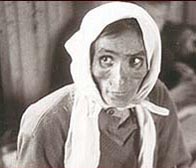
Can Jewish people forgive the atrocities of the Holocaust? Rabbi Albert Friedlander explores a question that has troubled survivors and later generations alike.
By Rabbi Albert Friedlander
Last updated 2011-02-17
Can Jewish people forgive the atrocities of the Holocaust? Rabbi Albert Friedlander explores a question that has troubled survivors and later generations alike.
Almost 800 years after his death, Leicester city council formally rebuked Simon de Montfort for his blatant anti-Semitism. A defender of the Earl noted that it is always difficult to judge historical figures by contemporary standards. Half a century after the defeat of the Nazis, does the same caveat apply to our judgement of the perpetrators of the Holocaust? Should one look for extenuating circumstances within the past century where the actions of the Nazis were part of a pattern of brutality involving much of Europe?
Before the war began, most countries were reluctant to take in more than a token number of refugees from Germany. Later, the refusal of the Allies to bomb the railroad tracks leading to Auschwitz or the lack of attempts to destroy the extermination camps were questionable decisions which we now view with concern. Our observance of a National Holocaust Day cannot ignore these ancillary issues which suggest a shared responsibility for that dark period of history.
Holocaust memorials exist for remembrance and are not intended to make us forgive and forget.
Holocaust memorials are being established all over Europe - Vienna, Berlin, Paris, and other major cities are notable examples of this new architecture of remorse. In London the new Holocaust Memorial within the Imperial War Museum, the dignified Holocaust Grove in Hyde Park, and the impressive Raoul Wallenberg statue near the Marble Arch Synagogue suggest a greater public awareness of the dark past which will now be re-enforced by a national day of remembrance. Complex reasons underlie this surge of remembering in Germany and Austria where remorse has combined with the national desire to shake off guilt and to close that chapter of history. Forgiveness is expected of neighbours. Does any of this apply to Great Britain on National Memorial Day?
Holocaust memorials exist for remembrance and are not intended to make us forgive and forget. Is there an intention here to turn to the victims - the Jews, the Sinti-Roma (gypsies) and other groups sent into the camps - to ask them to stop troubling the conscience of the world? Are we saying: 'Look what we have done for you. We can't be fairer than that. Now, stop opening these doors to the past. Move on; forgive and forget. It's for your own good...'?
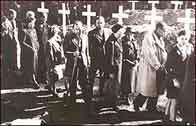 Ludwigslust civilians file past a mass grave of victims who died at the Nazi camp at Wobbelin © National Memorial Day is not intended for Holocaust victims. The Jewish community and other minority groups who suffered have their own day of remembering, their Yom Ha-Shoah. We light our own candles and do not want others to say the Kaddish for us. We are 'remembrancers'. Professor George Steiner uses this term to underline the basic link between the Jewish people and past generations. The Bible's emphasis on 'remembering' has been a continuous line in our prayers and ceremonies. The congregation and friends join mourners in their grief, but no one can be a substitute in this task.
We do accept the goodwill and the ethical awareness which has created this new national day, and feel that it is an expression of that deeper knowledge of the past which is essential for the future. It was and remains a rebuke to Holocaust deniers and to those who prefer to live in ignorance. It is also a challenge for Great Britain to practice self-examination and recognise the endemic xenophobia which still lives within the body politic. 'Know thyself' is the ancient Delphic lesson for every age. In Judaism, we relearn this teaching on every Yom Kippur, our Day of Atonement.
Throughout this past half century, our neighbours have enjoined us to 'forgive and forget'. In 1985, after the Bitburg Incident when Chancellor Kohl and President Reagan stood at the grave of SS officers in Germany, the British press carried long debates on the subject of forgiveness. When I was asked to speak for the Jewish community, I reported a frequently retold incident in my life:
The National Memorial Day is not intended for Holocaust victims.
'Can we forgive? Who are we to usurp God's role? Once, at a Kirchentag in Nurenberg, I talked about the anguish of Auschwitz. A young girl rushed up to me after the lecture. 'Rabbi, she said, I wasn't there, but can you forgive me?' and we embraced and cried together. Then an older man approached me. 'Rabbi', he said, I was a guard at a concentration camp. Can you forgive me?' 'No, I said. I cannot forgive. It is not the function of rabbis to give absolution, to be pardoners.' Between the New Year and the Day of Atonement, we try to go to any person whom we have wronged and asked forgiveness. 'But you cannot go to the six million. They are dead I cannot speak for them. Nor can I speak for God. But you are here at a church conference. God's forgiving grace may touch you, but I am not a mediator, pardoner, or spokesperson for God.'
A number of my Christian colleagues were unhappy with my stance. An Oxford Chaplain with great respect for the Jewish community still felt he had to enunciate the Christian principle that one must forgive. He concluded that our refusal to forgive might lead to a recurrence of the Holocaust. A refusal to forgive is seen as a fatal human weakness. However, throughout rabbinic literature, there is an awareness that an act of forgiveness is a relationship between humans requiring action from both sides.
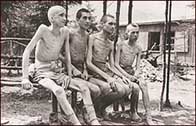 Starved boys at Ebensee concentration camp. This was one of largest camps with around 60,000 prisoners. They were used as live guinea pigs for scientific experiments. Some 2,000 died a week. © First, there must be repentance and the attempt to undo the evil committed. Forgiveness, difficult as it is, is a proper response by the victim. It is not always possible if the hurt is too deep and enduring. Both sides will then suffer: one carries the pain inflicted; and the other carries an awareness of an unfulfilled expiation. However, can the 'class action' of pardoning a nation take place at all? In Judaism, we see this as the prerogative of God. Nevertheless, we are approached and asked as a people to forgive. What can we do?
Leo Baeck, a survivor of the concentration camp and the leader of the Jewish community in Germany during that tragic time, gave a preliminary reply in the year in which Martin Buber accepted the Peace Prize of the Frankfurt Book Fair. In an article 'Israel and the German people' in the German Merkur, October 1952, he indicated that the kairos time of fulfilled hope had not yet come. If one tries to force the hour, it flies away. A possible reconciliation depends upon much self-examination on both sides. An honest peace must always contain within itself the remembrance of the past. The shadows still live in the present and will be part of the future. "Who is to give the answer?" asked Baeck. The survivors? The Jewish people? The shades of the dead? Examining the Jewish community at that time, Baeck noted the conspicuous absence of hate. However, pain, hurt and contempt can be encountered, along with a numbness of feeling, a withdrawal into oneself.
An honest peace must always contain within itself the remembrance of the past.
Fifty years later, we are closer to a time of peace between Israel and the German people. There have been many acts of contrition and compensation. We have also noted the Righteous Gentiles of that time, who have been honoured in Israel and in the world. Germany has regained a place in society; yet its task of self-examination is not yet complete.
Christianity has begun to overcome the prejudice that Judaism is a religion of stern justice, confronting a Christianity of gentle love. Love and justice exist in equal measure in our faiths. Arising out of the feeling of natural sympathy, many still feel that the survivors of the Holocaust cannot forgive because they are filled with hatred. We could not have survived if we had been filled with hatred. If we insist that the world must not forget the Holocaust, it is our sense for justice, and our awareness that one cannot blot out the past upon which the present rests.
Once, in Berlin, I lectured to the children of the 20th of July group who had tried to kill Hitler. I sat next to Helmut Kohl who believed in the grace of having been born after the events. I informed him that he could not simply remove the years from 1933 - 1945. 'You take pride in the great German traditions of Schiller and Goethe, of Bach and Beethoven', I said to him. 'But, in history or in logic, the middle cannot be excluded from the structure. You have also inherited the Holocaust.' All of us, observing our National Holocaust Day, carry part of that legacy within our society.
How does 'forgive and forget' enter into our meditations? For Jews, it is complementary to the word which marches throughout the Bible 'Sachor': Remember! Perhaps, in the inner ranges of our mind, we find it easier to forgive ourselves for past actions when we are aware that we have truly repented, that we have tried to undo harm and that we have made confession. This may also apply to the individuals whom we have encountered.
The National Holocaust Day should be an opportunity for peace and reconciliation, as much as for self-examination.
Again, when it comes to 'group actions' - to encounters with the perpetrators of the Holocaust - even 50 years later, we hesitate. How can we enter their thoughts? And yet, we are taught that the sins of parents cannot be visited upon children. The ancient revenants who stumble into public view should be tried, quite simply, so that justice can be seen be done. We will not waste our emotions upon them. And, in an imperfect and flawed world, one can reach out towards peace with nations who carry a great burden upon their shoulders.
The National Holocaust Day should be an opportunity for peace and reconciliation as much as for self-examination. Yet the last and greatest task may well be self-examination for the nation. Where were we when God asked Cain: 'Where is your brother Abel?'
Books
The Holocaust : A History of the Jews of Europe During the Second World War by Martin Gilbert (Henry Holt, 1987)
Final Solution : Origins and Implementation edited by David Cesarani (Routledge, 1997)
The Nazis: A Warning from History by Laurence Rees (New Press, 1999)
The Imperial War Museum in London has a permanent exhibition about the Holocaust.
The Auschwitz-Birkenau Memorial and Museum in Oswiecim, Poland
The United States Holocaust Memorial Museum in Washington DC
Albert H. Friedlander is the Dean of the Leo Baeck College in London, and Rabbi Emeritus of the Westminster Synagogue. He was born in Berlin in 1927, and was persecuted and arrested as child in late 1930s. He experienced Kristallnacht (Night of Broken Glass) in Berlin in November 1939 and then escaped to Cuba with his family in 1939. He arrived in the USA in 1940 and was ordained at Hebrew Union College in Cincinnati. He marched with Martin Luther King from Selma to Alabama and came to live in London in 1966.




BBC © 2014The BBC is not responsible for the content of external sites. Read more.
This page is best viewed in an up-to-date web browser with style sheets (CSS) enabled. While you will be able to view the content of this page in your current browser, you will not be able to get the full visual experience. Please consider upgrading your browser software or enabling style sheets (CSS) if you are able to do so.

