The early years
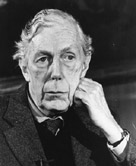 Anthony Blunt © In the early 1930s, the democratic world appeared to be in trouble. The Great Depression had caused widespread unemployment. Fascism was on the march in Germany and Italy. To many young students at Cambridge University, privileged though they were, this was worrying and unacceptable.
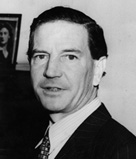
Four of them - Philby, Burgess, Maclean and Blunt - wanted to do something about it. They believed that the democracies would prove too weak to stand up to Hitler and Mussolini, and they knew that many people in Britain did indeed admire these leaders. They also thought that only the Soviet Union would be powerful enough to defeat Fascism. So, when they were approached by a recruiter from Moscow, the four young men agreed to serve the KGB.
The KGB believed that recruiting clever people from a respected university was a good game plan, because the chances were that sometime in the future these young men would be among Britain's rulers and well placed to betray their country's secrets.
This is how it turned out. By the time World War Two was underway, Maclean was climbing the ladder in the Foreign Office, Burgess was an intimate of prominent politicians, and Blunt was an officer in the Security Service - MI5. Even more astoundingly, Philby was an officer in the SIS. And all the while they were establishing themselves in these positions, these four men were reporting to Moscow.
It got better for the KGB. Just before the war ended, Philby was appointed head of the SIS's anti-Soviet section, so that the man who was charged with running operations against the Russians, was a Russian agent. Blunt, meanwhile, had been on the distribution list for material from the war's most secret operation, Ultra, decoded German radio traffic.
Then, as the Cold War got under way, Philby became SIS liaison officer with the newly formed CIA in Washington, where Maclean was first secretary at the British embassy, sitting on a committee that dealt with atomic bomb matters.
Burgess at this time was with the Foreign Office news department. Put together, their information should have been of inestimable value to Moscow. But the KGB files on these dedicated Soviet agents show a different picture.
Dealing with suspicion
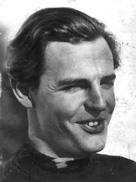 Donald Maclean © Once the KGB had convinced itself that the Cambridge spy ring was most likely a British conspiracy against the Soviet Union it faced a difficult decision. How was it to handle this?
If it cut off all contact with the Cambridge ring and it later turned out that its agents were genuinely loyal to the USSR, then the KGB would be blamed. Those officers running the Cambridge ring might be accused of sabotage. They might be shot. All right, then, Moscow reasoned, let's pretend that nothing has happened and do our best to reinforce Philby's conviction that we trust him and his ring completely.
And so the game of deceit and double-dealing continued. The Cambridge spies were deceiving their colleagues, their service, their families and their country. They did this in the sincere belief that they were serving a greater cause, through an elite intelligence service, the KGB, which fathered and mothered them and appeared to trust them totally. But the KGB, in turn, was deceiving the Englishmen, because it really believed that they were playing a treble game and were all traitors to the Communist cause.
The conclusion from all this is that the main threat to intelligence agents comes not from the counter-intelligence service of the country in which they are operating, but from their own centre, their own people.
In a dirty bogus business, riddled with deceit, manipulation and betrayal, an intelligence service maintains it sanity by developing its own concept of what it believes to be the truth. Those agents who confirm this perceived truth - even if it is wrong - prosper. Those who deny it - even if they are right - fall under suspicion.
From that moment on, the better that agent's information, the greater the suspicion with which he or she is treated. When other agents offer confirmation, the suspicion spreads, until the whole corrupt concern collapses, only for a new generation of paranoid personalities to start afresh.
Knowing this, anyone interested in the spy world should reflect on the moral problems of espionage, and how they might be confronted.
Perhaps one way would to be to consider whether we need intelligence services in the 21st century. They are only a comparatively recent phenomenon (the SIS dates from 1911, the KGB from 1917, and the CIA from as recently as 1947). It could be that nations have been the victim of a vast confidence trick to deceive us about the necessity and the value of spies.