Nuclear war
- Nuclear war
- Mankind's mastery of nuclear energy has increased its capacity for mutual annihilation by several orders of magnitude. For the most part, those concerned with the conduct of war have concluded that the indiscriminately destructive effects of nuclear weapons will dwarf any political or military objective for which they might be employed. What is called 'nuclear strategy' has thus been concerned chiefly with the logic of nuclear deterrence, whose object is to ensure that those who possess nuclear weapons will never use them.
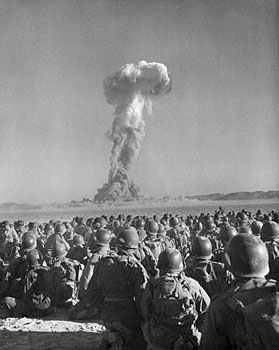
In the early years of the nuclear era, however, the self-defeating character of nuclear weapons as instruments of war was not yet apparent. American war planners considered atomic bombs to be potentially useful elements of conventional combined-arms operations, and a number of live-fire exercises were conducted to demonstrate the feasibility of the concept.
The first of these, called Desert Rock, took place at Yucca Flat, Nevada, in November, 1951. The fourth of its test detonations ('Shot Dog') is pictured above. The weapon used was roughly comparable to the one dropped on Hiroshima six years before. The men in the picture, from the US Army's 11th Airborne Division, are about seven miles from ground zero.
The aim of Desert Rock, in the words of the American Atomic Energy Commission, was to 'dispel much of the fear and uncertainty surrounding atomic radiation', an objective, it is fair to say, that remains unmet to this day.